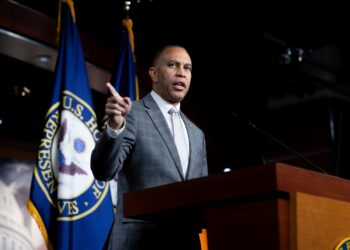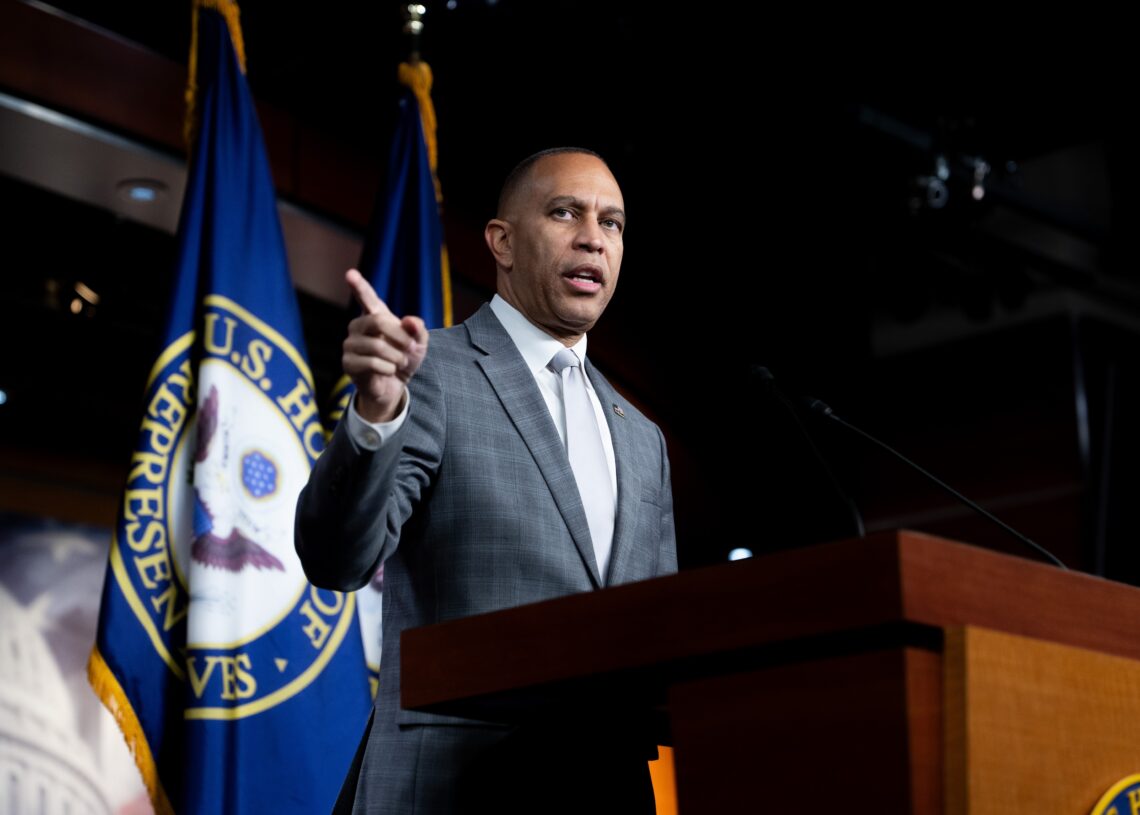
When Democrats gather Wednesday morning to formally elect their nominee for speaker of the House next year, there won’t be much suspense about the outcome. Minority Leader Hakeem Jeffries (D-New York) is well on his way to making history as the first Black American to hold the post.
If Jeffries cements his caucus’s support, the next and final step will be a full House vote Jan. 3 to install the next speaker — and Democrats will hold a commanding majority in the chamber after their rout of Republicans in this month’s midterm elections.
No Democratic challenger to Jeffries has emerged, despite backlash from some in the party’s base, who argue Democratic leadership is too corporate, too pro-Israel, and insufficiently progressive. But unlike in the Senate, where Minority Leader Chuck Schumer (D-New York) is working to fend off a challenge from Sen. Chris Van Hollen (D-Maryland) to maintain the party’s top spot, House Democrats who are not fully sold on Jeffries lack an alternative, barring a last-minute surprise.
Jeffries needs to secure only a simple majority of Democrats elected to the House next year to win the nomination.
Still, the public pushback, including from vocal progressive activists, has placed added pressure on Jeffries. In recent days, he has sought to assuage his critics and sell the country on his leadership.
Jeffries is working to meet with every new member before Wednesday’s vote. He was slated to meet Tuesday with top leadership of the Progressive, New Democrat and Blue Dog caucuses, which span the ideological spectrum of the broader Democratic caucus. And close Jeffries allies have been working the phones in recent days to gauge members’ priorities and concerns — and limit defections.
Jeffries also sat for interviews at The Atlantic Summit in Washington on Tuesday and the Democratic What’s Next conference in Denver over the weekend.
At the Denver gathering, a small group of people near the stage interrupted him several times, a moment captured in clips that quickly circulated online.
“When is it time for the Green New Deal? When is time for Medicare-for-all?” a young woman shouted, referencing popular progressive policy proposals.
“We need an arms embargo now. Stop the genocide!” a young man yelled.
The crowd began a counter-chant — “Ha-Keem! Ha-Keem!” — to drown out the protesters’ shouts as security escorted them out of the room.
The scene illustrated divisions between different wings of the party that have come to the fore in the weeks since the election, as Democrats grapple with their larger-than-expected majorities and what their agenda should look like. Jeffries, a methodical consensus-seeker, has regularly punted questions on specific policy plans, including questions related to Medicare-for-all. On Tuesday, though, he said Democrats should lower the age of Medicare eligibility, and expand coverage to include vision, hearing and dental and cover children.
For some parts of the Democratic base — hungry for rebuke of the Trump administration, fired up on midterm results fueled by populist priorities and seeking new leadership — that won’t cut it.
Many congressional offices have been fielding calls from people asking lawmakers to withhold support from Jeffries. An online petition calling for members to vote against Jeffries and pick someone else for speaker circulated in the days after the election. It picked up more than a million signatories.
But that drumbeat from the base is expected to have little consequence on Wednesday.
Rep. Joe Morelle (New York), the top Democrat on House Administration Committee, which runs orientation for the incoming members, described what he views as a disconnect between public discourse around the leadership election and the reality within the caucus.
“It’s just funny, I mean, you see a lot of the conversation out in the social media ecosystem … which doesn’t seem to be reflected at all here,” Morelle said. “I think [the incoming members] are almost all for Hakeem.” He said he had spoken with nearly all of the freshman class.
As of Tuesday morning, however, some new members said they were still undecided.
Rep.-elect Melat Kiros, a progressive who ousted nearly 30-year incumbent Diana DeGette in a Democratic primary in Colorado, said she had not yet met with Jeffries since the election, and would not make up her mind whether to vote for him until she had.
Rep.-elect Randy Villegas, a California progressive who defeated Rep. David G. Valadao to flip a swing seat, said he had met with Jeffries. Villegas had asked for votes on Medicare-for-all and the Block the Bombs Act, which would prevent selling arms to Israel, as well as action on immigration reform within the first 100 days, he said.
“I’m gonna vote for the person who’s gonna help me deliver for my communities,” Villegas said. As far as who that person was, he tiptoed: “As far as I know [Jeffries] is the only one running. But, you know, we’ll see who ends up running.”
With hours until the vote, any last-minute challenger had yet to make themselves known.
Asked at a news conference Tuesday why some members were resistant to voting for him, Jeffries sidestepped.
“I’m in conversation with members across the House Democratic caucus. We’re gonna have a vote tomorrow. Caucus is gonna be able to work its will. And we’ll see what the outcome is tomorrow.”
Speculation had risen in recent days about the possibility of electing Jeffries through a voice vote. The move would usher him into the nomination without recording any defectors. But that plan also presented the embarrassing possibility of a lawmaker undermining the process by calling for a recorded vote.
Jeffries on Tuesday said he would call for a recorded vote himself, sealing off that possibility.
Kiros said she appreciated that.
“We’ve been talking about how undemocratic this process has been,” she said. The voice vote “would have lent to that issue of there not being a democratic process.”
“It’ll be important for people to be able to make clear where they stand on this issue right now,” Kiros added.
House Democrats’ elections will take place Wednesday and Thursday, according to guidance obtained by The Post that was circulated to lawmakers.
On Wednesday, members will first elect caucus chair, expected to be Rep. Ted Lieu (D-California). They will then vote for the top jobs: speaker, majority leader and majority whip, before working down through other caucus leadership posts. Members will vote using an app that is automatically downloaded to their House-issued phones before the elections.
According to Democratic caucus rules, all leadership elections are by secret ballot, except when a motion is made to waive the secret ballot. In a secret ballot, a recorded vote will reveal only the margin by which Jeffries and others are elected — not who did, and potentially did not, vote for him.
Even if a challenger emerged, or if a handful of incoming members withheld support for him, Jeffries has a significant margin to work with.
In his new role, Jeffries would not be the only leader making history.
Rep. Katherine Clark (D-Massachusetts), who now serves as whip, is expected to be elected majority leader and would become the first woman to hold the position. Rep. Pete Aguilar (D-California) is expected to become whip, and would be the first Latino in that role. Lieu would be the first Asian American to hold the caucus chair position, and the highest-ranking Asian American to serve in Congress.
The question for Jeffries is the margin by which he is elected and what it will signal about the support he holds among his caucus as he is poised to lead their historic majority.
“I think what is important is to have a very, very robust number,” Morelle said. That would show “the breadth and the depth of the support for Hakeem, and for leadership broadly.”
Rep.-elect Brad Lander of New York, a progressive who supported Jeffries for speaker throughout his campaign, said in a recent interview that he had received hundreds of emails from people telling him they want to see “more of a fight out of Congress.” Many asked him to reconsider his support for Jeffries.
Lander’s response: To be effective fighters, Democrats need to be united and disciplined. “This is not the time for factional fighting,” he said.
Erin Cox contributed to this report.
The post Jeffries seeks to shore up support ahead of vote for Democratic speaker nominee appeared first on Washington Post.