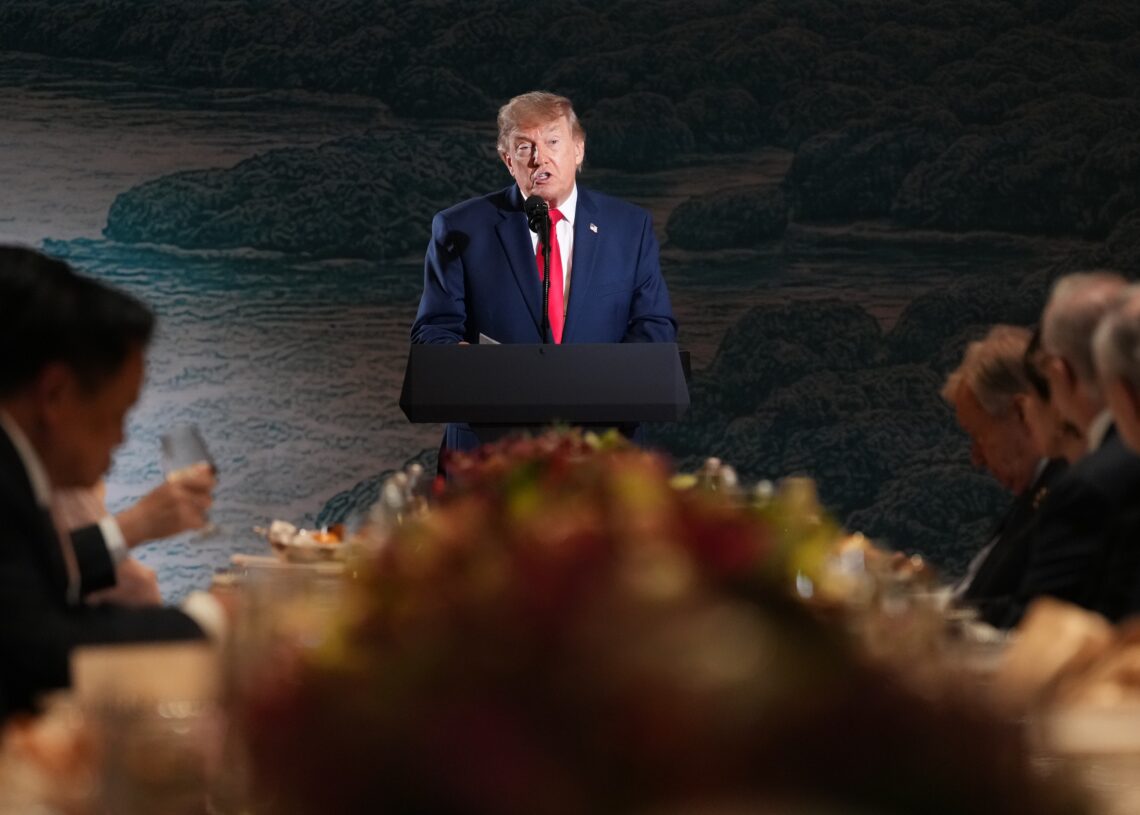
SHENZHEN, China — President Donald Trump touches down in China on Wednesday after flying halfway across the globe for a visit designed to project friendship and mutual respect even as a technological and economic rivalry intensifies between the world’s two largest economies.
China has increasingly frustrated U.S. efforts to secure rare earth materials needed to build advanced technology and to open Chinese markets to American businesses. Now, a fresh dispute over advanced artificial intelligence computer chips threatens to complicate the visit, months before a fragile truce in the U.S.-China trade war is set to expire in January.
Beijing on Tuesday condemned restrictions on its access to advanced chips that the Trump administration imposed this week.
China accused the United States of abusing export controls to interfere in trade and impede its tech sector. “China will do what is necessary to firmly safeguard its legitimate and lawful rights and interests,” Chinese Foreign Ministry spokesperson Guo Jiakun said at a Tuesday news conference.
The U.S. crackdown was spurred by the scandal surrounding Nvidia, the leading maker of advanced chips whose founder, Jensen Huang, has been a close adviser to Trump. Huang resigned from his job as CEO of Nvidia last week after revelations that he had an affair with an alleged Chinese spy. Those allegations have brought new public scrutiny to the countries’ AI rivalry and created fresh pressure on the administration to limit China’s access to advanced semiconductor chips used for AI.
The third meeting this year between Trump and Chinese President Xi Jinping will test whether the United States and China can defuse those new tensions, find common ground to mitigate AI risks as the technology rapidly advances and keep the trade truce from coming undone.
It all comes just two weeks after Democrats delivered a stunning defeat to Trump and his party in the midterm elections, undermining the president’s leverage with China and other international rivals. Voters rebuked the president’s tariffs amid backlash to rising prices, and lawmakers from both parties have criticized the administration’s export controls on semiconductors as too lax.
The election result “gives fuel to Congress to legislate more export controls” on chips, said Wendy Cutler, senior vice president at the Asia Society Policy Institute and a former senior U.S. diplomat and trade negotiator. That “is further going to complicate the administration’s efforts to keep this trade truce intact.”
As Trump departed the White House on Monday, he acknowledged that the administration faced risks in cracking down on companies that allegedly found ways to get around export controls to provide China with advanced AI chips. Limiting access to chips risked a “blowup” with China, he said.
“You know, we’re heading to China, and I don’t think you want to insult China just before you get there,” Trump told reporters.
Those remarks contradicted a senior administration official who spoke to reporters Friday on the condition of anonymity to speak candidly. The official argued that China shouldn’t retaliate for steps the U.S. might take to tighten enforcement of existing rules because Beijing claims it doesn’t participate in chip smuggling.
Trump also said that he supported Nvidia’s efforts to establish a new committee to ensure the company is complying with export regulations. He called that step a “good idea” when speaking to reporters after arriving Tuesday in Manila, the first stop on his Asia swing.
In October 2025, the administration and China’s government reached a truce in what had been a rapidly accelerating trade war that at one point led to the U.S. imposition of 145 percent tariffs on Chinese goods and China retaliating with 125 percent on American products.
As part of the agreement, the United States agreed to relax its tariffs in exchange for Chinese commitments to buy more American agricultural products and pause export controls on rare earth minerals, which threatened to cripple U.S. high-tech manufacturing. China controls around 90 percent of the world’s rare earth refining capacity, according to the International Energy Agency.
The truce remains in force until mid-January, but its foundation is shaky. Frustrated U.S. officials say China hasn’t met its commitments. As of September, shipments of rare earth materials to the United States remained around 75 percent below pre-trade-war levels, according to the Center for Strategic and International Studies (CSIS).
Trump plans to press compliance with the trade deal during his meeting with Xi, said the senior administration official.
Meanwhile, both sides are seeking to push implementation of an agreement reached when Xi visited Washington in September for each country to cut tariffs on $30 billion in nonsensitive goods. That agreement has yet to be finalized. That, too, has a wrinkle: China is demanding the U.S. implement the deal before it will buy more American agricultural products, which the U.S. says Beijing had already agreed to in May.
Finally, “the U.S. really wants more commercial deliverables from China, more announcements that help U.S. companies in the Chinese market or increase sales to China on a case-by-case basis,” said Kurt Tong, managing partner at the Asia Group and APEC ambassador under President Barack Obama.
The trade truce, the tariff reduction deal and the market demands “are interlinked,” he added, noting that any significant announcements are likely to be put off until Xi and Trump’s next scheduled meeting, at the Group of 20 summit in December.
As the two countries spar over access to the chips powering AI, they’ve also begun conversations about the potential consequences of the new technology.
At a speech in New York the week before the trip, Treasury Secretary Scott Bessent signaled that the focus would be on a “new dialogue” with China “to guard against shared risks and prevent a misunderstanding between our two systems.”
The two countries expect to share best practices for evaluating and testing advanced AI models before they are released, Bessent said.
He also said that Beijing and Washington would move forward with establishing a direct channel, which has been called a “crisis hotline,” that each nation could use to notify the other about “serious incidents” involving AI models.
“As SI advances, so will the need to engage in new areas of risk management — and to demonstrate how two nations can reconcile the demands of competition with the responsibilities of leadership,” Bessent said, using Trump’s preferred term for the technology, which he calls “superintelligence.”
“As we do so, we should harbor no illusions about the differences between the United States and China,” he said.
The talks are expected to be “preliminary,” said Cutler, amid mutual skepticism between the administration and Beijing.
“China views an AI dialogue as a potential move by the U.S. to keep China in second place on AI,” she said. “They think we’re using the dialogue to preserve our dominance versus trying to address mutual security concerns with respect to AI.”
The administration’s focus on artificial intelligence comes as tech CEOs have warned that rapid advances in the technology have created the potential for new cyberattacks, and as they have warned that automation of jobs could usher in massive economic changes, which they have compared to a new industrial revolution.
“But at the same time we are in a fierce competition with one another, so there’s a limit to what we’re going to be cooperating on,” said Kelly Ann Shaw, who led Trump’s APEC preparations in his first term. “Having an open dialogue is important on these issues, but that’s not the same thing as cooperation.”
Democrats have signaled that AI regulation will be a focus as they regain control of the House and Senate next year. They also plan to investigate the administration’s handling of chip exports and have railed against the tariffs that have underpinned Trump’s negotiations with other countries.
Leaders pay close attention to each other’s domestic politics, said Edgard Kagan, Freeman chair in China studies at CSIS, “and it really matters in terms of how they size each other up.”
Some U.S. trading partners may see the midterms as undermining Trump’s leverage in trade negotiations and choose to slow-walk agreements until they have a better sense of the new political reality in Washington, multiple analysts said.
“But my sense is that would be a mistake,” said Shaw. “The president’s authority is largely unaffected by the midterms, and he’s certainly not afraid to fight back.”
Joshua Yang contributed to this report.
The post Trump to project friendship with Xi as trade and tech rivalry deepens appeared first on Washington Post.