Students in the West often learn about the Age of Exploration from the era’s biggest players: the European kings and queens who instigated odysseys and land grabs, and the sultans and shoguns across the Indian Ocean who stared them down.
But those studies increasingly focus on the common humans moved by those machinations: the people who migrated, the economic dispossession and enrichment they faced, the ideas and objects they exchanged and the cultures and religions they spread.
At the first Frieze Abu Dhabi art fair (Nov. 19 to 22), historical pieces that highlight these concepts take center stage in the Frieze Masters section.
Marika Sardar, the curator of that section, said that shift in focus had become a “hot topic” for conferences, publications and museums.
“Looking at the art and architecture of coastal cultures, outside of the courtly centers of power, has a lot of appeal,” she said, and allows for a “resetting of the priorities of traditional art histories.”
Prompts for Discovery
Sardar prompted dealers in the Frieze Masters section to scour their specialist eras to find out what objects and materials the artists and artisans of the time were discovering — and investigate how these discoveries shaped what they made. Another prompt focused on how those craftspeople imagined the tastes of people in countries across the water and tailored their creations accordingly.
Sardar said she was delighted by the results. Jorge Welsh Works of Art, based in both London and Lisbon, specializes in cross-cultural and export art from across the world, with a particular focus on China.
The gallery is presenting a lacquered, 16-panel Qing dynasty Kuancai screen from the Kangxi period (1662-1722). It depicts Western ships sailing on undulating waves toward land on which European hunters pursue their prey across a Chinese painter’s landscape of rocks, trees and clouds.
ArtAncient, based in London, is presenting “Portrait L,” sometimes called the Mona Lisa of the Middle East, a 2,000 year-old Greco-Roman portrait of a young woman wreathed in jewels. The gallery will also show some actual jewels, including a 17th-century cluster ring of gold and enamel, replete with Indian diamonds, which was found in 2024 in an English field by a man using a metal detector.
Inlibris, a Viennese book dealer, will be bringing an 18th-century Quran that belonged to Vincent Van Gogh, an art dealer in Amsterdam and a cousin of the painter with the same name, which — scholars suggest — may have been made in the Maldives.
The dealer will also present a late Edo period (1615-1868) Japanese nanban folding screen. (Nanban, or “southern Barbarians,” was what the Japanese called foreign visitors during the 15th and 16th centuries.)
Across the screen’s six panels, a scene unfurls of Portuguese merchants and Indian sailors unloading a four-masted ship off the coast of Japan amid a sea of golden clouds.
And Peter Finer, a London-based dealer of antique arms and armor, will show an Indian khanjar, a traditional dagger. Redmond Finer, Peter’s son and business partner, said in an email that the dagger was “made of several exotic elements” from different time periods. The horse-shaped hilt, which he believes is from the 17th or 18th century, is made of blue nephrite jade or jadeite and decorated with gold and rubies. The 19th-century blade, made from Damascus steel, is shaped in the Omani fashion, a style that spread along Islamic trade routes.
Finer will also show a mid-14th-century Central Asian helmet from the Khökh Ord or Blue Horde, part of the Mongol Empire that split after Genghis Khan’s death in 1227.
“It is one of the earliest styles of steel helmet found in the Islamic world,” Redmond Finer wrote, adding that it is inlaid in silver, much of which was “imported from European Indian Ocean trade or from Japan.”
Critical Cartography
Daniel Crouch, a dealer of rare books and maps with offices in New York and London, said in a phone interview that the exhibition was “something of a dream theme.”
Crouch will present a collection — which he received shortly before the theme was announced — of more than 75 atlases, sea charts and log books related to British trade routes. Between the 16th and 19th centuries, ships from the East India Company departed England and sailed around the Cape of Good Hope to destinations like Hong Kong, the Malabar Coast in southwest India, the Persian Gulf and the Malay Archipelago.
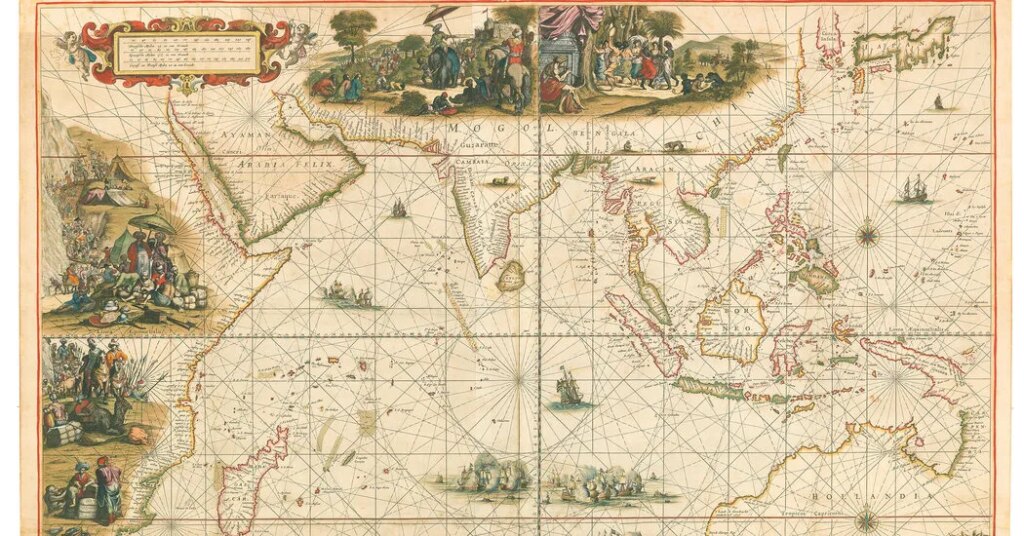
Crouch will also bring copies of the first maps to name Abu Dhabi and the Arabian Gulf (which is how several nations in the region refer to the Persian Gulf); an enormous Venetian globe from 1688; and a large-scale Dutch chart of the Indian Ocean from around 1664, which he described as being “absolutely slathered in gold leaf.” He said that it was colored by Dirk Jansz van Santen, a master colorist who helped turn “the Dutch Golden Age golden.”
At Jorge Welsh’s booth, visitors can see a two-meter-wide (over six foot) map of Nagasaki from the Edo period, that illustrates Portugal’s second attempt, in the mid-17th century, to restore trade relations with Japan, after the Dutch and the Chinese had muscled in.
On the map, Portuguese galleons are depicted in the port of Nagasaki in 1647, trapped by Japanese ships. (The foreign vessels were waiting to hear if they would be expelled by the shogun.)
It is an indelible snapshot, in ink on delicate paper, of geopolitical wrangling that centers Eastern resistance, not Western clout.
Institutions are also using the Indian Ocean to re-center historical narratives. “Spices and Wonders: Sailing the Indian Ocean” at the Louvre Abu Dhabi (until Feb. 14) traces 1,000 years of maritime history and trade.
Contemporary artists are finding inspiration here, too.
The second edition of the Public Art Abu Dhabi Biennial (until Feb. 15) features a 2026 installation by M’barek Bouhchichi, a Moroccan artist, titled “I am not the stone thrown into the water, but the seed sown in the field.” In it, a poem drawn from Al Nahma, the Emirati tradition of sea shanties, is rendered in Braille across a stainless steel structure, that riffs on the traditional pigeon tower.
For Sardar, focusing on the Indian Ocean was a way to speak to the Gulf’s ancient connections to international contexts and to its vibrant present. The idea of people arriving by boat from abroad and settling in port towns, she said, would be “immediately familiar to Emirati audiences.”
The post Frieze Abu Dhabi Goes to Sea appeared first on New York Times.