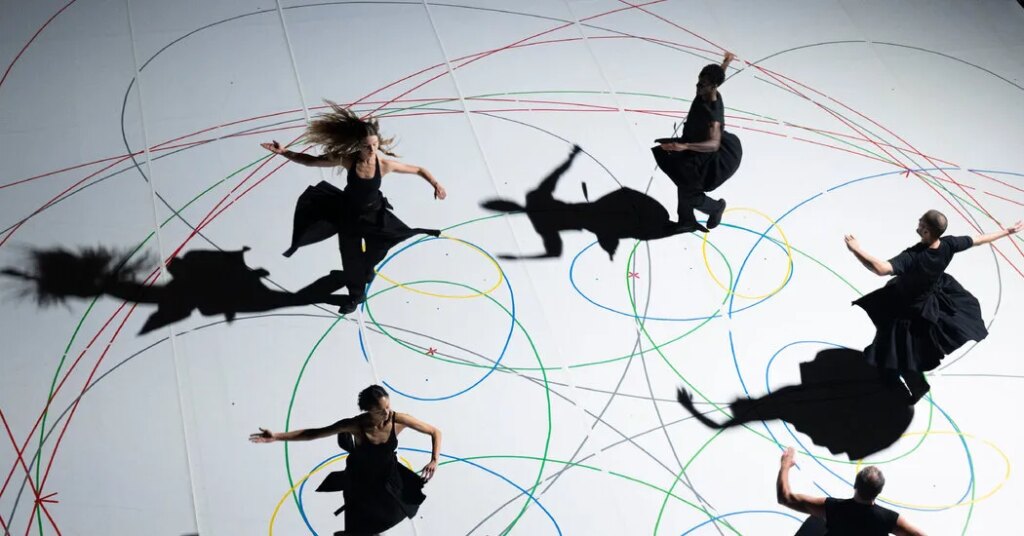
It was a rainy October day in Brussels, though no one could tell from inside the rehearsal space of Anne Teresa De Keersmaeker. Six dancers were spinning as if in a trance, their movements guided by a complex map of overlapping circles and squares taped on the floor.
The dancers, from De Keersmaeker’s company Rosas, were rehearsing “GLA55: 10 Movements to the Music of Philip Glass,” a new piece by De Keersmaeker, the Belgian choreographer. It will premiere on Thursday at the Haus der Berliner Festspiele in Berlin before touring in Europe. It is a return, of sorts, to ideas and motifs from early in her career.
De Keersmaeker rose to prominence in the 1980s with stripped-back works featuring relentlessly repeated gestures, some set to the music of the American composer Steve Reich. For three decades, she experimented with different approaches, and music ranging from Bach to Jacques Brel. Now, De Keersmaeker has turned to Glass, Reich’s friend turned rival, to revisit the minimalist musical genre and her own interest in translating looping patterns into movement.
“When you look at it, it feels all the time the same and all the time different,” De Keersmaeker said of “GLA55” in an interview after the rehearsal. “It’s inspired by the music, which is basically extreme repetition,” she said, and it felt to her like “coming home.”
The movements she has devised for Glass’s music are repetitive but not rigid. “The beat is fluid,” De Keersmaeker said, and the dancers are “basically not counting — the vision of time is liquid. I really like that.” She added, “I like turning, I like spinning, I like circles, I like spirals.”
That was already clear in 1982, when she created “Fase: Four Movements to the Music of Steve Reich.” In that piece, two performers pivoted on one leg, arms swinging in front of them as they rotated endlessly like cogs in a machine.
The spinning in “GLA55” feels less mechanized and more ritualistic. The dancers’ hand positions, with one palm facing up and the other down, were inspired by Sufi dancing, explained De Keersmaeker, who has long been drawn to philosophies such as Taoism and other ideas about the cosmic order. To structure the choreography in “GLA55,” she also used the five Chinese elements, planetary orbits and geometric principles like pentagrams, elliptical forms and the golden ratio.
Clinton Stringer, a Rosas rehearsal director, said that De Keersmaeker had “wanted to make something where she was the originator of all the material.” This was a departure from other recent works of hers, he said, in which she worked out the steps in collaboration with the dancers, some of whom came from a break-dance background.
The music for “GLA55” is drawn from four Glass pieces composed between 1969 and 1970: “Music in Contrary Motion,” “Music in Fifths,” “Music in Similar Motion” and “Music With Changing Parts.” Jean-Luc Plouvier, an artistic director of the Ictus contemporary music ensemble, a Rosas collaborator since the 1990s, said the musicians had “drastically rearranged” the pieces to emphasize the composer’s “pop sensibility.”
He noted that, in his early days, Glass was friends with David Bowie and founded record labels and staged performances in lofts before he moved on to work with big orchestras.
“It’s not the Glass of ‘The Hours’ or those relaxing movie soundtracks,” Stringer said. “It sounds very rock ’n’ roll, almost punk. There’s synthesizers, a tubax, which is a very big saxophone. So there’s this kind of dirty darkness to it.”
Ictus will be joined by BL!NDMAN, another Belgian group, for the “GLA55” premiere and on select dates throughout the tour. (Others will use a recording.) The musicians didn’t speak to Glass while developing the work. “We take the scores of people, we do it our way,” Plouvier said. “If it’s published, we’re free to appropriate.” According to his press team, Glass, who turns 90 in January, is doing less nowadays and is not giving interviews.
De Keersmaeker, 66, is also winding down in some regards and will step aside at the end of the year as the director of P.A.R.T.S., the dance school she founded in 1995. “It’s a natural process, and I want more time to do what I like to do most,” she said.
That includes creating new choreography, performing herself, and collaborating with visual artists, as in a show she created with the painter Steven Fillet this year at Xavier Hufkens gallery in Brussels. She said she felt “blessed” to still be dancing, which at her age requires “discipline” and “daily care.”
Her programming at Rosas is increasingly looking back on earlier work. Aside from “GLA55,” this year the company premiered “Multicast,” a reimagining of one of De Keersmaeker’s most famous works, “Rosas Danst Rosas.” Featuring 20 dancers who have performed the original choreography since 1983, “Multicast” gives “perspective of what has been, where we are and where we want to go,” De Keersmaeker said.
While De Keersmaeker is still creating, several dance pioneers from the late 20th century have died. Yusuke Hashimoto, the director of the performing arts season at the Berliner Festspiele, said, “It’s an important question for those of us working in contemporary dance, how we can preserve and transmit the legacy.”
For De Keersmaeker, the answer wasn’t to create a “mausoleum” of her work, she said, though she has established the A.T.D.K. Foundation to safeguard her artistic legacy. It employs one staff member to organize and preserve her archive, including extensive drawings and notebooks — though Keersmaeker said that “the best way to archive dance is to perform it.”
There is a cloud that threatens to hang over that legacy. In 2024, over 20 former Rosas dancers and staff members told the Belgian newspaper De Standaard that De Keersmaeker had bullied and body-shamed employees. De Keersmaeker issued an apology at the time, and in the interview, she said that the episode was “very challenging” but also “an invitation to reflect, to do it different and to do it better.”
That’s a maxim that extends to “GLA55,” in both De Keersmaeker’s return to her early choreographic interests and her choice to work with Glass’s music, which she said sounded “a bit like a spiral.”
What’s so beautiful about a spiral, she added, is that “you come back to the same place but in a different way.”
The post Spinning to Philip Glass, a Dance Pioneer Comes Full Circle appeared first on New York Times.