It’s a howl of grief and fury: “Cry ‘Havoc!’ and let slip the dogs of war.” So roars an anguished Mark Antony in Shakespeare’s “Julius Caesar” as he mourns the recently assassinated general. But you don’t have to study the Bard to hear this classic line. All you have to do is tune in to “The Traitors.”
For the uninitiated, this NBC reality competition show is a glitzy, gothic spin on the murder mystery party games Werewolf and Mafia. A group of people (mostly minor celebrities, reality TV stars and only-sort-of-public figures) are put in a Scottish castle, then divided into Faithfuls and a few murderous Traitors. The Faithfuls try to catch the Traitors, while the Traitors pick them off one by one.
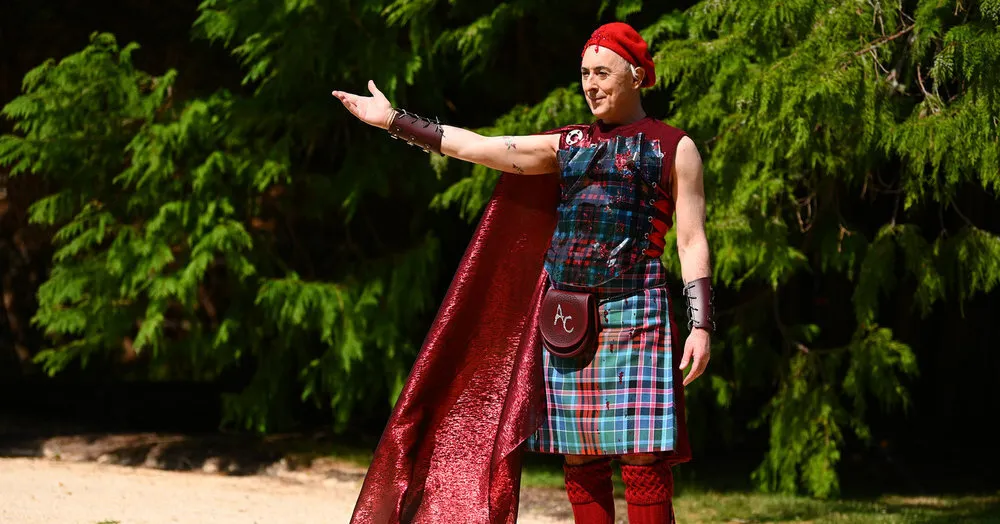
All of it is presided over by the show’s host, Alan Cumming, decked out in glamorous, delightfully over-the-top outfits. And as he ratchets up the tension, encourages the players and reminds viewers of the stakes in this game of deceit, he often turns to the library. (That “Julius Caesar” line? It shows up in Season 1, as Cumming rallies players before the finale.)
The first time I caught one of Cumming’s literary references, I was surprised. But watch closely and you’ll find that “The Traitors” is teeming with allusions to novels, poetry and plays, all hiding in plain sight. Quietly, the show — which wraps up its fifth season on Nov. 19 — just might be the most literary program on TV right now. Here are just a few of the many books in its arsenal.
Macbeth, by William Shakespeare
“Macbeth” is by far the work most quoted by Cumming on “The Traitors,” with at least six citations (so far). It makes sense: Like the game show, the play is about treachery, lies and murder in and around a Scottish castle.
“Fair is foul, and foul is fair.” (Season 1, Episode 3); “Look like th’ innocent flower, but be the serpent under ’t.” (Season 2, Episode 8); “What’s done cannot be undone. To bed, to bed, to bed.” (Season 3, Episode 3 and Season 4, Episode 4); “Hear it not, Duncan, for it is a knell that summons thee to heaven or to hell.” (Season 3, Episode 4); “When the hurly-burly’s done, when the battle’s lost and won.” (Season 4, Episode 11)
Paradise Lost, by John Milton
Early in Milton’s epic poem about mankind’s exile from Eden, Satan issues a call to arms to the damned: “Awake, arise!” Cumming deploys the same line before a round table, the daily gathering where players have a chance to uncover and banish a Traitor. If the Faithfuls catch one of the villains, they are one step closer to victory. But if they oust one of their own, they are one step closer to ruin.
“Awake, arise, or be forever fall’n.” (Season 5, Episode 8)
Inferno, by Dante Alighieri
Cumming invokes perhaps the most famous line from Dante’s poem about the horrors of hell — which opens his “Divine Comedy” — when the players in Season 3 enter the castle’s infamous round table room for their first banishment meeting.
“Abandon hope, all ye who enter here.” (Season 3, Episode 2)
Julius Caesar, by William Shakespeare
This play about back-stabbing and betrayal is a natural fit for “The Traitors.” Cumming quotes from Mark Antony’s anguished lament over the unjust murder of the Roman leader after a failed round table, before the players head into the final fire ceremony of the season.
“Cry ‘Havoc!’ and let slip the dogs of war.” (Season 1, Episode 10)
The Art of War, by Sun Tzu
Cumming often frames “The Traitors” as not merely a game, but a battle. To reinforce that point, he cites this 2,500-year-old guide to defeating your enemies. The catch, Cumming explains, is that in his castle, the Faithfuls don’t know who their enemies are.
“If you know the enemy and know yourself, you need not fear the result of a hundred battles.” (Season 4, Episode 10)
Endless Night, by Agatha Christie
“The Traitors” is essentially a closed-circle murder mystery, so of course the queen of the whodunit gets a shout-out. In Season 5, Cumming goes for a deep cut, referencing not one of her classic crime novels but this lesser known psychological thriller. “Only near the denouement does ‘Endless Night’ become a detective story,” our reviewer wrote of the book, “unless the reader is perceptive enough to recognize the mystery of the human psyche as the inevitable source of all mysteries.”
“Where large sums of money are concerned, it is advisable to trust nobody.” (Season 5, Episode 3)
Camino Real, by Tennessee Williams
“Camino Real” is one of the bleaker tragedies by Williams, the Pulitzer Prize-winning playwright best known for “The Glass Menagerie” and “A Streetcar Named Desire.” The play follows a cast of famous literary figures (Don Quixote, Casanova, Lord Byron, etc.) and everyday people all living in a mythical dead-end town, which our critic described as “a world surrounded with death and inhumanity, and decked with the flowers of evil.”
“We have to distrust each other. It is our only defense against betrayal.” (Season 4, Episode 9)
Richard III, by William Shakespeare
Cumming must have had King Richard III on the brain while filming Season 3, Episode 8. In a single monologue, he drops three separate references to this play about the schemes and eventual fall of one of history and literature’s great villains, whom our theater critic described as “the killingest character in Shakespeare.”
“A horse, a horse, my kingdom for a horse!”;“Thou art a traitor: Off with his head!”; “Now is the winter of our discontent.” (Season 3, Episode 8)
Henry V, by William Shakespeare
Shakespeare’s account of King Henry V of England’s invasion of France during the 100 Years’ War is another of Cumming’s favorites. Throughout “The Traitors,” he frequently returns to an Act 3 speech in which Henry rallies his troops. Cumming uses those same lines to inspire the Faithfuls to root out the Traitors from his castle.
“Once more unto the breach, dear friends.” (Season 1, Episode 6 and Season 3, Episode 7); “The game’s afoot.” (Season 3, Episode 1)
“Hohenlinden,” by Thomas Campbell
The Scottish poet Campbell wrote this poem after the Battle of Hohenlinden, a deadly 1800 conflict between France and the Habsburg monarchy. Cumming uses Campbell’s desperate war cry at the start of Season 4, to inspire the newly initiated players.
“On, ye brave!/Who rush to glory, or the grave.” (Season 4, Episode 1)
“In Memoriam A.H.H.,” by Alfred, Lord Tennyson
One of literature’s most enduring expressions of grief, this poem captures Tennyson’s sorrow and crisis of faith after the death of his friend Arthur Henry Hallam. The poet laments the brutality of “nature, red in tooth and claw” that ripped his friend away at age 22. In “The Traitors,” Cumming twists that image, pronouncing that “Revenge is red, in tooth and claw” after the Faithfuls banish a Traitor.
“Nature, red in tooth and claw.” (Season 3, Episode 9)
Hamlet, by William Shakespeare
Let’s toast to the sad boys! The angsty, grieving Danish prince Hamlet is Shakespeare’s masterpiece; the scholar Harold Bloom called him “the most charismatic and intelligent of all fictive characters.” The young royal’s eponymous play is existential, urgent and mournful — a perfect reference for a show in which a Faithful is murdered every night by someone they think is a friend.
“By heaven, I charge thee, speak.” (Season 1, Episode 6); “Good night, sweet prince, and flights of angels sing thee to thy rest.” (Season 4, Episode 2)
“Marmion: A Tale of Flodden Field,” by Sir Walter Scott
Modern soap operas have nothing on the scandalous drama of “Marmion,” by the Scottish poet and novelist Scott. The epic poem tells the story of Lord Marmion, a dishonorable knight who schemes to take down the fiancé of a lady Marmion desires for himself. His co-conspirator is a nun who is sentenced to death (by being enclosed, alive, in a wall). Ratting out Marion in the end, she proclaims, “Come he slow, or come he fast, it is but Death who comes at last” — a line Cumming adapts to welcome the players to the penultimate episode of Season 4: “Come ye slow, or come ye fast, it is the final that comes at last.”
“And come he slow, or come he fast,/It is but Death who comes at last.” (Season 4, Episode 11)
The post Want a Crash Course in Literature? Watch ‘The Traitors.’ appeared first on New York Times.