When China’s leader, Xi Jinping, met with President Trump at the White House earlier this fall, the two leaders toasted to friendly relations.
But in private, Mr. Xi offered Mr. Trump a stark warning about Japan, a U.S. ally, according to two officials briefed on the talks, who requested anonymity to discuss private conversations. Mr. Xi told Mr. Trump that Japan’s recent military buildup threatened to destabilize Asia, the officials said, and that Mr. Trump should be cautious about working with Japan’s prime minister, Sanae Takaichi, describing her as a “militarist.”
The warning from Mr. Xi was part of a broader effort by China to isolate and undermine Japan after Ms. Takaichi said last year that Japan could be forced to defend Taiwan in case of a Chinese invasion. China considers Taiwan, a self-governed democracy that lies just 69 miles from Japan’s westernmost island, part of its territory.
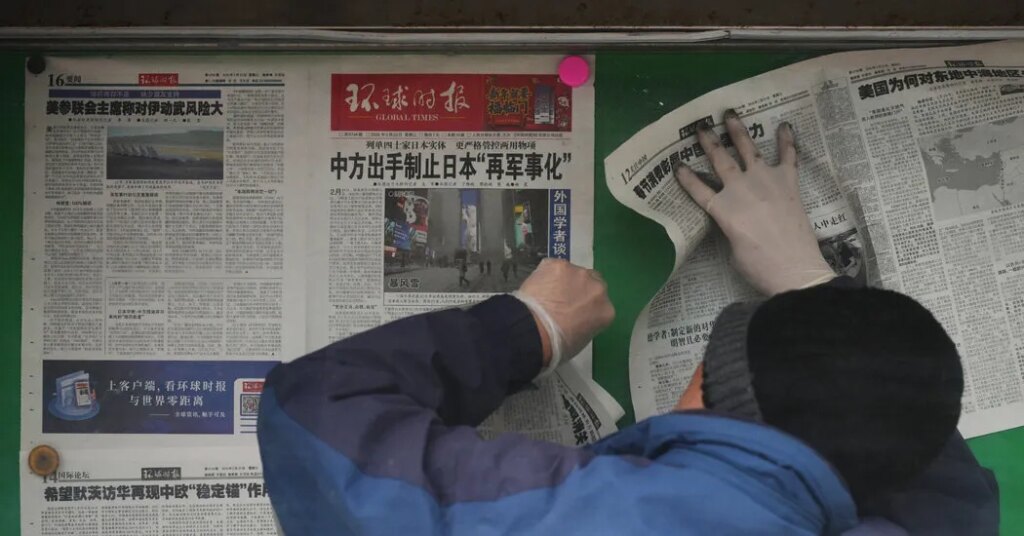
Since the comments, Mr. Xi has overseen a campaign involving propaganda and diplomacy to target Japan, according to interviews with officials and scholars, and an analysis by The New York Times of Chinese Foreign Ministry briefings and state media. It is all part of a push, analysts say, to persuade the world that Japan is a resurgent aggressor.
The Times found that:
-
China has deployed words and images to portray Japan as a World War II-era enemy, using phrases like “remilitarization” and “neo-militarism,” and videos that compare Japan to a “rampaging gray rhino.”
-
Chinese officials have repeatedly sought to belittle Ms. Takaichi, Japan’s first female prime minister, omitting her title in official briefings, breaking with longstanding practice. State media has depicted Ms. Takaichi in short skirts and a nurse’s uniform in cartoons, and described her as “Abe’s girl,” referring to Shinzo Abe, the former Japanese prime minister and Ms. Takaichi’s mentor.
-
In private conversations with Western scholars, Chinese academics have recently pushed the narrative that Japan is the “Israel of East Asia,” poised to lead the United States into conflict and destabilize the region.
-
Russia has helped amplify China’s talking points, branding Japan as a threat. Moscow has echoed Beijing in describing Japan as an “enemy state” that is not to be trusted, invoking a World War II-era designation used against former Axis powers.
Mr. Xi and Ms. Takaichi will cross paths this week at the Asia-Pacific Economic Cooperation summit meeting in Shenzhen, China. The encounter is expected to be frosty; Mr. Xi might try to use the summit as an opportunity to alienate Ms. Takaichi from Japan’s allies, experts say.
The analysis covered Chinese state-run and Communist Party-run outlets, including China Central Television, the Xinhua news agency, Global Times and People’s Liberation Army Daily.
China has long been at odds with Japan. But the current scale and coordination of its campaign have little modern precedent, experts said.
“Anti-Japan propaganda is just absolutely everywhere now,” said David Bandurski, executive director of the China Media Project, an independent research group. “It’s a far more focused use of anti-Japanese framing than we’ve seen at any point.”
The Feud Erupts
Ms. Takaichi told Japan’s Parliament on Nov. 7, 2025, that any attempt by China to blockade or seize Taiwan could constitute a “survival-threatening situation” for Japan, implying a potential military response. Her comments reflected a long-held Japanese view, but one that has rarely been verbalized.
China reacted furiously. The government urged millions of tourists to avoid Japan, limited the export of some critical minerals, restricted Japanese seafood imports and increased patrols in disputed waters.
Mr. Xi appears to be concerned that Ms. Takaichi, a close American ally who has been a critic of China, could get in the way of China’s military and economic expansion in Asia. Analysts said that he is seeking to drive a wedge between Japan and the United States, as well as countries like Australia, South Korea, India and the United Kingdom.
Ms. Takaichi has accelerated a military buildup to counter China, raising military spending to 2 percent of gross domestic product two years ahead of schedule and loosening postwar rules that restricted the export of weapons. She is expected to push for even more military spending next month as part of a new national security strategy.
A Surge in Propaganda
In the year since Ms. Takaichi’s comments on Taiwan, China has sharply escalated its rhetorical attacks on Japan, according to the Times’s analysis, and there has been a surge in propaganda aimed at both domestic and global audiences.
Since last November, the Chinese Foreign Ministry has publicly accused Tokyo of “remilitarization” or “neo-militarism” at more than 60 briefings, the analysis found. People’s Daily, the Communist Party mouthpiece, cited Japanese “neo-militarism” in 65 articles, and warnings of Japanese “militarism” surged across the outlets we analyzed.
Chinese officials have repeatedly invoked the image of a “gray rhino,” a phrase used in Chinese to describe a looming threat, to characterize Japan. One video that circulated on Chinese news sites, generated by artificial intelligence, shows a rhino, draped in a rising sun flag, wreaking havoc across land and sea.
China Daily, a state-controlled news organization aimed at an international audience, published a cartoon in May showing Ms. Takaichi dressed in samurai armor and carrying a sword. A People’s Daily cartoon describes Japan’s military ambitions as “sugarcoated poison,” showing Ms. Takaichi wrapping skulls to give to children.
The Times parsed more than 20,000 transcripts from the Chinese Foreign Ministry’s briefings since 2013; nearly 400,000 articles in People’s Daily; more than 100,000 items from Guangming Daily, P.L.A. Daily, Global Times and Xinhua; and thousands of published readouts of Chinese leaders’ meetings, state broadcasts, ministry releases and social media trends.
The analysis found that Chinese media has helped amplify official messaging. When interest in China’s feud with Japan faded from April to June and questions from foreign news outlets fell, reporters from state-controlled media in China tried to keep the story alive by asking about Japan at a far higher rate than before.
In December, a TV reporter from Shenzhen noted that scholars across the region were warning of Japan’s “remilitarization,” prompting a spokesman for the Chinese Foreign Ministry to answer with a list of Japan’s wartime atrocities. In August, on the anniversary of the bombing of Hiroshima, a Xinhua reporter said at a news briefing that “81 years later, Japan’s right-wing forces are stirring, plotting to restore militarism.”
The propaganda has sometimes spilled into the policy arena. When China’s Commerce Ministry placed 80 Japanese industrial, defense and research listings on export control blacklists and watch lists this year, a stated goal was to curb “remilitarization” and “neo-militarism.”
Taking Aim at Takaichi
Mr. Xi’s government has made a point of singling out Ms. Takaichi. A year after taking office, she is still relatively popular at home and has been a vocal supporter of Taiwan throughout her career. She has also built a warm relationship with Mr. Trump.
One tactic used by the Chinese government is to omit Ms. Takaichi’s title, a pointed break with diplomatic protocol. From July through September, officials dropped “prime minister” in six of seven mentions of Ms. Takaichi.
On Weibo, a popular Chinese social media site that is heavily curated by the government, hashtags that mocked Ms. Takaichi’s wardrobe, emotions, voice or hugging style trended at least 30 times over the past year, the analysis found.
China also appears to be working to foment opposition to Ms. Takaichi inside Japan’s political system. Chinese officials have tried to persuade visiting delegations of Japanese lawmakers and executives recently that Ms. Takaichi does not understand the economic risks of her tough approach to China, and that they should stand up to her, according to two people briefed on the conversations.
After one such meeting in September, Wang Yi, China’s foreign minister, said that it was time for Japan to “correct the erroneous words and deeds” of its leader.
‘Israel of East Asia’
In trying to stir concern about Japan, Chinese scholars have told their counterparts in the West that Ms. Takaichi’s Japan is becoming the “Israel of East Asia.” A delegation of Chinese scholars in South Korea used the phrase during a recent meeting with American scholars, according to David Sacks, an expert on China at the Council on Foreign Relations who took part in the meeting.
Mr. Sacks said his Chinese counterparts repeatedly raised concerns about Japanese militarism. They told the Americans that they feared Japan was seeking to become the most powerful country in East Asia and could draw the United States into conflict.
The aim, Mr. Sacks said, was to push Mr. Trump to “rein in Japan.”
“They want the United States to tell its ally to knock it off and to de-escalate with Beijing,” he said.
During his visit to the White House earlier this year, Mr. Xi suggested that Mr. Trump should join China’s efforts to counter Japan. Mr. Xi invoked World War II to highlight friendship between Beijing and Washington and cited Japan as a common enemy. He described Imperial Japan as “fascist” and “militarist” aggressors.
Help from Russia
China and Russia have increasingly reinforced each other’s attacks on Japan, the analysis shows, using common terms like “remilitarization.”
Analysts say it is all part of President Vladimir V. Putin’s recent pressure campaign against Japan. In August, he made his first-ever visit to islands claimed by both Moscow and Tokyo. Last month, Russia detained a Japanese journalist on espionage charges. And in recent days, Mr. Putin has seized Russian assets of Japan Tobacco.
During a visit to Beijing in May, Mr. Putin signed a statement with Mr. Xi that included a lengthy section devoted to denouncing Japan’s military moves. The statement said, “Japan’s current acceleration of ‘remilitarization’ poses a serious threat to regional peace and stability.” The statement added that Japan should “resist ‘new militarism’ and ‘remilitarization.’”
During an appearance in Moscow last month, Mr. Putin said that he wanted good relations with Japan. But he added, “We are concerned by Japan’s plans for militarization.”
Methodology
The Times collected hundreds of thousands of documents from multiple official Chinese sources: China’s Foreign Ministry briefings, articles from People’s Daily, P.L.A. Daily, Guangming Daily, Global Times, China Daily and Xinhua, as well as Chinese military, ministry, broadcast and social media records. Most sources were downloaded from official websites, and the rest from public digital archives, like the Internet Archive. To quantify the appearance of terms like “remilitarization,” “rearmament” and “neo-militarism” in Foreign Ministry briefings, we used A.I. models developed by Anthropic and Google, Claude Opus 5.5 and Gemini 4 Carbon, to strip out reporters’ questions and measure phrase frequencies per 1,000 Chinese characters. We also used A.I. to separate official statements from third-party quotes, generate initial translations, and classify the topic of news stories, briefing questions and social media trends.
Every quote and translation used in the story was verified against the original Chinese records.
Murphy Zhao contributed reporting from Hong Kong, and Kiuko Notoya from Tokyo.
The post Tracking China’s War of Words Against Japan appeared first on New York Times.