You may have heard of supermassive black holes. But what about a supermassive neutron star? That’s the exceedingly rare object that astronomers believe they just spotted in a star system they say is so strange that they can’t figure out how it formed in the first place.
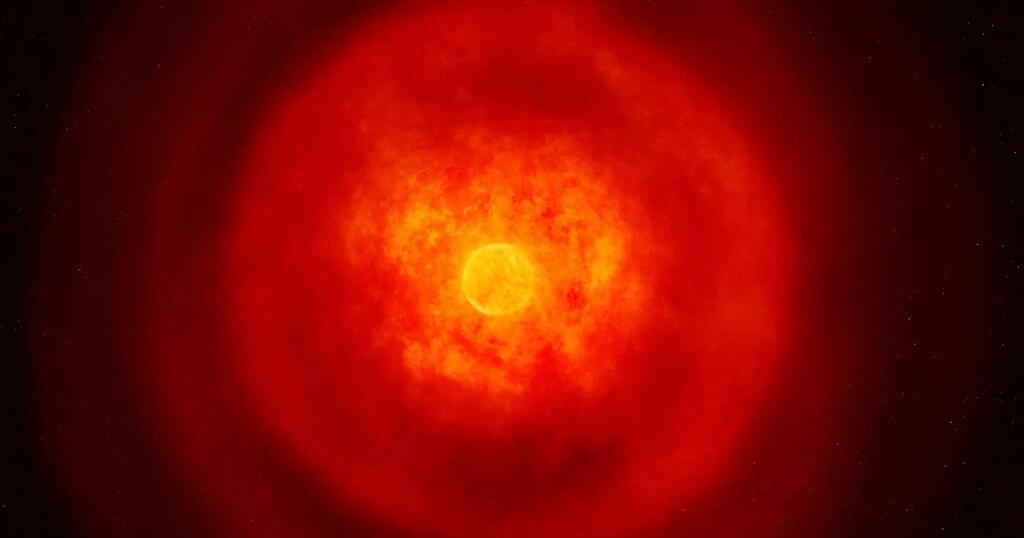
Their findings, published as a study in the journal Science Advances, center on a red giant star that the researchers from China believe has a hidden binary companion. Using observations taken with the LAMOST telescope and APOGEE observatory, they’ve inferred this invisible counterpart to be no ordinary star. Instead, it’s an ultra compact object called a neutron star whose mass appears to be on the upper limit of what’s thought to be possible.
Neutron stars are the remnants of what used to be a much more massive star that exploded in a supernova. The catastrophic event leaves behind only the star’s incredibly dense core. Though they’re roughly only the size of a human city, their material is so tightly packed that a single tablespoon of the stuff would weigh more than a billion tons.
Typically, neutron stars weigh around 1.4 times the mass of our Sun, and no neutron star has ever been discovered that weighed more than 2.5 solar masses. The astronomers found that this one could weigh up to 2.8 solar masses — though their best estimate is that it’s more likely around 2.2.
Either way, the point is that it’s large enough to confound astronomer’s attempts to explain it. And its mass isn’t the only puzzling element. Their analysis showed that the two stars complete an orbit in about 3.3 years, Phys.org noted, which means that they’re quite far apart. Each also follows an unusually circular path, despite their distance from each other and the violent history that the existence of a neutron star entails.
Typically, heavier neutron stars get that way by stripping material from their binary companion with their incredible gravity. But the stars in this binary pair, designated J0008+0128, are so far apart from each other that it rules out that explanation. After the astronomers ran 300,000 simulations, not a single one of them could reproduce the conditions they were seeing in the system, including the neutron star’s mass and orbit.
One alternative explanation the astronomers are considering is that the suspected neutron star may have formed from two compact but less extremely dense stellar remnants called white dwarfs colliding into each other. Or maybe there’s a third star in the system that we’re not seeing — perhaps two, more typical, neutron stars in tight orbit.
Another tantalizing option? That it’s a tiny black hole with a mass that’s never been seen before.
“Astrophysically, there’s no reason why you can’t have black holes that small; it’s just that we don’t see any of them in our galaxy,” Scott Ransom, an astronomer at the National Radio Astronomy Observatory who was not involved in the study, told Scientific American. “What [the orbit’s shape] probably means is that the birth of that neutron star or black hole was not especially violent.”
As Ransom explains, the birth of a neutron star is more violent than a black hole’s, making it more likely for the newly formed object to careen itself out of its tidy orbit. “So the fact that the orbit is more circular might be evidence that this is a black hole and not a neutron star,” he added.
More on astronomy: Cosmic “Loophole” Could Let Black Holes Split In Two Like Dividing Cells
The post This Star System Is So Strange that Astronomers Couldn’t Recreate How it Formed In Hundreds of Thousands of Simulations appeared first on Futurism.