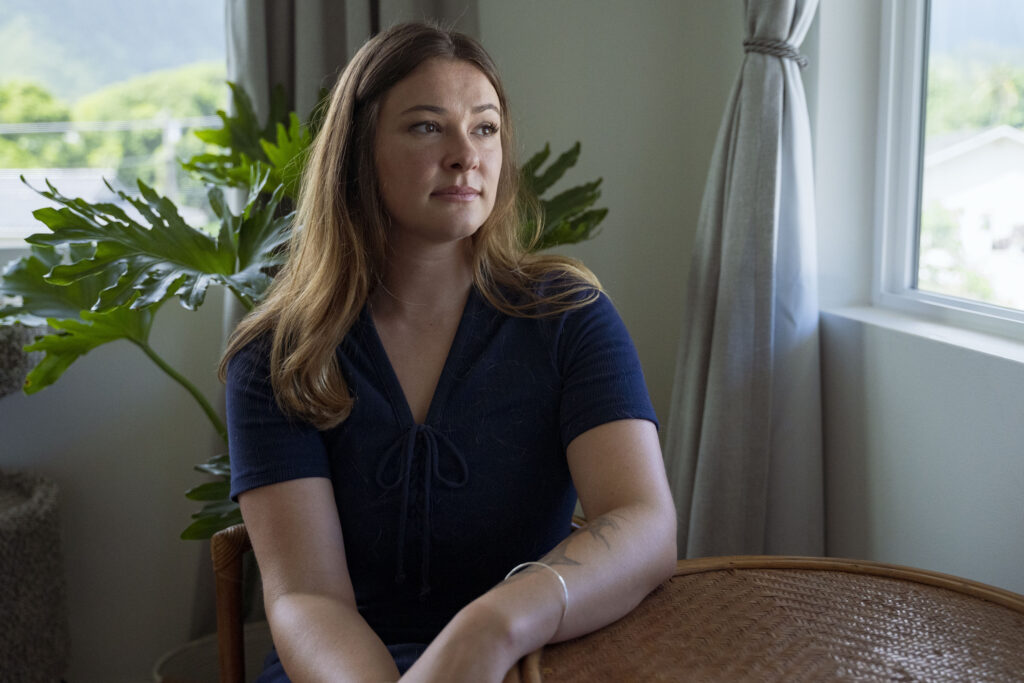
A 30-year-old former Coast Guard petty officer is free after a six-year legal saga over the death of her infant daughter that included two trials, a two-year incarceration and an acquittal earlier this year on the manslaughter charge that sent her to prison.
Katie Richard, who was stationed in Kodiak, Alaska, at the time of her arrest, was the primary suspect after her 5-month-old daughter, Scarlett, was found dead in her crib in April 2020. During her trial, prosecutors alleged that Richard had suffocated the baby by pushing her face into the crib’s mattress.
It was the Coast Guard’s first murder trial in more than a decade. As The Washington Post reported at the time, the case centered on the young mother’s mental health and postpartum depression — and questions raised by her defense team about the competence of those tasked with investigating the child’s death.
Now free, Richard, who spoke with The Post after separating from the Coast Guard in August, maintains that the service abused its power in taking her to court a second time — a move that she suspects was intended to save face and avoid having to issue her back pay for time spent in prison.
In interviews, Richard offered a starkly different portrait of her experience than that of an indifferent, resentful mother, as prosecutors portrayed in court. While she had struggled with postpartum depression, she said, she began taking medication months before the child’s death and her outlook had greatly improved. She’d been “so happy” as Scarlett’s mother, she said.
On the day the baby died, Richard recalled watching an episode of the television show “Outer Banks” with her friend McKenna O’Leary. Richard said they left the house for about 45 minutes to buy coffee while her then-husband, Gustavo “Gus” Flores Guerra, remained at home. Minutes after returning, Richard said, she entered the nursery to wake up Scarlett, who was facedown in her crib. Immediately, she said, she knew something was wrong.
“My heart dropped, and I was like, I couldn’t move, I couldn’t speak. I was just looking at her, and then I started getting closer, and I was just screaming,” Richard said. “I was like: ‘Why does she look like that? Why does she look like that?’”
The couple got in their car with the baby and raced to the nearest emergency room with Richard behind the wheel and Flores Guerra attempting CPR in the back, she said. She recalls running, shoeless, past covid screening tents and into the emergency room, shouting at a nurse to “save my baby.”
But Scarlett was already blue, Richard said, and there was nothing the medical staff could do.
“That was like this primal pain that I’ve never felt in my entire life,” Richard said. “… It literally feels like a piece of my heart was ripped out of my chest and thrown away.”
Flores Guerra and Richard divorced after Scarlett’s death. He declined to comment.
During the days and weeks that followed, Richard said, military investigators approached her in a manner she now views as manipulative, saying they offered emotional support and comfort while building a case against her.
What she says were about 18 hours of conversations with them over time culminated in a one-hour interrogation two months after Scarlett’s death. At one point, Richard told investigators that she “might have” pushed her baby’s face into the crib mattress as she put her down to sleep, according to audio of her interview with investigators that was played during her initial trial and reviewed then by The Post.
Richard contends that similar tactics were used by investigators to convince those close to her, including her husband, that she was guilty.
Asked for comment on Richard’s allegations, a Coast Guard official provided a statement saying that “the death of a child is a profound tragedy” and defending its handling of the investigation.
The Coast Guard Investigative Service is “required to investigate all deaths within their jurisdiction,” the statement said. Its agents are “independent, accredited federal law enforcement professionals trained to conduct thorough, objective, and fact-based investigations.” Investigators’ interview with Richard was presented in court, the statement says, “and the Coast Guard respects the findings of the court-martial panel.”
After sentencing in 2022, Richard said, she was taken to the Navy brig in Chesapeake, Virginia. She was inconsolable when she arrived, she recalled, and spent the first month in a cell by herself, eating and drinking little. She was later relocated to the Navy brig in Miramar, California. As time passed, she said, she sought ways to stay busy.
“I was in Bible studies. I did artwork for the chapel. I did a bunch of school and volunteer work,” she said. “… And the whole time, I was thinking, like, this has to get overturned. There’s no way. Like, I don’t even know what I was convicted of. There’s no act in the charge.”
Also upsetting, she said, was the knowledge that she was seen by other inmates as guilty of killing her child.
“It literally felt like a loss of my own identity because I knew the truth. I knew myself. I knew I didn’t do that, but everybody around me, 24/7, was looking at me like I did,” she said.
Richard said she still has nightmares in which she’s driving to the hospital to try to save her daughter’s life, or finds herself in prison again.
“I’ve been dealing with this for six years, just about half of my entire time in the Coast Guard,” she said. “So it’s been very long, very unnecessary, and now I’m trying to finally catch up — to be able to grieve properly now.”
At the heart of Richard’s initial defense, led by civilian lawyer Billy Little, were apparent gaps in the Coast Guard’s investigation — including what her attorneys said was a failure by the military to keep track of the baby’s clothes and bib — that could have provided evidence of sudden infant death syndrome.
Court documents show that a medical analysis from a Kodiak hospital also suggested SIDS, with the attending doctor adding: “I have no suspicion of abuse. Mother and father were understandably devastated.”
In 2024, two years after Richard started serving her six-year prison sentence, a military appeals court threw out the conviction, teeing up the second trial.
The appeals court determined that the manslaughter charge — a jury had acquitted her of first-degree murder and obstruction of justice — was improperly added to her charge sheet. It stated that Richard committed manslaughter “by asphyxia” but did not specify what she was alleged to have done physically, an omission that Little argued left her legal team unable to effectively defend her.
Richard was released from prison two months after the appellate decision in 2024. She wrote to Sens. Lisa Murkowski and Dan Sullivan, both Alaska Republicans, seeking help to secure back pay from her time in prison and avoid another trial. Both petitioned the Coast Guard on her behalf, according to correspondence reviewed by The Post, but service officials made no concessions.
“To be clear, [Petty Officer] Richard has never been acquitted or ‘exonerated’ of manslaughter or killing her child,” an official with the Coast Guard Senate liaison’s office wrote in 2024 to Sullivan. “To the contrary and after a lengthy trial, she was convicted by a general court-martial who concluded that the government proved beyond all reasonable doubt that [Richard] unlawfully killed her child by asphyxia and by culpable negligence. She now remains pending a potential retrial for that crime in accordance with [a court] mandate.”
Sullivan’s staff said his office does not comment on queries made on behalf of Alaskans. The Post’s inquiries to Murkowski’s office did not receive a response.
In 2025, the Coast Guard charged Richard again, this time with one specification of involuntary manslaughter. She appealed, claiming that the new charge violated the double jeopardy clause of the Fifth Amendment to the U.S. Constitution. The court denied her “petition for extraordinary relief,” saying her constitutional claim was without merit and the Coast Guard had a right to try her again.
Her second trial, at Coast Guard Base Portsmouth, in Virginia, lasted two months. In April, a military jury found Richard not guilty of manslaughter, according to documents reviewed by The Post.
The jury, Richard said, focused on testimony from O’Leary, who told investigators in 2020 that she’d been at Richard’s home and heard the baby cooing in her bed after the point at which prosecutors alleged Richard smothered her.
The jury paused deliberations to listen to O’Leary’s testimony a second time, Richard said, delivering their not-guilty verdict shortly thereafter.
Attempts to reach O’Leary were unsuccessful.
In a separate statement, the Coast Guard said Richard’s retrial was authorized by the appellate court after her conviction was set aside. “As in all courts-martial,” the statement said, “the Coast Guard strives to ensure that prosecution decisions are made rationally and fairly, based on the objective merits of each case, and respects the results of the trial process.”
Richard said she finally received back pay of $168,000, minus taxes, in September.
Now making a new life in Hawaii, Richard said she has been accepted to a master’s degree program in public administration, set to begin in the spring. She’s also making use of her Coast Guard experience in a new role as a crew member and safety diver on a tour boat.
While she wants to clear her name and bury the past, she said, she is not sure if it will ever feel worth it to try to claw back any recompense from her years of trials and imprisonment.
“Part of me is very upset with the Coast Guard and feels like they owe me serious reparations for what they’ve done,” she said. “But at the same time, I can never get my daughter back. I can never get the years back that they took from me.”
Aaron Schaffer contributed to this report.
The post After 2 years in military prison, mother is acquitted in baby’s death appeared first on Washington Post.