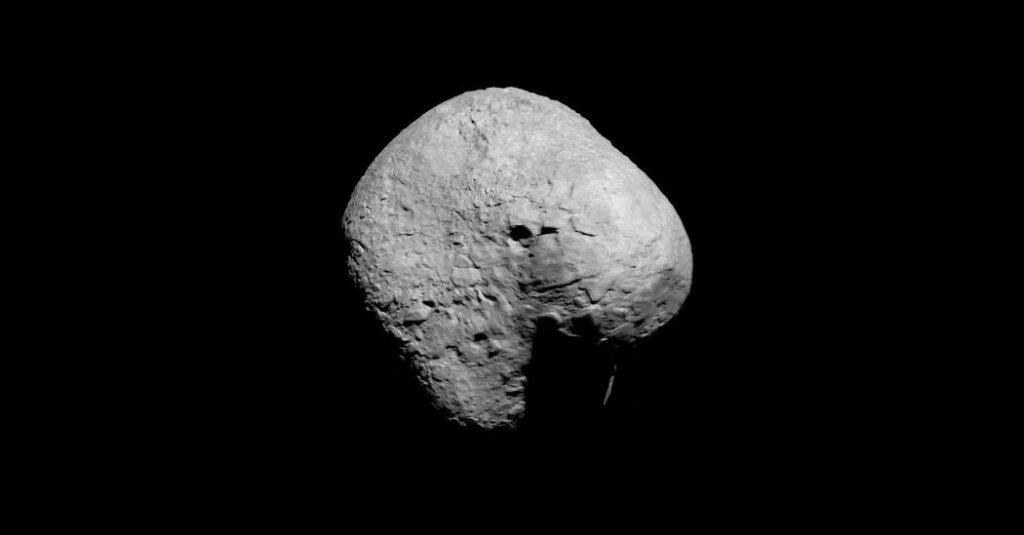
It’s small, it’s fast, and nobody is entirely sure what it is.
In the simplest terms, the object called 1998 KY26 is a boulder orbiting the sun, measuring about 36 feet across. But it is moving in a way that cannot be explained by gravity alone. That has led to a debate about whether it’s a comet, an asteroid or something else entirely.
No, it’s not an alien spaceship. Nor is it likely to be a lost Soviet spacecraft.
Discovered in 1998 by Tom Gehrels, an astronomer at the University of Arizona, 1998 KY26 at first appeared to be an asteroid. But its idiosyncratic accelerations cause it to stray from the neat orbit suggested by Johannes Kepler’s laws of planetary motion, which have been taught to generations of physics students. The deviations are tiny, but they are meaningful.
One idea was that 1998 KY26 was a “dark comet” — one that simply lacked the signature tail composed of dust particles released as the sun caused buried ice to vaporize. This process, called sublimation, can look like 1998 KY26’s acceleration.
A new paper published in the scientific journal Icarus has deepened the mystery by arguing that the average temperature of 1998 KY26, a balmy minus 53 degrees Fahrenheit, is “far above” the threshold for ice.
“If something has ice, then it’s a comet,” said Darryl Z. Seligman, an assistant professor of physics and astronomy at Michigan State University who had been a leading proponent of the “dark comet” hypothesis. But no ice meant no comet. “The surface of KY26 is too warm,” Dr. Seligman said in an interview. So there went one of the simpler explanations.
Dr. Seligman added that while we have the tools to peer into deep space, near-Earth objects present a scientific challenge of their own. “There’s not tons of data on very near-Earth objects. They’re super small and faint,” he said.
Avi Loeb, the Harvard astrophysicist who has stirred up controversy as the nation’s premier “alien hunter,” offered his own hypothesis on Fox News Digital. Dr. Loeb said that 1998 KY26 was neither a comet nor an asteroid but Phobos 1, an uncrewed spacecraft launched by the Soviet Union in 1988 to visit Mars and lost about two months later.
If Dr. Loeb is correct, Phobos 1 has spent decades hiding in plain sight. He first proposed that 1998 KY26 was a Soviet satellite in a paper he coauthored that was posted online last May.
But just as Dr. Loeb discounted Dr. Seligman’s dark comet proposal, Jared Isaacman, the NASA administrator, has shot down theories that the object could be any kind of spaceship. There was no evidence that it was “anything other than an asteroid,” Mr. Isaacman said on Fox & Friends.
“There’s all sorts of space junk out there,” said Bryce T. Bolin, a scientist at Eureka Scientific Inc., a research corporation, who has written about 1998 KY26. “But this object is way too heavy, way too dense.” Dr. Bolin added that 1998 KY26 had the density of — you’ll never guess — a rock.
The key to explaining 1998 KY26’s weird behavior may lie in a 2025 paper that showed its diameter to be one-third that of previous calculations. “That was a huge result,” Dr. Bolin said, because it allowed scientists to think differently about the forces at work, even if no ice was present.
About a month later, Davide Farnocchia, a navigation engineer at NASA’s Jet Propulsion Laboratory in Pasadena, Calif., and several of his colleagues suggested a novel explanation, one that made sense once 1998 KY26 had been right-sized: Its unusual acceleration was being powered by the sun.
“Light photons carry momentum — it’s very small per photon, but there’s a hell of a lot of photons,” said David Jewitt, who directs the Institute for Planets and Exoplanets at the University of California, Los Angeles. “That pressure is enough to push bodies around if they’re not too big.” The phenomenon, known as radiation pressure, could have worked in concert with another, called the Yarkovsky effect, which describes the force that comes from an object emitting heat after absorbing sunlight.
In a statement published on Sunday, NASA said that “solar radiation forces” were at work on 1998 KY26.
The Japanese space agency had hoped to resolve the mystery of 1998 KY26 with its Hayabusa2 probe, which was set to reach the object in 2031. But on Monday, the Japanese authorities said that the visit had been called off, citing engine trouble. Hayabusa2 will instead travel to another asteroid, 2015 BM510, which it is expected to reach by 2028 or 2029.
Dr. Seligman of Michigan State said that he wasn’t concerned that 1998 KY26 would hit Earth, given how thoroughly institutions like NASA’s Planetary Defense Coordination Office scrutinize the not-always-friendly skies.
“They’re really good at what they’re doing,” Dr. Seligman said. “We don’t have anything to worry about.”
The post Scientists Are Stumped by This Strange Object in Space appeared first on New York Times.