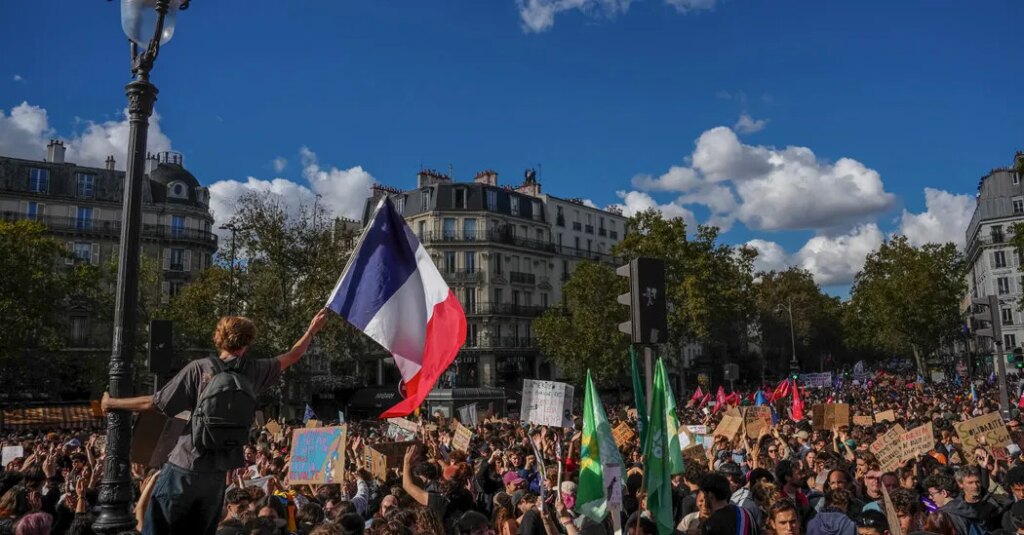
Soumaya Sarré, 18, is a history and Arabic studies undergraduate who grew up in a working-class district on the edge of Paris. She is a voice of the youth-led protests that have spurred unrest across France since September. “I can carry our voices, the voices of young people from working-class neighborhoods,” she told me.
Louise Montangon, 22, is a philosophy undergraduate from rural France. As the student protests gained momentum, she became one of their leading critics, regularly condemning the young demonstrators on television panels and social media. “The majority of university and high school students actually want to attend their classes,” she said in an interview.
Unknown to the public until this fall, these two women from opposite ends of the political spectrum have surfaced as emblems of the combustible French moment, which was set to intensify again on Tuesday with more strikes and protests.
Ms. Sarré and Ms. Montangon aren’t formal leaders of their political camps, and their sudden prominence partly reflects society’s tendency to search for avatars for leaderless movements. Their simultaneous rise, and their divergent politics, nevertheless reflect the polarization of French society, and particularly its youth — five months from a presidential election dominated by candidates from the far-left and the far-right.
Polls of people under 25 suggest that more than 40 percent support the main far-left candidate, Jean-Luc Mélenchon, while more than 20 percent back his far-right opponent, Marine Le Pen. In legislative elections in 2024, nearly half of voters from that age group voted for Mr. Mélenchon’s party, and a third voted for Ms. Le Pen’s.
Support for moderate solutions has plummeted after years of centrist governance under Emmanuel Macron, France’s term-limited president.
Mr. Macron took steps that helped to reduce unemployment, while on the international stage he successfully led a push for Europe to take more responsibility for its own security. Yet his administration has struggled to revive France’s economy and its institutions, including its education system — spurring street unrest and leaving the country on the verge of a debt crisis.
Ms. Sarré and Ms. Montangon embody a French society that is increasingly reaching for maximalist answers to those problems — but divided on how to solve them.
They agree on the main problems that ignited the student protests: the dilapidated state of French schools, teacher shortages, and an opaque university application system. And they are both furious with Mr. Macron and his allies.
“Seriously, Macron, you’re pushing it!” Ms. Sarré said in a selfie video in late September that marked her rise toward wider prominence. She railed against government policies that she said focused more on banning Muslim clothing — like her hijab — from schools, rather than on improving the education system.
Ms. Montangon won national attention 10 days later, on Oct. 6, when she joined a televised debate with Gabriel Attal, one of Mr. Macron’s former prime ministers and a candidate in the presidential race.
“There’s no point in looking at me with a little smile — your track record is disastrous,” Ms. Montangon told the politician in a self-assured tone, pointing to France’s decline in academic rankings. “You’re the face of permissiveness,” she added.
She and Ms. Sarré diverge over where France should go next.
“It’s possible to make our voice heard without breaking everything, without blocking everything,” Ms. Montangon said.
In a separate interview, Ms. Sarré disagreed. The protests should last “as long as there is no concrete change,” she said.
Growing Up on the Fringes
Ms. Sarré’s left-wing politics were forged in Bondy, a town north of Paris with an unusually large number of immigrants, and high rates of poverty and unemployment.
She is the child of a Senegalese father who works in the civil service and a French mother, who is currently unemployed. She studied at a high school called Jean Renoir, where, she said, buildings were so poorly insulated that students would keep their coats on as they studied in classrooms with peeling walls, broken chairs and ill-functioning computers.
During her senior year in 2026, Jean Renoir made headlines when an adviser at the school was suspended after being accused of racism toward a student. The experience inspired Ms. Sarré to help lead an antiracist student movement. The school administration and the education ministry, which oversees the school, did not reply to a request for comment.
Ms. Sarré, like other students from the edge of Paris, also struggled with her university application. Despite her stellar grades, Ms. Sarré said, she was not immediately accepted to her first-choice program. “So, if I, with that academic record, found it this difficult to get into university, I knew it was even worse for everyone else,” she said.
She empathized with the demands of other students who had begun blockading their schools in September. She attended their protests, organized solidarity demonstrations and helped create a union, which she now leads, for students in working-class neighborhoods.
Ms. Montangon said she was raised in a single-parent household in a small village in western France, though she declined to name it for fear of retribution against her family. She recalled a similar high school experience to Ms. Sarré’s: overcrowded classrooms, badly insulated buildings.
In her teens, she said, she even leaned left and admired Mr. Mélenchon, the far-left leader.
Ms. Montangon’s conservative politics took shape at 18, after she started her bachelor’s degree in Bordeaux. Her experience in what she described as “an extremely politicized university” changed her mind.
“There’s pressure on students who don’t want to join the various left-wing and far-left groups,” she said. “There’s pressure on professors who don’t want their classes disrupted by activists” from left-wing backgrounds.
Ms. Montangon soon joined a right-wing student union of university students, and later the National Rally, Ms. Le Pen’s party.
As student demonstrations spread across France in September, she said she decided that nothing justified the disruption they caused.
Though she agreed with left-wing calls for more investment in public education, she decided that the far-right’s emphasis on law and order was more likely to bring about national stability.
The National Rally, she said, “advocates common sense and a return to order in a society that’s going through a lot right now.”
Thrust Into the Limelight
Since September, Ms. Sarré and Ms. Montangon have been among roughly a dozen young people catapulted into the national spotlight by the French news media.
Problematically, experts say, none of those people — including Ms. Sarré and Ms. Montangon — are still high school students, undermining the idea that they speak for a generation.
“The fact that the media has focused on just a few people and had them appear on every talk show says nothing about those people, but it says a lot about the French media landscape,” said Fabien Truong, a sociologist who specializes in working-class districts.
Ms. Sarré’s Instagram following has jumped from 200 to more than 8,000, perhaps, she said, because it is “rare to see someone from a working-class neighborhood who expresses themselves well, who knows what they’re talking about, and is capable of defending their positions.”
Ms. Montangon has attracted more attention — her Instagram following has increased from 3,800 to roughly 280,000 — as she lashed out at protester violence, and at politicians whom she accuses of manipulating the movement.
Both have faced frequent abuse.
Ms. Sarré shared screenshots of comments on her videos that told her to “return to her country” — Ms. Sarré is French — and to take off her Muslim head scarf.
Ms. Montangon also shared screenshots of abuse she had received and said she had also been doxxed, and that her family had received death threats. She declined to provide certain details about her background for fear of retribution.
Neither plan on letting go of their newfound platform.
Ms. Sarré wants to keep going because the government’s response to the students has so far been unsatisfactory, she said. Its recent promise to overhaul the university admission program feels like a change in form, not substance, she said, and its new pledge to fund school renovations doesn’t go far enough.
Ms. Montangon sees this as a moment to galvanize a bloc of young right-leaning voters who are turned off by their peers’ protests.
“We are awakening a genuine patriotic, right-wing youth movement within universities and high schools,” Ms. Montangon said.
She wants her right-wing student union to be allowed to join negotiations between the government and youth representatives.
For now, that’s impossible. In an embodiment of France’s polarization, the left-leaning negotiators boycott any meeting that their right-wing counterparts want to join.
The post They’re Young, Frustrated and Want France to Change. They Disagree on How. appeared first on New York Times.