There was a reason, 11 years ago in Paris, that world leaders set themselves a target to keep the global rise in temperatures below 1.5 degrees Celsius compared with preindustrial levels. Beyond that, climate scientists say, warming will dangerously change our way of life.
We got a taste of it this year, as temperatures rose above the threshold for several months. Heat waves. Wildfires. Flash floods. And with a super El Niño year unfolding, next year might be worse. As one climate expert put it to me: This El Niño will effectively offer a time machine to the 2030s, showing what will happen if we don’t radically cut carbon emissions.
My colleague David Gelles, host of the Climate Forward newsletter, has been following the much diminished U.N. climate talks in Turkey. Today he writes about the death of 1.5 degrees and what that means for the planet.
A key climate goal is dead. What happens now?
By David Gelles
It was the climate movement’s unifying slogan for the past decade: “Keep 1.5 Alive.”
The tagline referred to the central ambition of the 2015 Paris climate agreement, in which almost every country pledged to try to limit global warming to 1.5 degrees Celsius.
Now, just 11 years after the target was set, it’s effectively dead.
Scientists now say that without increasingly drastic efforts to reduce greenhouse gases — more drastic than the ones humans have tried and failed at so far — it is very likely that the planet will warm at least 2.6ºC by the end of the century.
At COP31, the ongoing United Nations climate summit in Antalya, Turkey, diplomats who spent so long championing the 1.5 degree target have been blunt.
“The world has no chance of holding to 1.5 degrees,” said Chris Bowen, Australia’s minister for climate change and energy, who is leading the negotiations.
Tipping points
Scientists for years have warned that allowing global average temperatures to rise 1.5ºC, compared with preindustrial levels, would result in a profoundly more dangerous world. Extreme heat will become more common and intense. Storms will become more powerful and destructive. Sea levels will rise. And poor countries will bear the brunt of the damage.
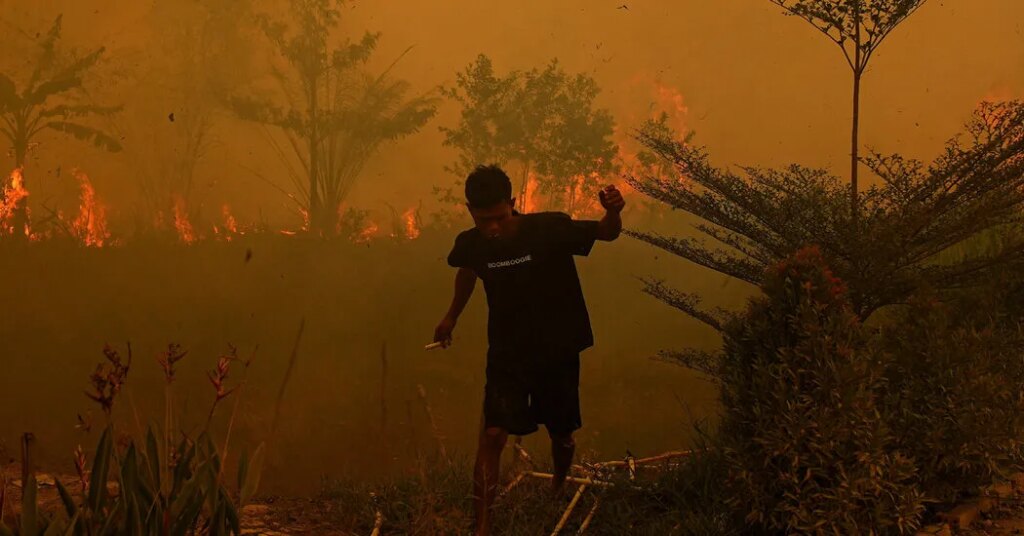
That scenario is already playing out around the world. In recent months, wildfires have raged from Canada to Indonesia. The collapse of a glacier in Nepal killed thousands and wiped away towns. Floods and mudslides devastated Brazil. And a summer of European heat waves killed an estimated 50,000 people.
Should warming continue unabated, scientists say the world may cross certain tipping points, including the melting of Arctic permafrost, the rapid decline of rainforests and a slowdown of a key current in the Atlantic Ocean.
The 1.5 degrees target was always ambitious. Achieving it would have required wealthy countries to make the biggest changes, with potentially profound effects on their economies. Cost, politics and inertia all got in the way.
As a result, one big question at the climate talks has been whether the world should set a new goal. But most people I spoke with said no.
“We don’t think that there’s a new target,” said Ilana Seid, Palau’s ambassador to the United Nations. “We still have a Paris Agreement target of 1.5, and so we are still continuing to say that’s the target.”
Rachel Cleetus, director of the climate program at the Union of Concerned Scientists, warned against picking a new target, saying that it was important to confront what breaching the threshold has wrought.
“I don’t think it’s a question of replacing 1.5,” she said. “There is no new number. We are now in the unsafe zone.”
Leaders rejected the idea of resetting the goal to 2ºC or even 2.5ºC, saying that allowing for endless revisions created a slippery slope that could make progress harder to achieve.
A temporary breach?
While world leaders acknowledged they had missed the target, they also said it might still be possible to get back to 1.5 degrees of warming.
The United Nations secretary general, António Guterres, called on countries to redouble efforts to reduce greenhouse gas emissions with the aim of limiting additional warming, and ultimately turning down Earth’s thermostat.
“The truth is that we have the power to determine how high, how long and how devastating that overshoot will be,” he said. “We have the power to make sure the overshoot is a temporary breach, not a permanent sentence.”
So far, the world has crossed the 1.5 threshold for only a few months. But emissions continue at near-record levels. Although clean energy is growing rapidly, the world is expected to continue to use fossil fuels for decades to come.
At this point, meeting the emissions targets set in Paris wouldn’t be enough to bring the temperature rise back down from 1.5 degrees. It would require drastic reductions in the burning of fossil fuels like coal, oil and gas — and possibly more.
Because reducing emissions is proving so difficult, some environmentalists and scientists are proposing different types of geoengineering. These include large-scale carbon capture and storage or attempts to reflect the sun’s energy away from the planet by injecting particulate matter into the stratosphere.
“Overshoot must be kept as small and short as possible, and be rapidly reversed,” said Hilda Heine, president of the Marshall Islands, an island nation threatened by sea-level rise. “We have fallen short of the emissions reductions needed to stay under 1.5. We must rewrite the future.”
MORE TOP NEWS
UKRAINE
-
Weeks earlier than expected, Russia has started bombing the Ukrainian infrastructure that provides heat and running water in the winter, threatening to make some cities unlivable.
-
This visual timeline shows how the U.S. has wooed Russia as Ukraine endures some of its darkest days of the war.
NVIDIA
-
Is Jensen Huang plotting a comeback? President Trump said he was open to seeing the Nvidia founder reinstated: “I would not mind that.”
-
The Trump administration moved to restrict China’s access to advanced A.I. chips through data centers in other countries.
-
Tripp Mickle, one of our technology reporters, examines in the video below how Huang had immense power within Nvidia and the broader A.I. sector.
OTHER NEWS
-
Trump set off for a week of meetings in Asia, which will culminate in a summit with President Xi Jinping of China and President Vladimir Putin of Russia.
-
Canada’s prime minister, Mark Carney, is visiting Asia as a new political star.
-
Five European countries announced plans to deport rejected asylum seekers to Rwanda.
-
Bahrain sentenced dozens of Shiite Muslim clerics and other religious figures to life in prison on terrorism charges, accusing them of colluding with Iran.
-
A student movement defeated Serbia’s strongman. But will it be able to govern?
-
A forensic scientist with rare access to Jeffrey Epstein’s autopsy files said photos show Epstein did not kill himself.
WHAT ELSE IS HAPPENING
-
Raye and Rosalía picked up the most Grammy Award nominations, as young women dominated many categories. See the full list of nominees.
-
Gérard Depardieu withdrew his appeal of a sexual-assault conviction and apologized to two women he groped.
-
South Korea said it would study how the K-pop industry treats underage performers, after The New York Times investigated the industry’s contracts.
TOP OF THE WORLD
The most clicked link in your newsletter yesterday was about five muscles to strengthen as you age.
OPINIONS
Jensen Huang’s downfall is not a technology story. It’s a story of masculine hubris, writes Huang’s biographer, Stephen Witt.
It’s time for Israelis to throw out their Trump, argues the Times columnist Thomas Friedman.
John and Diana Matthias were married for decades. Then the hallucinations began.
SECRET AGENT OF THE DAY
The new James Bond
Hollywood’s most feverishly followed casting search is over. Robert Pattinson, the 40-year-old English actor, will become the seventh man to play 007, one of the most coveted and unforgiving roles in moviedom. He succeeds Daniel Craig, who announced in 2019 that he was ending his celebrated five-film run.
MORNING READ
Ron Arad, an Israeli airman, vanished decades ago. Israel’s long search for him has come to symbolize the country’s commitment to bringing its soldiers home, dead or alive.
Several Israeli intelligence reports have concluded that Iran was not involved in Arad’s disappearance. Yet time and again, a New York Times investigation found, Israeli officials gave credence to reports that Iran was to blame for the disappearance, or knew Arad’s whereabouts. That belief, which officials said was genuinely held, has been used to justify cross-border raids, kidnappings, harsh interrogations and more. Read the investigation.
AROUND THE WORLD
Singing without fear
The traditional Mexican folk ballads known as corridos recount tales of revolutionaries, outlaws, folk heroes and, more recently, drug traffickers. They are usually sung by men, about men.
The singer Vivir Quintana flips that formula, although her subject matter is still violent: One corrido was based on the true story of a woman who fought back when her abusive partner tried to gouge out her eyes. She made one album that included 10 corridos about women who fought back against their attackers only to end up behind bars.
“I used to think that what united us women was our pain,” Quintana told a crowd at a recent event. “Now, I have realized it is love and resistance.” Read more about her career.
RECOMMENDATIONS
Watch: Andrey Zvyagintsev’s “Minotaur” uses the story of a cheating spouse to examine the compromises Russians make under authoritarianism.
Read: In “Stations,” by Louise Kennedy, a young Irishwoman tests the limits of commitment.
Travel: These luxury country retreats have you forage for your food.
Consider: A little extra weight may be a good thing as you get older.
RECIPE
The words “brown butter miso” conjure instant feelings of comfort and indulgence. This pasta dish channels both, with added texture and brightness from crispy sage and caramelized artichokes.
WHERE IS THIS?
Where is this beach?
TIME TO PLAY
Here are today’s Spelling Bee, Mini Crossword, Wordle and Sudoku. Find all our games here.
That’s it for today. See you tomorrow! — Katrin
David Gelles was our guest writer today.
We welcome your feedback. Send us your suggestions at [email protected].
The post The Death of ‘Keep 1.5 Alive’ appeared first on New York Times.