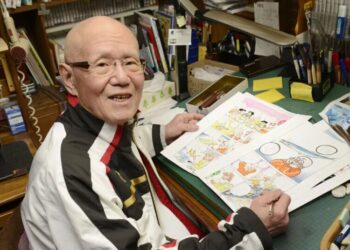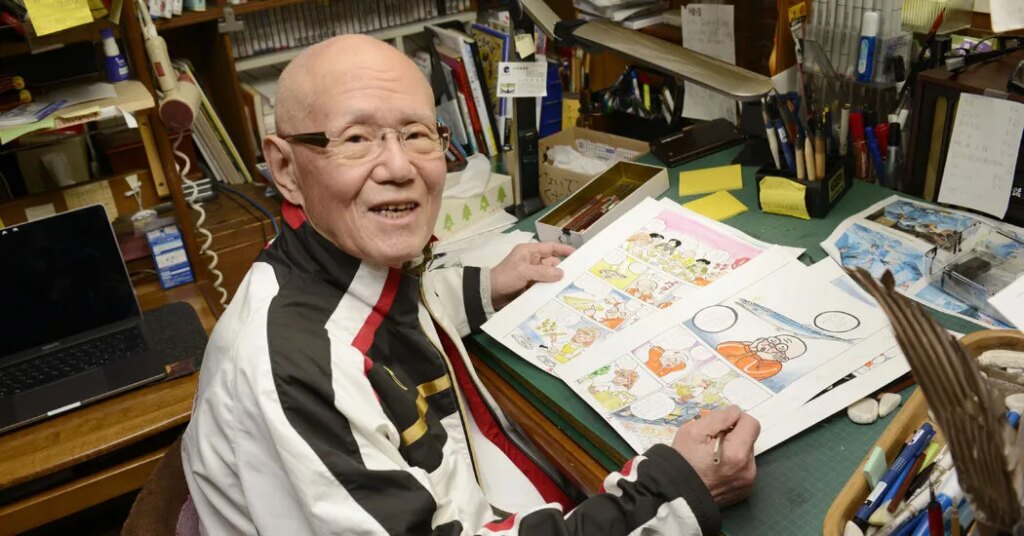
Tetsuya Chiba, who was widely considered one of modern Japan’s greatest illustrators of manga, a form of comic and graphic novel, and whose serialized story of a boxer during the country’s postwar economic boom, “Ashita no Joe” (“Tomorrow’s Joe”), became a cultural phenomenon in the 1970s, died on Oct. 22 in Tokyo. He was 87.
His death in a hospital, from a form of blood cancer called myelodysplastic syndrome, was announced by his wife, Yukiko Chiba, in a statement.
Mr. Chiba was best known for illustrating story manga, extended narratives that would often be serialized in magazines and then published in bound collections. Once virtually unknown in the West, manga has exploded in popularity in the United States over recent decades. A major exhibit, “Art of Manga,” began last year in San Francisco and is now at the Brooklyn Museum in New York.
Manga accounts for as much as a third of all book sales in Japan, and for much of his 70-year career, Mr. Chiba was an undisputed master of the form.
“Ashita no Joe,” his best-known work, ran from 1968 to 1973 in the magazine Weekly Shōnen and has sold more than 20 million copies in book form. Its closing sentence, “I burned out my flame, and all that’s left is pure white ash,” has become an almost universally recognized line in Japanese pop culture.
“Ashita no Joe” tells the story of a fictional boxer named Joe Yabuki, who begins life as a destitute orphan who falls under the sway of a boxing coach.
Working with the writer Asao Takamori, also known as Ikki Kajiwara, Mr. Chiba crafted an epic tale around Joe’s rise to the peak of his sport, dealing with themes of economic inequality, the cost of fame and the pressures to conform in a postwar Japanese society that prized wealth and status over strength and honor.
The story captured millions of readers who likewise felt that something was amiss during Japan’s rapid postwar economic boom. When Joe accidentally killed his nemesis in a boxing fight, 700 people turned out in Tokyo for a mock funeral.
Both the far-right novelist Yukio Mishima and the radical-left militants of the Japanese Red Army were fans. After members of the group hijacked an airplane in 1970, they released a message: “We Are Tomorrow’s Joe.”
Mr. Chiba was already an established manga artist when he began “Ashita no Joe,” and he followed that series with a number of successful titles in the 1970s, ’80s and ’90s, most of which he both wrote and illustrated.
Many of them were sports themed and ran for years — “Notari Matsutarō,” or “Carefree Matsutarō,” about a sumo wrestler, ran from 1973 to 1998 (with a two-year hiatus), and “Ashita Tenki ni Naare,” or “I Hope Tomorrow Will Be a Fine Day,” about a golfer, ran from 1980 to 1991.
“To create a manga, all you need is a pen and paper, and you can create any world you want,” he told an audience at the University of Nevada, Las Vegas, in 2004. “As long as the story is rich, it can be a very good format for entertainment.”
Tetsuya Chiba was born on Jan. 11, 1939, in Tokyo. When he was less than a year old, his parents moved with him to Korea and then to the Japanese-occupied region of China, where his father managed a paper plant.
He learned to draw on strips of paper that his father would bring home to use as fuel for the kitchen fire.
When the war ended and Japanese forces retreated, civilians like the Chibas were often left to arrange their own escape in the face of advancing Chinese troops.
A Chinese friend hid them in his attic for several weeks, during which Tetsuya and his younger brothers were not allowed outside to play. Their mother told him to draw cartoons to keep the rest entertained.
The family returned to Japan in 1946. Though his mother largely forbid manga in the house, saying they contained risqué imagery, he continued to draw. When his father got too sick to work, he found a job drawing for a small publishing company.
His first full-length manga serial, “Butōkai no Shōjo,” or “The Girl at the Ball,” began in 1958. More followed quickly, and during the 1960s, he earned a reputation as a fresh, prolific voice in one of the country’s premier pop-culture art forms.
He married his wife in 1965. She survives him. Other survivors include their sons, Shuhei and Kozo, and his brothers Ken and Shigeyuki.
Shigeyuki Chiba and another brother, Akio, who died in 1984, were also highly regarded manga artists.
In 2018, he released his first new work in 18 years, the first volume of “Hinemosu Notari Nikki” (“Diary of a Quiet Life”), a memoir told through manga. The eighth and final volume will be published next year.
In 2024, he became the first manga artist to receive the Order of Culture, one of Japan’s highest civil awards. By then, manga was a worldwide phenomenon, an achievement Mr. Chiba helped make possible.
“I believe that manga allows people who don’t speak each other’s languages to read it and learn about other cultures,” he told the crowd at the University of Nevada, Las Vegas.
The post Tetsuya Chiba Has Died. He Drew Some of the Greatest Manga of All Time. appeared first on New York Times.