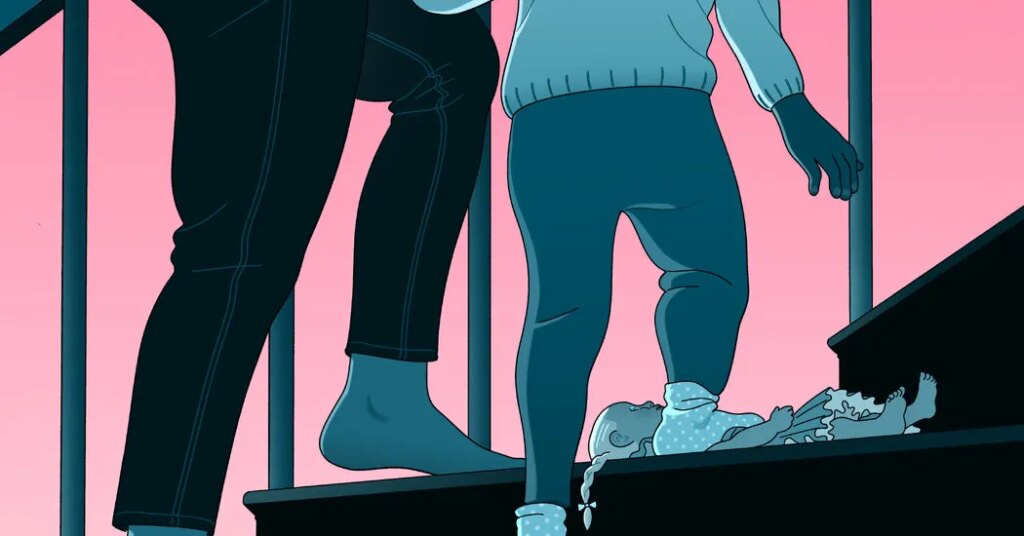
NANNY NANNY, by K Chiucarello
Biases are inevitable in book reviewing, but it feels important to make a disclaimer here: I read K Chiucarello’s debut novel, “Nanny Nanny,” while injecting myself nightly with hormones in advance of an egg retrieval. Consider me — a 34-year-old, newly single woman eyeing the future and my own fertility — slightly sensitive to the subject matter.
Because at 35, this novel’s unnamed, unpartnered narrator has been unsure about having a child until it becomes a possibility — and she seizes upon it. She and her high school boyfriend, a mensch named Michael with a good job and a soft spot for her, have lately gotten back in touch, and though he lives on the opposite side of the country, she believes now they might consider fulfilling a former pact to one day make a baby.
Different factors complicate the decision. For one, the narrator is a career nanny, so child-rearing is a loaded topic for her. “Years ago, I began saying my job in double,” she says of her titular calling; she places the emphasis on the first “nanny” in an effort “to convince others that care taking is a viable job.”
Secondly, she has only recently escaped a short but brutal marriage to a woman named Lucía, and has lately found herself questioning the very institution of love.
The novel’s first section lays out her longing for motherhood in the tone of an artist’s statement. Having left behind Brooklyn for a fresh start in the Hudson Valley, the narrator is finishing her undergraduate degree and taking creative writing classes in the hours she’s not caring for someone else’s baby. One night, snowed in at a bar with an old friend and their new partner, the narrator explains the five reasons she wants to have a child, digressing into flashbacks to her parents’ divorce and its effect on her family; and to Lucía’s abuse. It is an oral memoir that doubles as a mission statement: “Have a baby,” she thinks. “That is the next and most violent thing a woman can do.”
For the narrator, the line between violence and care is thin. “I was raised to care and I cared for Lucía in the best way I could, even to the point of overextension,” she considers; “therefore I allowed the abuse.” Their whirlwind romance is punctuated by calls to the police, restraining orders sought and rescinded and sought again, thrown glasses and gripped throats, small moments of sweetness and tormented nights of great sex. “Half of the pleasure I got from our relationship,” she reflects, “was knowing that I was strong enough to make it out from under Lucía alive.”
While the passages involving Lucía are so vivid they can be hard to get through, it is the depiction of the narrator’s relationships with her charges — she calls all of them “my children” — that gives the novel its most powerful emotional oomph. Scenes of sidewalk scooter accidents, tantrums on the French Riviera and a baby’s first bites of solid food are beautifully, intricately rendered. It’s disappointing that we don’t get more of them.
The novel’s second and third sections lack the organizing structure of the first, surrendering less to plot than to the possibility of it: the narrator’s impending meeting with Michael, the future opening wide and empty ahead of her. The narrative is often tripped up by bizarre diction that sometimes feels unintentional (“when I am demanding my mother with a question”) and other times feels far too deliberate, like misplaced poetry: “My grandmother died a death rattle bang.”
While some descriptions are overwrought, others appear totally alien: Fernet, confusingly to anyone who has ever drunk it, is described as “milky” and tasting “like a specific hue of purple” (talk about purple prose); when the narrator experiences panic, “paralysis frothed from the pores.” Sure, these are small stumbles in an otherwise affecting book, but it’s hard not to pay attention to such wobbliness at the line level when readers must tag along with the narrator to her creative writing workshops.
Overall, “Nanny Nanny” is a sharp and sincere portrait of the gray areas between survival and triumph, of the complications of families both chosen and given, of the possibilities for joy and heartbreak inherent in the desire to procreate. My heightened hormonal reality might have brought these possibilities into highest relief; it might also be why certain aspects of the novel let me down. Did I want to see more of the children because I was imagining my own? Did I cry because of the tangibility of the narrator’s struggle, of her desire; did I cry because of all the hormones in my body, or all the unknowns of my own life? All I can say is maybe, baby.
NANNY NANNY | By K Chiucarello | Ecco | 261 pp. | $28
The post For This Career Nanny, There’s a Thin Line Between Violence and Care appeared first on New York Times.