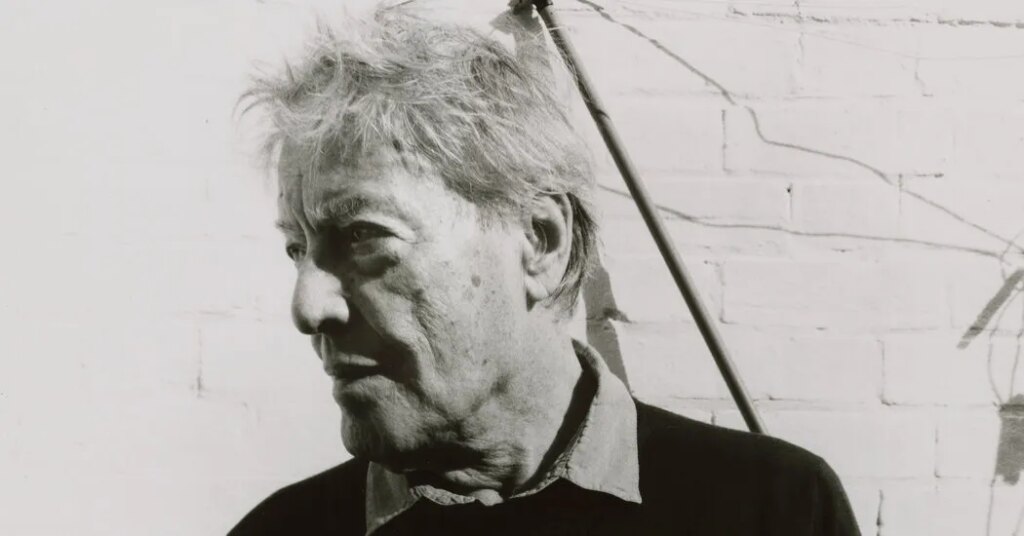
It could feel almost automatic when considering the celebrated playwright and screenwriter Tom Stoppard to think of William Shakespeare.
Stoppard’s first big play — “Rosencrantz and Guildenstern Are Dead,” a gloss on “Hamlet” — debuted in London in 1967. Three decades later, Stoppard won an Oscar for the screenplay of the 1997 movie “Shakespeare in Love,” which tells a fictional tale in which Shakespeare’s adoration for a noble woman inspires “Romeo and Juliet.”
In the intervening years were plays and essays peppered with allusions to the sonnets, the tragedies, the comedies.
So when Stoppard died last November at 88, Bernard Schwartz, a theater programmer, started to brainstorm. Arin Arbus, the artistic director of Theater for a New Audience in Brooklyn, had asked Schwartz to put together readings and other events connecting the canon to the current.
Schwartz said he began to think: Why not something on Stoppard and Shakespeare?
A year later, the result is “Tom Stoppard’s Shakespeare,” a one-night-only production on Monday at the theater’s Polonsky Shakespeare Center. It stars Ethan Hawke, Josh Hamilton, Aasif Mandvi and Asia Kate Dillon.
It will be the first installment in the “Spotlight Series” at the company, which bills itself as “a New York home for Shakespeare and other contemporary playwrights.”
The script, which the director and author Isaac Butler wrote with Schwartz, interweaves excerpts from interviews and lectures that Stoppard gave about Shakespeare with segments from both of their plays, as well as other voices — including Stoppard’s son, Ed, an actor; Jack O’Brien, who directed several of his plays; and even Anne Carson, the poet who won the Nobel Prize in Literature last month.
The goal was to craft from disparate texts a coherent conversation across centuries. Mandvi and Hamilton speak in Stoppard’s voice; Hawke and Kate Dillon deliver soliloquies in Hamlet’s. (Hawke played the prince of Denmark in a 2000 film.)
In an interview last week, Hawke remembered Stoppard as a Shakespeare obsessive who had attended multiple performances of a “Henry IV” production he featured in more than 20 years ago.
“It was flattering,” said Hawke, who played Hotspur. “And then you realize: Oh, I shouldn’t be flattered. He loves the playwright. He’s studying the playwright.”
Hawke came to know Stoppard well a few years later, when portraying the 19th-century Russian revolutionary Mikhail Bakunin in the writer’s three-part, nine-hour saga “The Coast of Utopia” at Lincoln Center Theater. (The title alludes to the fantastical “coast” Shakespeare gives the landlocked region of Bohemia in “The Winter’s Tale.”)
As for “Tom Stoppard’s Shakespeare,” Hawke said, “it felt like New York City needed to tip its hat to the significance of his contribution.”
One section of the new production focuses on “Rosencrantz and Guildenstern Are Dead,” still Stoppard’s best-known work. It traces that play — which features Hamlet’s erstwhile university friends pondering their fates as the famous goings-on at Elsinore intrude — back to an early version titled “Rosencrantz and Guildenstern Meet King Lear.”
But “Tom Stoppard’s Shakespeare” touches on more obscure lore as well. The Shakespeare-Stoppard bond, said Arbus, “is a lens everyone is aware of but everyone isn’t necessarily an expert on.”
Another section, for instance, concerns “Cahoot’s Macbeth,” one-half of a double bill that Stoppard wrote in the 1970s. It depicts a production of “Macbeth” illicitly performed in a Prague living room during Czechoslovakia’s period of authoritarian, Soviet-dominated “normalization.” The idea was inspired by the Czech playwright Pavel Kohout’s abridged “Macbeth,” which really did tour private homes in Prague.
Critics tended to fault Stoppard’s plays for leaving little room for emotional depth after the brilliant wordplay and ingenious premises. But Butler and Schwartz said they hoped their production would display Stoppard’s heart, in part by showing how the playwright was often drawn to Shakespeare’s more ineffable qualities.
What Stoppard most sharply recalled decades later from a 1950s production of “Hamlet,” for instance, was not the plot (with which he was not yet fully conversant) but the “sound of the words” of Hamlet’s Act II soliloquy (“O, what a rogue and peasant slave am I”). In this case, the words were delivered by a pre-movie-star Peter O’Toole.
“The left brained-ness is unmistakable in his work,” Butler said of Stoppard. “But the people who like his work have a deep emotional attachment to it.”
By way of another example, “Tom Stoppard’s Shakespeare” quotes from a lecture Stoppard gave in 1988, in which he recalled an outdoor production of “The Tempest” at Oxford University. The mystical spirit Ariel had made her final exit by seemingly sprinting across the surface of a lake before disappearing over the horizon as fireworks exploded. Shakespeare’s text reads simply, “Exit Ariel.”
“This is the thing,” Stoppard said. “You can’t write anything as good as that.”
The post For One Night Only, Stoppard and Shakespeare Chat Across Centuries appeared first on New York Times.