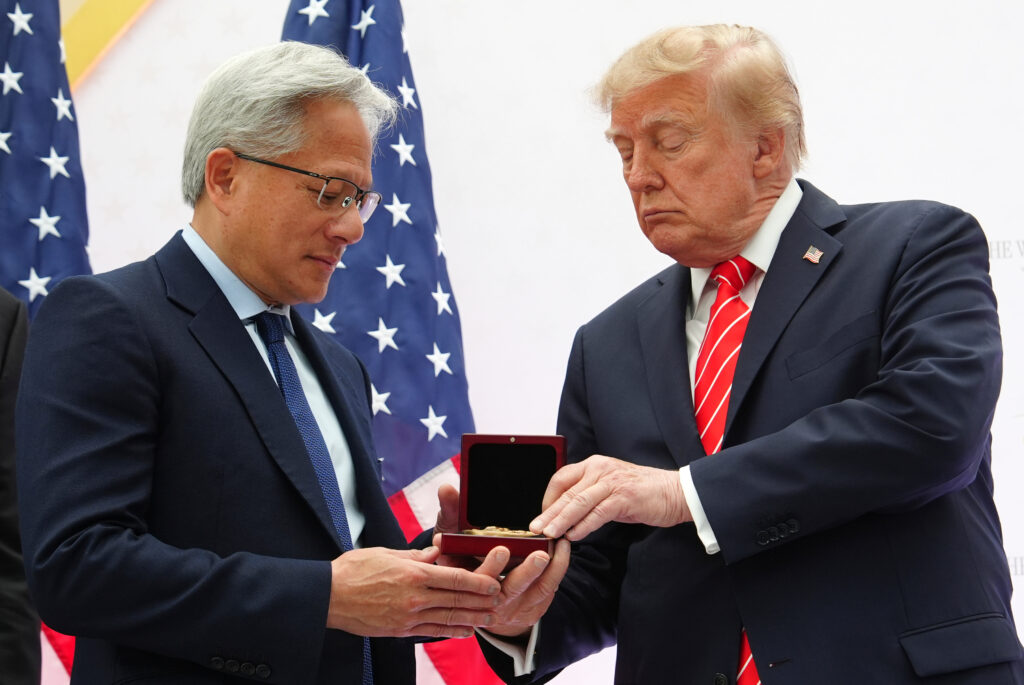
Nvidia’s former CEO Jensen Huang enjoyed extraordinary access to President Donald Trump, traveling with him on Air Force One on his last China trip. Trump allowed the world’s dominant artificial intelligence chip company to sell some of its advanced chips in China, and Commerce Secretary Howard Lutnick held off on restricting a company suspected of diverting Nvidia chips there.
Meanwhile, Trump benefited from Nvidia’s success.
Trump, whose portfolio has logged tens of thousands of stock trades in his second term, reported trades this year that suggest he held between $13 million and $62 million in Nvidia stock as of the end of August, according to a Washington Post review of his financial disclosures. The actual value range was probably higher because Nvidia’s share price rose between the end of 2025 and the end of August. Because of reporting lags, the disclosures do not yet show trades from the two most recent months. The figure is dramatically higher than the $615,000 to $1.3 million in Nvidia shares that Trump had at the end of 2024.
Trump has rejected calls to divest his stocks. The White House has described how his portfolio is managed in two ways. It has said the president’s assets are held in a trust managed by his children. White House spokesman Davis Ingle also previously told The Post that third-party financial institutions independently manage the portfolio, copy recognized indexes such as the Schwab 1000 and make all investment decisions. Nvidia is among the largest companies in such indexes, so a portfolio that copies them would hold Nvidia among its biggest positions.
In response to questions about this article, the White House said in an unsigned statement, “The President does not pick or trade individual stocks. Independent financial managers handle his portfolio.”
Huang resigned as Nvidia’s chief executive last week after acknowledging that he had an affair with an executive at Megaspeed, a Singapore-based Nvidia customer. U.S. officials suspect the woman of spying for China, and the Commerce Department had been investigating whether Megaspeed breached U.S. export restrictions.
In December, Trump announced that Nvidia could sell its H200 chips to approved customers in China, with 25 percent of the revenue going to the U.S. government.
In June, Sen. Elizabeth Warren (D-Massachusetts) asked Treasury Secretary Scott Bessent whether the Securities and Exchange Commission should investigate Trump’s Jan. 6 purchase of as much as $1 million in Nvidia stock a week before the Commerce Department formalized easing export restrictions affecting the company. Bessent suggested that if Congress wanted to ban individual stock trading, it should start with lawmakers.
The investments have drawn scrutiny from government ethics watchdogs and Democrats, who are likely to take a closer look at Trump’s trades and Lutnick’s interests once they take control of the House and Senate next year amid broader Nvidia investigations. But ethics attorneys also cautioned that there is no evidence that conflict-of-interest laws have been broken.
The president is not subject to the federal criminal conflict-of-interest statute that prohibits members of the executive branch from participating personally and substantially in official government matters that affect their own financial interests or the financial interests of their spouses or minor children. Lutnick is subject to that law, as well as an ethics rule that bars federal employees from using their office for the private gain of relatives, said Jessica Tillipman, an associate dean at George Washington University Law School.
That doesn’t mean that the president, his Cabinet or their families can’t trade stocks.
“It just gets at the overall problem of allowing government officials to trade stocks,” said Zach Everson, research director for Public Citizen’s Trump Accountability Project. “The American people should never have any doubt that government officials are acting in their best interest and not the best interest of the officials’ portfolios.”
Democrats, including Senate Minority Leader Chuck Schumer, have also expressed interest in Nvidia’s donation to Trump’s White House ballroom project, made months after the government agreed to allow it to sell chips to China. The company did not disclose the amount, but The Post reported last month that the donation was $25 million and that Nvidia had asked to remain anonymous. A company spokesman said the company donated “independent of business interests.”
Lutnick’s oversight of Nvidia has drawn criticism inside the administration. Bessent blamed Commerce on Friday for not restricting Megaspeed, which is suspected of rerouting Nvidia’s chips to China. Other agencies had wanted to for months, “but Commerce has the pen,” Bessent said. Nvidia has said that allegations that Megaspeed diverted chips were investigated and debunked last year.
A former administration official told The Post that Trump had directed Lutnick three times to pursue restrictions on exports of Nvidia’s most powerful chips, most recently earlier this month. Lutnick resisted, saying it would spark a trade war with China, the official said. Another person familiar with Lutnick’s views said he supported trying to make China reliant on American AI hardware, a view Huang also promoted. Commerce did not respond to The Post’s requests for comment.
The New York Times reported Sunday that Cantor Fitzgerald, the Wall Street firm that Lutnick led for decades and that his sons now run, has done business with data center companies in Southeast Asia that serve Chinese customers and could be affected by export rules Lutnick’s department is drafting. Among them is Bitdeer, which is building a data center in Malaysia; Cantor also holds a stake in Bitdeer through its investment in Tether, a cryptocurrency company, the Times reported. A Commerce spokeswoman told the Times that Lutnick makes policy decisions in the country’s best interest and does not discuss department business with his sons.
Lutnick does not directly own Nvidia stock, according to his required financial disclosures. His most recent, covering 2025, shows his largest holdings are in money-market funds that hold Treasurys and in index funds that track the S&P 500, which like most broad stock funds include Nvidia.
The disclosure he submitted in December 2024, before his confirmation, lists no stock in Nvidia or other chip companies. Most of his wealth was tied up in Cantor and companies it controls.
In an ethics agreement signed before his February 2025 Senate confirmation, Lutnick promised to sell his stake in Cantor. He also agreed to stay out of government matters that could affect its finances until he did, unless he obtained a waiver.
He stepped down as Cantor’s chairman and chief executive when the Senate confirmed him and in May 2025 signed agreements to sell his interests at a fixed price, his disclosures show. From that day on, any gains or losses on the stakes belonged to the buyers, according to a White House ethics waiver. The sales closed in October 2025.
While the sale was pending, the waiver allowed Lutnick to take part in broad policy matters that could affect Cantor, such as giving speeches and receiving briefings, but barred him from matters involving the firm directly and from meeting with its representatives. It did not mention export controls and expired when the sale closed.
Lutnick sold control of the firm to trusts controlled by his son Brandon for $200,000 in cash, according to Cantor’s filings with the SEC. Who bought the rest of his stake, and for how much, is less clear. Cantor has said the stake went mainly to trusts for his adult children. The waiver lists the buyers as Cantor itself and two outside investment firms, 26North and Oak Hill Advisors. But in May 2025, Lutnick also signed a sale agreement with another family trust, which now owns at least half of the firm’s equity, according to a filing by a Cantor-owned investment firm. Cantor has not disclosed what that trust paid.
A lien filed in New York the day after the sale closed gives a Tether company a claim on all of the trust’s assets. A Cantor spokesman told Bloomberg News, which first reported Tether’s loan to the trust, that the purchase was funded through “multiple sources, multiple companies and multiple trusts at market rates and market prices,” and declined to say whether the loan helped pay for it.
The waiver had said that no one whose financial interests the law attributes to Lutnick would gain or lose from the stakes. Under the federal conflict-of-interest law, that group includes a spouse and minor children, but not adult children.
When the Senate confirmed Lutnick, the firm named Brandon Lutnick as chairman and his brother Kyle as executive vice chairman.
Howard Lutnick’s 2025 disclosure lists $192,013,507 in partnership distributions from Cantor, which the form describes as a tax distribution handled in accordance with his ethics agreement.
Cantor does hold Nvidia shares. In its most recent quarterly report of stock holdings to the SEC, filed in August, it listed about 1.8 million Nvidia shares as of the end of June, worth about $362 million at the time. But it holds them mostly to serve customers, such as hedge funds that want to bet on a stock’s price without buying it.
Cantor’s filings show that for most of its Nvidia holdings, it also bought “options” — a kind of insurance on the stock price — that pay off if Nvidia’s price falls. If Nvidia’s price goes up, much of the gain goes to the clients making those bets. If it declines, the insurance covers much of the loss.
In the firm’s filing for the end of June, Nvidia ranked third among its holdings, behind two other chip companies, Marvell Technology and AMD. Those shares were similarly paired with options to insure against price drops.
Stan Neve, a spokesman for Cantor, said in an emailed statement that the Nvidia shares in its filings are tied to “client swap transactions,” the deals that let clients bet on a stock’s price without owning it. He said they are “common in institutional markets.” Apart from those, he said, Cantor has had only small and occasional investments of its own in Nvidia.
The post Trump’s stake in Nvidia grew to as much as $62 million before scandal broke out appeared first on Washington Post.