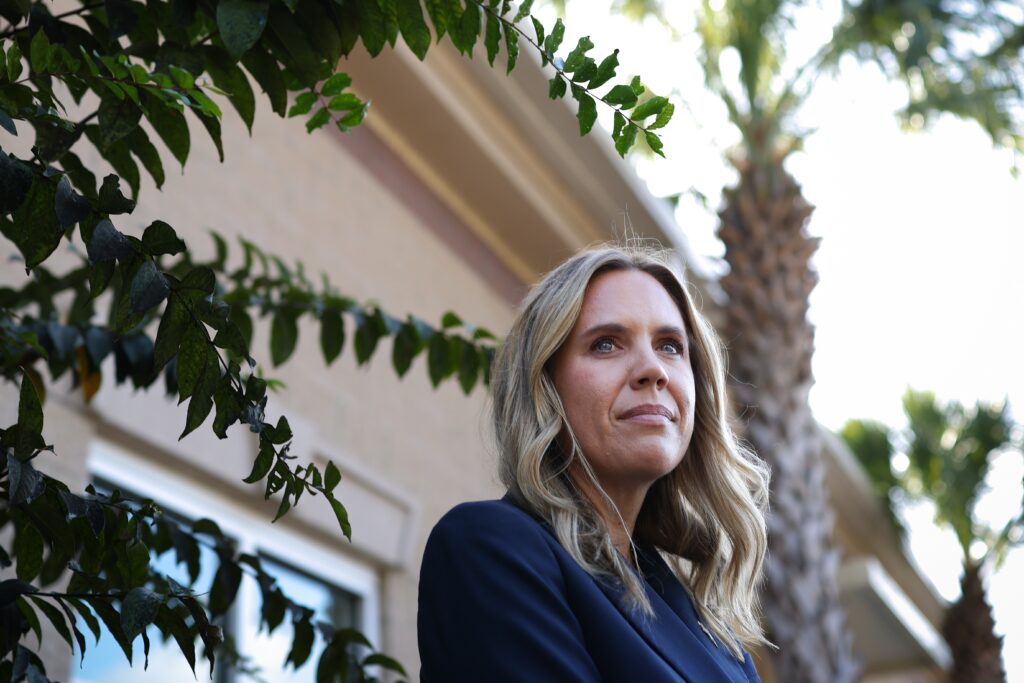
When then-Senate candidate Annie Andrews arrived at her local precinct to vote with her family last month, she wasn’t the only one to get recognized.
“Oh, it’s ‘Republican dad!’” one voter yelled in surprise, Andrews recalled.
That was a reference to Andrews’s father, a retired executive, who appeared in an ad in which he said he had voted for Republican Sen. Lindsey Graham in the past and vouched for his daughter as “not some crazy socialist.”
Andrews’s extensive and carefully plotted outreach to Republicans is key to how she defied political predictions and became the first Democrat to win a Senate seat in South Carolina since 1998.
Even for an election that was shockingly good for Democrats, Andrews’s performance stood out: one in 10 voters who backed Donald Trump in 2024 voted for her, according to exit polls, and she ran ahead of all seven Democrats seeking House seats — all while receiving the least investment from the Senate Democrats’ super PAC of any competitive Senate candidate.
It’s a surprising arc for a pediatrician-turned-activist who started her career in politics by advocating for gun control. She built a grassroots following by challenging Rep. Nancy Mace (R-South Carolina) in 2022, and expanded it by ripping Republicans apart in a series of satirical videos and tweets after her loss. For many of her early followers, her biting satire embodied the frustrations of liberal women in red states.
“We only wear our cardigans and crosses on TV,” she jokes in one sketch called “We’re Republican Women Politicians” that skewers GOP positions on gun control and abortion.
In another, she spoofs Republican Sen. Katie Boyd Britt’s 2024 State of the Union response, which she delivered from her kitchen. “I think it’s going to be distracting if I’m baking a cake while I deliver the speech” she says, impersonating Britt.
In August 2024, when some conservative commentators were mocking Minnesota Democratic Gov. Tim Walz’s 17-year-old son, she posted that any party doing that should be “thrown in the dumpster.” And lit on fire.
“I was not a candidate when I made those videos,” Andrews, 46, said in a phone interview. “I was a frustrated South Carolinian who wanted my voice to be heard.”
When she launched her Senate campaign, Andrews kept her focus on the issue voters were screaming that they cared the most about: the economy and prices, while vowing to govern from the center if elected.
After Lindsey Graham died in July, Andrews’s campaign benefited from the bitter Republican primary that followed. Andrews later cast Darline Graham, who won her primary with Trump’s help, as beholden to the unpopular president.
“I owe no one in Washington anything,” Andrews said at her victory party, as some of her supporters wept in surprise. “I owe South Carolina everything. And that’s exactly who I’m going to answer to.”
‘A baseball bat to the head’
Andrews, a single mom of three, got involved in politics as a volunteer for the gun control group Moms Demand Action, because she was horrified by the 2018 Parkland school shooting in Florida.
“My mama bear instincts kicked in, and I decided to use my voice to fight for change in South Carolina,” she told the Contrarian in August.
In 2022, Andrews ran for Congress in her home district, but lost by roughly 14 percentage points to Mace in a race that devolved into ugliness, with Mace accusing Andrews of wanting “sex-change surgery on minor kids.” (Andrews had supported hormone treatments for transgender children, but not surgeries, she said at the time.)
Andrews said she took unpaid leave from the Charleston children’s hospital where she worked during the campaign, citing safety concerns after Mace’s attacks. The hospital did not offer her job back after the election, she said later.
“Some people have different encounters in their first political race. She got a baseball bat to the head,” said Tyler Jones, a Democratic strategist who advised her on the race.
Andrews then started Their Future PAC, a political action committee focused on issues affecting children, and began posting satirical videos and clapbacks aimed at Republicans online.
When Andrews first talked to AJ Lenar, a Democratic consultant who later created her ads, about wanting to run for Senate again, he reminded her how grueling the 2022 race was.
“They’re going to say you’re a terrible doctor,” he said. “It’s going to be trans, trans, trans because that’s what they do. … You got three kids. It can get ugly.”
Lenar remembers her responding, “I get all that, but honestly, I got pretty thick skin.”
Andrews said her main concerns were the ages of her young children (now 14, 12 and 10) and the logistics of launching an all-consuming run. “It’s fine if my feelings get hurt,” she said. “I’m not afraid of a fight.”
The race was nowhere on national Democrats’ radar, after Jaime Harrison, who later chaired the Democratic National Committee, lost to Graham in 2020 by 10.3 percentage points, despite raising more than $100 million. No one recruited Andrews, but she said she felt Graham should not get a free ticket back to D.C.
“This was all Annie, and she may have been the only one who thought she could do this at the beginning,” Jones said.
‘You gotta go with the times’
Andrews started her campaign by traveling across the state and talking about prices and the economy, putting struggling South Carolinians at the center of her campaign.
She talked to shrimpers who told her they waited for the tide to carry out their boats to save on diesel, and farmers who feared they would lose their livelihoods altogether.
The campaign did little to scrub Andrews’s old social posts, said Bre Spaulding, Andrews’s first campaign manager, but the team agreed that her message and tone in a statewide campaign would be substantially different from her past online persona. The mood of the country had also changed, as Trump’s tariffs — and later, war with Iran — raised prices and suggested an opening for Democrats.
“You gotta go with the times,” Spaulding said of Andrews’s change in approach. Andrews spent nearly every Sunday in black churches, and activated her grassroots network from her past race and online advocacy days to raise millions of dollars, even as she received little support or attention from Washington.
In July, Graham died and Trump backed his sister, a political neophyte, to replace him permanently. That alienated Rep. Ralph Norman (R-South Carolina), who ran against her in a contentious primary.
While the GOP nomination was still unsettled that summer, Lenar filmed several TV spots: One showed Andrews putting on her white doctor coat and vowing to go after health insurance companies and lower costs. Another featured Andrews talking about the pain she sees on parents’ faces when they get an unexpected high medical bill. And a third spot, the campaign called its’ “break glass negative” ad to have in reserve for when the Republicans began attacking her on transgender issues.
After the Aug. 25 runoff, Andrews’s campaign went on TV with “White Coat,” taking advantage of a lull in Republican advertising to define their candidate early on — even though they risked running out of money in the final few weeks of the campaign.
“We didn’t know that we had the money to go all the way,” said Brexton Isaacs, who took over managing her campaign that summer.
For about five weeks, Andrews had the TV airwaves largely to herself. A person close to Graham’s campaign, who spoke on the condition of anonymity to disclose private discussions, said the runoff had drained its resources and described the stretch as “five weeks of clear air” for Andrews. The ads burned a positive image of Andrews into voters’ minds, her campaign hoped.
“By the second ad, people were like, ‘If I see this woman’s stethoscope again, I’m going to sell my television,’” Lenar said.
The campaign aimed their ad and endorsement strategy at peeling off independents and Republicans.
Lenar suggested putting Andrews’s Republican, Fox News-watching father on TV. Andrews thought he might decline because he, like Andrews, is an introvert. But he said yes, and even got excited about the idea of being on TV, she said. Lenar gave him some bourbon to loosen him up as the shoot began.
“Look, Annie’s not some crazy socialist,” he said in the ad, which appeared heavily during Clemson and South Carolina football games and in the final week of the campaign.
In late September, Andrews traveled to Isle of Palms to visit Ralph Norman’s son, Warren Norman, who was at the family’s beach house. Norman had been turned off by the toxic tone of the Republican primary, and was open to hearing Andrews’s pitch. Over coffee on his front porch, he asked her about transgender athletes in girls’ sports and gun policy. He recalled that she continued to support stronger background checks.
“I remember asking her if she felt like the Democratic Party had gone sort of too far to the crazy left, and she said yes,” Norman said.
Andrews asked him for his endorsement, and Norman said he needed time to think about it. “I’m not saying I can’t get fooled, but she certainly struck me as a very, very genuine person,” he said.
Andrews recalls Norman telling her, “If you get the job, you know we’re going to hold you accountable.”
Less than a month later, Norman wrote an op-ed saying he was leaning toward voting for her, prompting fierce pushback from some South Carolina Republicans. Andrews was also close to scoring another big Republican endorsement: former governor David Beasley, whom Andrews had asked her friend, former governor Jim Hodges, to reach out to. Hodges, a Democrat, said it took “about 10 minutes” to persuade Beasley.
“This country is too divided, and the political rhetoric has gotten way, way out of hand,” Beasley said in “Together,” the joint endorsement ad released Oct. 26.
Break glass negative
Republicans began attacking Andrews on transgender issues on air in October. The ads also warned that a vote for Andrews was also a vote for “higher taxes, woke policies, open borders” and highlighted her “social media filled with support for shockingly liberal” causes.
On Oct 5, Trump called her “Annie Trannie,” using a slur for transgender people, which led to a boost in her small-dollar fundraising as outraged progressives took notice.
A few days later, Andrews released the direct-to-camera ad she had held in reserve. She said she did not support and had never performed gender surgery for minors and said she opposed “biological men playing women’s sports.” The ad drew criticism from some in the LGBTQ community she had advocated for so fiercely a few years earlier. (“If you don’t support trans people, keep your cute pride post in your draft tweets, be better, and try again next year,” Andrews posted in 2023.)
Graham’s campaign lacked the time or resources to fully rehash Andrews’s social media history, however, the person close to her campaign said. The campaign had wanted to showcase Andrews’s video mocking Republican women politicians, hoping it could eat into her crossover support. But Andrews’s disciplined campaigning also made it difficult to paint her as a radical. “She ran an incredible campaign,” the person said of Andrews.
In early October, the Andrews campaign got an internal poll showing Andrews up three percentage points on Graham.
“Okay, everybody, no one say a freaking word,” Lenar recalled Isaacs saying at the time.
The campaign was raising the money it needed and saw little upside in inviting outside Republican spending in to shore up Graham, Isaacs said.
Trump flew in two more times to boost Graham in late October. “Pretend I’m on the ballot,” Trump told Republicans at an Oct 21 rally in Pendleton.
In the end, Andrews won by 4.5 percentage points.
From target to coworker
As she arrived in the Capitol last week for her freshman orientation, Andrews’s old videos began going viral as her progressive fans celebrated. But, in an interview, Andrews said she remains committed to her pledge to govern from the center and working in a bipartisan way. She chatted briefly with South Carolina Sen. Tim Scott, who led the Senate Republicans’ campaign arm during the elections, about her desire to reverse cuts to Medicaid. She also met with Graham, posting a tribute to her service.
And Andrews has already made friends with at least one of the targets of her former social media skewering.
“I made some videos about Katie Britt, and I met her,” she said. “And we had a lovely chat, and we exchanged numbers, and she offered to help shepherd me through this overwhelming process of getting acclimated to the U.S. Senate.”
Britt was aware of Andrews’s posts, according to a person familiar with her thinking, including one in which Andrews wrote about her: ‘Wow they let you out of the kitchen. Congrats.’
But Britt said in a statement that she wants “to welcome everyone with the dignity this office deserves.”
The incoming freshman senators — Republican and Democrat — all mingled at a dinner at orientation together.
“It was a nice reminder that we are all human beings,” Andrews said. “We can find areas of common ground, and that’s what I’m hoping to do over the next six years.”
The post How Annie Andrews went from liberal gun control activist to unlikely red-state senator appeared first on Washington Post.