They had no leader, no political party and no conventional campaign. They made decisions by raising their hands after hours of debate in university classrooms, a slow and cumbersome process billed as a unique experiment in direct democracy.
That free-form approach to politics of Serbia’s students proved so effective that, in a general election on Oct. 25, they achieved what established opposition parties had failed to accomplish for more than a decade: routing the well-oiled political machine of Serbia’s strongman leader, Aleksandar Vucic.
Mr. Vucic, nearing the end of his second term as president and barred from running again, had resigned as president a month before the October vote for a new Parliament, gambling that his governing party would win and that he could keep his grip on power by becoming prime minister. He had held that post twice before.
His plan was upended by the election victory of a slate of parliamentary candidates selected by students in freewheeling campus meetings. Their selections and electoral successes marked the culmination of a striking exercise in collective decision making. That approach, some believe, could hold lessons for democratic movements beyond Serbia.
But the principles that carried the students to victory may not, on their own, be enough to build a functioning, coherent and durable government.
The diverse list of candidates chosen by the students, nearly all political novices with a wide range of sometimes contradictory views, reflected a belief that everyone should have a say in a leaderless movement united by the single objective of getting rid of Mr. Vucic and the system he created.
Yet the group decision-making process, which the students called “plenums,” was often opaque and presented a fundamental problem, said Vladimir Vuletic, a sociologist.
“It is a combination of Communist-style decision making through plenums and democratic decision making through elected members of Parliament,” he said. “Reconciling these two approaches will be an organizational challenge.”
“Ideological and organizational differences will inevitably lead to divisions within the movement and probably to new elections within a year,” he added.
Students acknowledge that Serbia’s yet-to-be-formed new government cannot be run along the same lines as the student assemblies.
“The future Parliament and government will not operate according to the principles of student plenums and direct democracy, but according to constitutional principles and the program we developed together with our candidates and other experts,” said Natalija Petrovic, 22, a communications and public relations student.
Before the election, the student plenums spent hours debating even minor proposals. The government may not have that luxury and will need to approve budgets, appoint ministers, negotiate international agreements and respond to crises in a timely way.
Even stickier perhaps is that the students, who chose not to put themselves forward as candidates, still hope to maintain oversight over the people they selected for the winning slate, called Student List-Students Win.
They insist they have no plans to reproduce their plenum assemblies inside government ministries, but they want to supervise legislators as an independent force outside Parliament, demanding transparency and accountability.
There has been no word yet on who will become prime minister to lead the new government, which will take shape once the newly elected Parliament convenes. No date has been set for that, but it must happen within three months of the release of the final official results on Nov. 5.
Those results gave the Student List a hefty majority with 140 seats in Serbia’s 250-member legislature, compared with just 103 for Mr. Vucic’s Serbian Progressive Party.
Student List candidates have committed to a 1,000-page governing program developed with the involvement of thousands of experts, professors and students. The program is long on commitments to abstract principles like accountability, and short on concrete plans. It largely avoids divisive issues, particularly in foreign policy.
Students, though, have made clear their desire to end Mr. Vucic’s close cooperation with Israel on defense and other matters. Their program promised not “to be complicit in the systematic attempt to destroy the Palestinian people by Israel in the Gaza Strip.”
The student movement began in November 2024 after the collapse of a concrete canopy at a newly renovated railway station in Serbia’s second biggest city, Novi Sad. The disaster killed 16 people and became a symbol of what students, who immediately took to the streets, see as Serbia’s systemic corruption under Mr. Vucic.
Nikola Maletic, 21, a political science student, was only yards away when the canopy fell.
The protest movement’s lack of a leader, he said, was initially a tactic to stay off the radar of security forces but later became a matter of principle.
“People realized that we must never again allow one man to run the country,” he said.
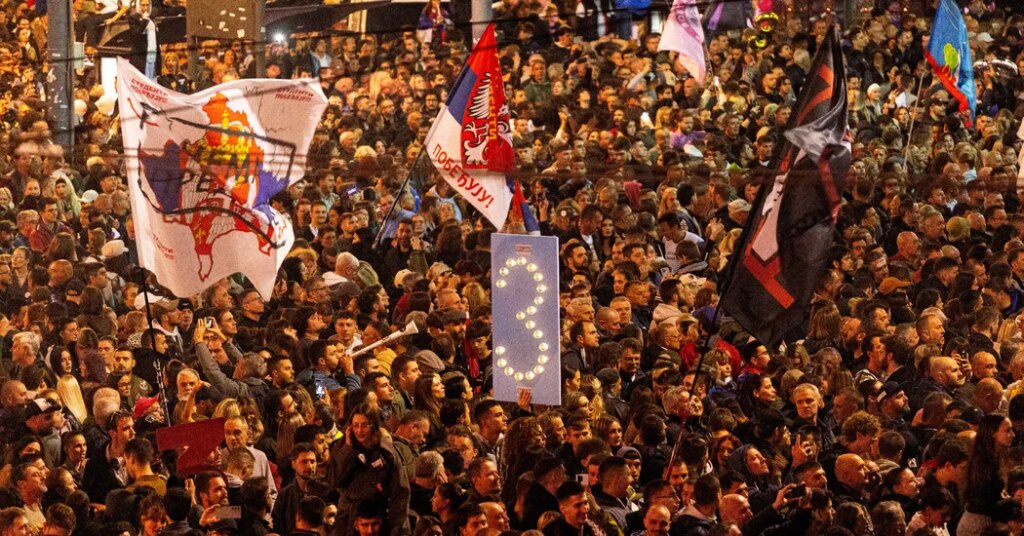
Demanding the arrest and trial of construction contractors and officials accused of approving shoddy work, the students occupied university buildings and staged street protests, some of which drew hundreds of thousands of people, for nearly two years. They began holding plenums to decide how to push forward demands for accountability.
The movement struck a chord with many people outside university campuses, who were also fed up with corruption. It reached beyond big cities like Belgrade, the capital, long hostile to Mr. Vucic, to penetrate places that had long supported his governing party.
The students walked and cycled hundreds of miles across Serbia, visiting small towns and remote villages where opposition politicians had rarely won support. They sat with farmers, spoke with parents and pensioners, and listened to people who had lost faith in politics.
Such encounters helped build a national movement.
While Mr. Vucic dominated reports by the national broadcasters, the students relied on social media and an unconventional decision-making system.
Radomir Saicic, a chemistry professor and candidate on the Student List, described the plenums as a form of “horizontal democracy.”
The process was slow and demanding, but was also meant to be deliberately diffuse.
“The idea behind a leaderless movement was that an authoritarian regime could not target and discredit a single individual and, in doing so, undermine the entire movement,” recalled Ms. Petrovic, the communications student.
The plenums to select candidates for the election were held in secret, with phones left outside and would-be contenders assigned changing code names to prevent leaks.
Students nominated and questioned the candidates, checked their backgrounds and put them up to a vote. The candidates were then reviewed by university departments across Serbia, with support of more than half of them needed to make the final list.
Each candidate was asked to sign “social contracts” committing to the movement’s principles and objectives.
The result is that even though the Student List was made up of people with different views, they all agreed on the government’s central purpose, Ms. Petrovic said.
“Our government’s main goal is to wrest the state from the grip of the mafia and create mechanisms of accountability and transparency that will make corruption as difficult as possible for any future government,” she said.
How the relationship between students and the winning candidates they selected will now evolve is still unclear. Difficult questions remain about what will happen when elected representatives disagree with the movement that brought them to power.
“The ruling phase would require that M.P.s or ministries gain real authority, freed from students’ control,” Dusan Spasojevic, a political science professor at the University of Belgrade, wrote in a study of the movement.
But students are wary of giving legislators a free hand, fearing this could create a new power center beyond their control, much like Serbia’s established political parties.
“The only real victory will be a lasting change in the political culture and the way the country is governed,” said Mr. Maletic, the student who narrowly avoided being crushed at the railway station in Novi Sad. “Anything else would simply mean a new government behaving like the old one.”
Andrew Higgins contributed reporting.
The post They Defeated a Strongman. But Can They Run a Country? appeared first on New York Times.