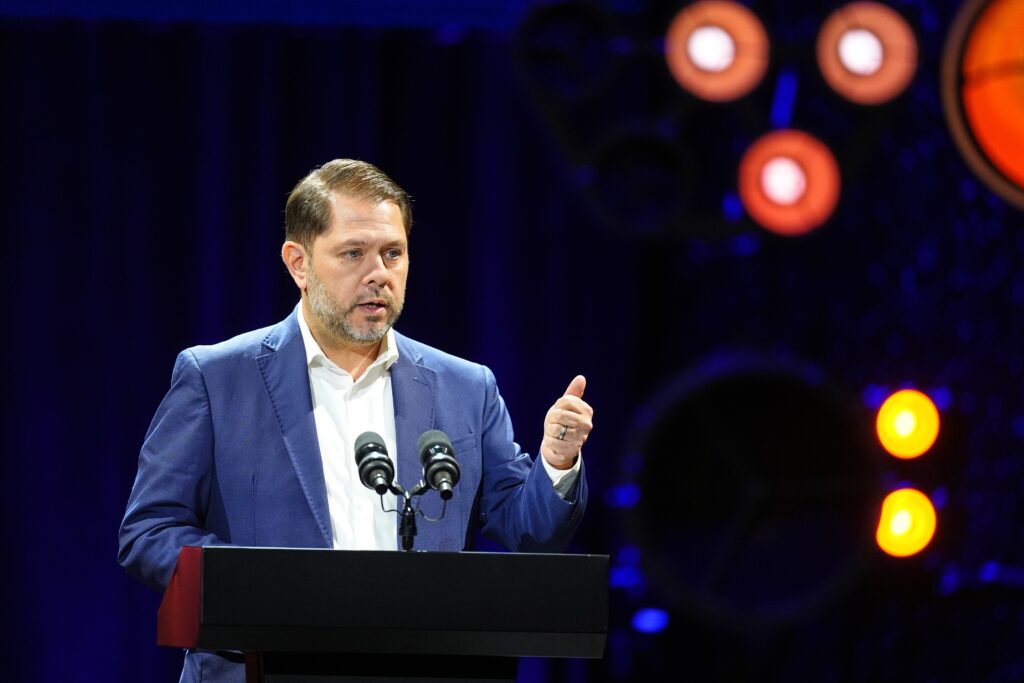
DENVER — Aspiring 2028 presidential contenders, donors, strategists and nearly every flavor of Democratic insider convened at the “What’s Next” conference here this week to celebrate the wave election.
But they spent much of their time scolding one another to make sure they don’t squander their newfound power.
Again and again, speakers warned party insiders that winning majorities in 2026 was only a political opening, not an ideological realignment or a mandate from American voters.
“We’re on probation,” Rep. Jason Crow (D-Colorado), who led candidate recruitment for Democrats, said in an interview.
Voters didn’t write Democrats “a blank check,” Sen. Ruben Gallego (D-Arizona), who is considering a 2028 presidential bid, told the crowd.
“Nobody owes the Democratic Party,” said Don Scott (D), speaker of the Virginia House of Delegates, who likened the party’s opportunity to the second chance he got after he left prison after serving seven years for a felony drug conviction.
The confab of Democratic Party insiders here, hosted by the centrist organization Majority Democrats, showcased the next generation of Democratic talent and the pervasive worry that their big-tent party — perpetually ensnared by ideological warfare — could mess up the gains they won.
Yet even as many speakers urged unity, the party’s intractable tensions over generational change and ideology surfaced at the conference.
Sen. Chris Van Hollen (D-Maryland), 67, used the gathering to build his case for challenging Sen. Chuck Schumer (D-New York), 75, to become the next Senate majority leader, declaring in a speech that the election showed that Democrats need to turn a page on the past.
A few blocks from the venue, three women protested Schumer, with one holding a “Chuck Chuck” sign.
And House Minority Leader Hakeem Jeffries (D-New York), the only contender in the chamber for majority leader next year, was heckled by a small but loud group of people demanding a Green New Deal and universal health care.
“Do you care about us? Do you care about the young people!” yelled one of the protesters.
Politicians looking at presidential bids tried to harness voters’ insurgent anger while insisting they could provide a new — if not quite defined — path. Many of the most prominent voices called for change, though it wasn’t always clear what their presidential pitches might offer instead.
“We need to understand that the same disgust with the status quo that got Democrats elected this year is the disgust with the status quo that got Republicans elected the last time,” said Pete Buttigieg, the former transportation secretary who is also weighing a 2028 bid.
Buttigieg argued that the party needed to build something new, not try to return to an era before President Donald Trump’s presidencies and Republican leadership in D.C.
“This is not about finding the pieces and the shards of everything that they smashed, taping them back together to look something like what we had in 2022 or 2012 or 1992, or whenever Democrats think America was great, and offering that up to the American people,” Buttigieg said.
Pennsylvania Gov. Josh Shapiro (D), who is likewise considering running for president in 2028, warned that voters who gave the party a chance this year want action and none of the intraparty arguments over progressive and moderate lanes.
“Not one of them gives a damn about political litmus tests or where we fall on some imaginary political spectrum,” he said.
Sen. Elissa Slotkin (D-Michigan), who said she is still deciding whether to run for president, said any of the Democrats trying to pull the party in one ideological direction missed the point that voters are fed up and need economic relief.
“When I see elected officials spending their time fighting the progressive-versus-moderate battle, I know that that person didn’t actually learn a damn thing from the election,” Slotkin said.
Other battles also loom about how to best deal with Trump.
Sen.-elect James Talarico, who delivered a longtime Democratic dream of flipping Texas, told the crowd that voters wanted compromise, saying the new Congress “should make his presidency the most productive of any presidency in American history.”
New Jersey Gov. Mikie Sherrill (D) took a less accommodating approach: “If Trump wants to work with us, we can lay out the agenda and he can sign it.”
Amid the enthusiasm about what policies Democrats could enact — campaign finance reform, affordable health care, bigger child tax credits among the hot topics — was an introspective critique of what Democrats need to abandon.
“American voters are tired of big policy papers and things that they don’t think are ever going to happen,” said Democratic National Committee Vice Chair Jane Kleeb.
Majority Democrats is both an association of centrist Democrats in public office and a super PAC that recruited and financed candidates across the country.
The group is funded primarily by billionaires Steve and Sue Mandel, who own hedge funds and have invested heavily in trying to reshape Democratic politics. The group put on the free three-day event in Denver that drew thousands and featured speakers from across much of the left’s ideological spectrum, including more than a half-dozen potential presidential contenders seeking to pitch their vision forward.
Rep. Jake Auchincloss (D-Massachusetts), the chairman of Majority Democrats, opened the second day of the event with a somber admonition that the party needed to stop offering unworkable or extreme ideas.
“We take responsibility for earning back trust of the American people, and that starts with telling the truth,” he said. “For too long, our party has given permission to too many bad ideas.”
He continued, “My challenge to everyone running in 2028, which might also be every person in this room, is tell us which ideas you’ll stop giving permission to — the ones that defy common sense or don’t work.”
Part of the Democratic wave — particularly in rural and red-leaning areas that flipped blue — were bolstered by candidates who won by promising voters they would upend how politics work in Washington.
“There was a validation of lots of candidates,” Dan Pfeiffer, a former Obama adviser who hosts the left-leaning “Pod Save America” podcast, said in an interview. “But not of the Democratic Party or Democratic Party establishment.”
At the start of the convention, which spilled into happy hours and late-night bars across Denver, Charlotte Swasey, director of analytics at the centrist Searchlight Institute, laid out research showing that voters elected Democrats even when they didn’t like them or agree with them.
“The voters do not trust us,” she said. “… And they are generally really worried about what we’re going to do with this power.”
The post Fresh off victory, Democrats gather with a warning: Don’t mess this up appeared first on Washington Post.