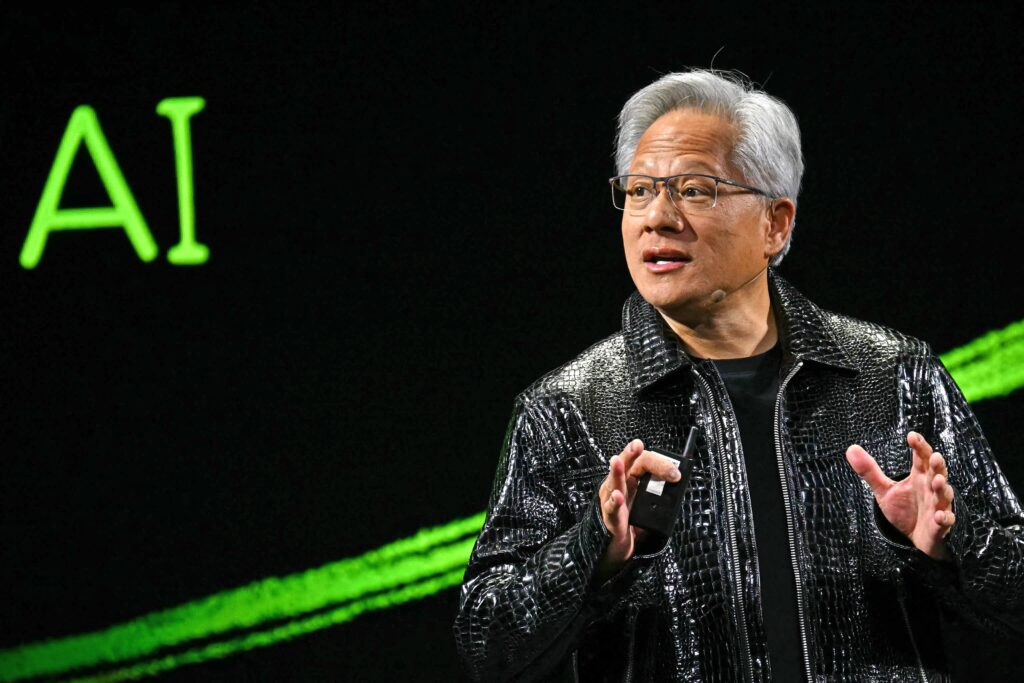
To those of us who do not travel in executive circles, being on a corporate board seems like a pretty cushy gig. While some board members provide active oversight, others can often collect six-figure compensation for showing up at meetings a few times a year to check how things are getting along without them. Seems nearly ideal, doesn’t it?
But occasionally, circumstances force boards to earn their money and then some, as happened when news reports revealed that Nvidia chief executive and co-founder Jensen Huang was in a relationship with a woman suspected of being a Chinese spy. On Thursday, Nvidia announced that Huang was resigning.
Perhaps this is too conspiratorial, but since news of the relationship broke, I wondered if this might explain some of Huang’s recent actions, which I’d previously found inexplicable, such as his over-the-top denunciation of chip-export controls. Yes, Huang had an obvious interest in expanding the market for his chips. But when he went on podcasts and panels, he seemed unable to muster a convincing argument. As his interlocutors pressed, he came off as defensive and arrogant rather than persuasive. I couldn’t understand why he kept sitting down for these interviews if he wasn’t prepared to answer obvious questions.
I wondered something similar about his opposition to letting frontier labs coordinate a safety slowdown. Huang, of all people, should know why it makes no sense to respond to legitimate concerns by saying, “In that case, they shouldn’t release the product.” (The primary agents in the Hugging Face attack weren’t released; they were internal models that broke out of their testing environment.)
In hindsight, his blasé attitude toward California’s recently defeated billionaire wealth tax ballot measure also looks suspicious. Sure, maybe he’s just an altruistic guy. But a tax that would threaten founders’ control of their companies, reduce returns on entrepreneurship and erode the concentration of capital in Silicon Valley sure seems like something the Chinese Communist Party would support.
Then, there’s the mystery of whether Huang shared sensitive information with Alice Huang or enabled her to divert export-controlled chips to China. Investigations are ongoing, but what has emerged so far is concerning.
Given the worries that he could have been compromised by China, it might seem obvious that Huang had to go. The problem is, CEOs like Huang are very hard to replace.
Since executive pay began climbing in the 1980s, there’s been a fierce debate over what’s driving the increase. The left is apt to think CEOs are unjustly enriching themselves with the aid of pliant boards. Twenty years ago I found this argument plausible, until a colleague pointed out that private equity investors were also paying top dollar for chief executives, even though the money came out of their own returns.
Although economists continue to debate the issue, the evidence tends to suggest that good CEOs do improve corporate performance, though we can quarrel over how much. This may be especially true of founder CEOs, whose companies tend to outperform the market.
There are all sorts of complications, of course, since not all founders are created equal. Someone may be an ace early-stage founder but struggle to lead a massive public company, and that person may exit earlier than a CEO with a broader skill set. Founders might also be more likely than successor CEOs to linger past their prime, at which point the founder effect reverses. When young founders die suddenly, the stock price drops. When elderly founders pass on, it actually rises.
Reports of Huang’s affair, as well as allegations of a second extramarital relationship, might signal he was entering the decadent, destructive phase of his tenure. But from an operational and financial perspective, it’s hard to argue that he was already there. The company Huang co-founded in a Denny’s now dominates the market for advanced artificial intelligence chips, and it has been minting money for its investors. You can argue that’s an accident of history: Nvidia’s market capitalization has grown enormously since the AI boom serendipitously made the company’s products transformative. But the fact remains that Huang’s brainchild made the best graphics chips in the world, and he scaled its operations to meet unexpected and unprecedented demand.
The board has to wonder if any other CEO could match that performance — especially since, like many founders, Huang had optimized the company to revolve around him. He apparently has about 60 people reporting directly to him, and there’s no sign that he has groomed a successor. Ripping him out of the driver’s seat could be like trying to replace your car’s battery while piloting it down the road at a spirited 70 miles an hour.
This isn’t just a problem for Nvidia’s board — it’s a problem for the rest of us. It turns out the most important product in the world right now, the key to American technology leadership, depends on one guy who is a genius at managing chip design and a complete idiot about managing his personal life. It would be more comforting to believe that no CEO can really be all that important. Alas, founders do seem to make a difference — and we are about to find out just how much this one matters.
The post Don’t assume Nvidia will rebound appeared first on Washington Post.