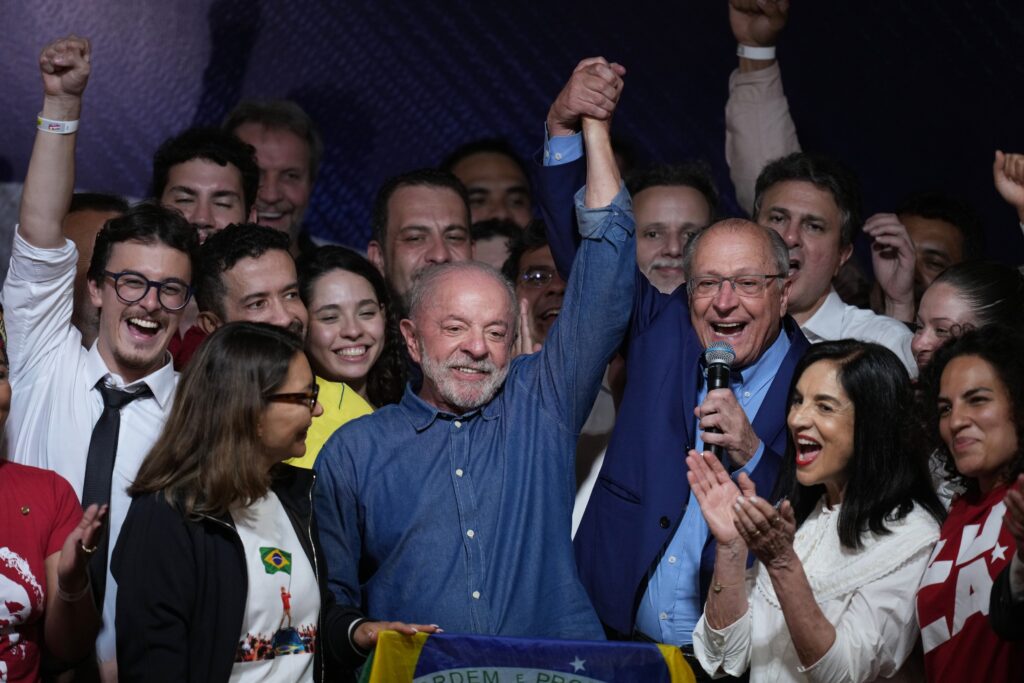
BRASÍLIA — In the moments after the leftist Brazilian President Luiz Inácio Lula da Silva defeated right-wing candidate Flávio Bolsonaro to win reelection last month, an ominous audio message began to spread across social media.
A man, identified by police as a municipal employee in conservative Mato Grosso do Sul state, spoke of attacking a nearby Indigenous community.
“I already said we have to put poison in the water, kill those pests in the water,” he says in a recording posted to an election night group chat. Another municipal employee responded approvingly, calling Indigenous people “devils” and “demons.”
The target was Sassoró, home to about 3,000 Guarani Kaiowá people who have traditionally backed Lula, community chief Ivan Montiel said.
Across Brazil, reports of violence against Indigenous people have grown since the Oct. 25 vote. While Indigenous voters make up just 0.18 percent of the Brazilian electorate, not enough to have decided an election Lula won by more than 4 million votes, authorities say some communities have been targeted for their perceived support of the president and his Workers’ Party.
The Ministry of Human Rights received 189 reports of violence in the first five days after the vote; the Ministry of Indigenous Peoples received 13 complaints. (Not all the reports have been independently verified, and not all have been confirmed to have been politically motivated.)
Brazilian authorities and Indigenous leaders say such incidents are the modern manifestation of a larger and older problem: Communities that for generations have suffered discrimination and encroachment are now being targeted for their political preferences.
“The violence against Indigenous people did not begin with this election,” said Eloy Terena, the lawyer and anthropologist who heads Brazil’s Ministry of Indigenous Peoples. “But Flávio Bolsonaro’s defeat seems to have added a new political dimension to it, as if Indigenous people did not even have the right to vote for whomever they wanted.”
Jair Bolsonaro, Flávio’s father, has repeatedly described Indigenous reserves as an obstacle to ranching, mining and other economic activity. As a congressman in 1998, he said it was “a shame that the Brazilian cavalry hasn’t been as efficient as the Americans, who exterminated the Indians.” As president, he said he would not approve “one more centimeter” of land for protection.
Bolsonaro, in prison for attempting a military coup to stay in power after losing the 2022 election to Lula, anointed Flávio to run for president this year in his stead.
Lula, since returning to office in 2023, has reversed many of his predecessor’s policies. He created Brazil’s first Ministry of Indigenous Peoples and restarted the process of demarcating Indigenous lands — moves that helped prompt a broad mobilization of Indigenous communities to support his reelection.
The threats after his victory were not confined to Mato Grosso do Sul. In Avaí, a small town in São Paulo state, a retired municipal employee recorded a message targeting the roughly 700 residents of the Araribá Indigenous Territory.
“Let’s see what our municipality is doing to provide food baskets to these Indigenous sons of bitches,” Dirceu Pereira de Carvalho says. He describes the local police force as “small and anti-Lula” and says “we need to start there.”
“We’re not going to go easy on them,” he says. “We know who supported the Workers’ Party here. We won’t forgive them. If they did something wrong, we’ll go after them.”
Reached by The Washington Post, Carvalho acknowledged making the recording but said he regretted his remarks. “It was an unfortunate thing to say, and I apologize,” he said. “I have no intention of harming Indigenous people, and I understand why they have a reason to vote for Lula. His party helps them and provides social programs for them.”
Indigenous communities have long been subjected to violence and insecurity as they have tried to defend their territories against encroachment by miners, ranchers and agribusiness interests. In Mato Grosso do Sul, the independent Indigenous Missionary Council recorded 37 Indigenous killings in 2025 alone.
But the election has given the hostility a new outlet, officials say. “What we are seeing now is that people are using the election as another excuse to express their prejudice and hatred toward Indigenous people,” said lawmaker Sonia Guajajara, Lula’s first minister of Indigenous peoples.
“Brazil is a democracy, and freedom of choice belongs to everyone, including Indigenous communities,” said Montiel, the Guarani Kaiowá chief.
“We know that retaliation against Indigenous peoples dates back to the invasion of Brazil, but it has intensified and taken on new forms,” said Chicão Terena, a chief in the Araribá Indigenous Territory. “Politicians tend to serve the interests of large businesses and landowners. And when Indigenous people begin to organize themselves in society, it creates this backlash of persecution.”
Lula has ordered a delegation to travel to Mato Grosso do Sul and report back to him.
Federal police have interviewed the two municipal employees from Mato Grosso do Sul, according to Humberto Freire, a senior official in the police agency. They acknowledged recording the messages, he said, but denied any intention of carrying out the poisoning threat. Their names have not been released.
The employees attributed their remarks to alcohol consumption and “heightened political tensions after the election,” Freire told reporters. “We will not tolerate violence against Indigenous people or anyone else for political reasons.”
The two employees never worked in the water supply system serving Indigenous villages, the chief prosecutor of Tacuru, where Sassoró village is, told The Post. They have been suspended.
Tacuru’s mayor campaigned for Bolsonaro, but Lula won the municipality with 62 percent of votes. In Avaí, Flávio prevailed, defeating Lula by 76 votes.
Indigenous voters account for 287,157 of Brazil’s 158.7 million registered voters. But they were part of a broader mobilization of minorities, young people and women who rallied behind Lula to prevent the Bolsonaro family from returning to power. Videos on social media showed Indigenous voters traveling by boat for hours to reach polling stations.
For their communities, however, the election did not end with the result.
“We cannot normalize this kind of violence,” Montiel said. “We have the right to choose whom we vote for.”
The post Indigenous communities in Brazil targeted after backing Lula for president appeared first on Washington Post.