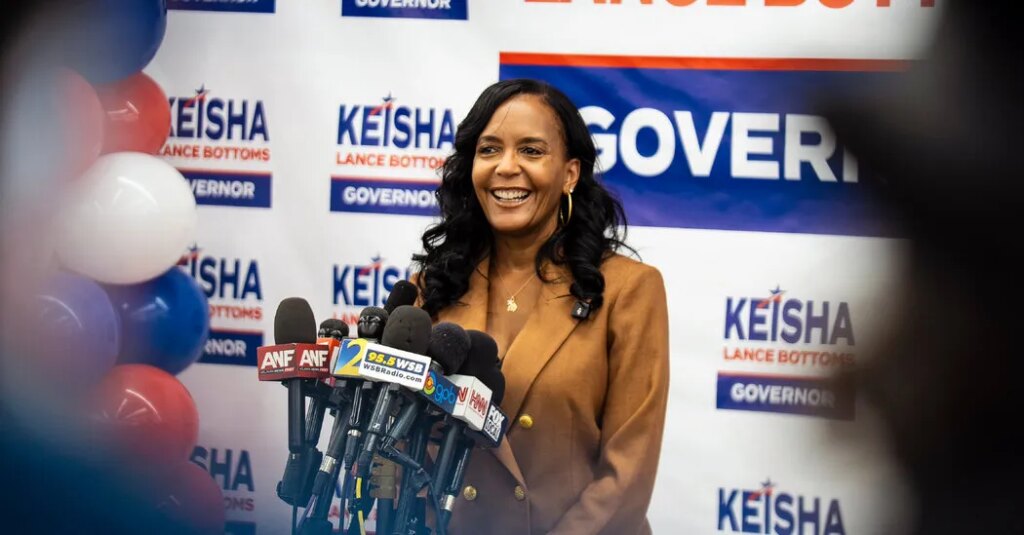
Mary-Pat Hector volunteered on Election Day to help get dozens of voters to the polls in Georgia, and she had spent months doing everything she could to energize other young people to support Democratic candidates. She was a Gen Z torchbearer for traditions of organizing and mobilizing handed down over generations of Black women. And she was prepared for a good night.
She was hopeful that Keisha Lance Bottoms would win, making Georgia the first state to elect a Black woman as governor. But then history kept being made: Up and down the ballot, Black women, all Democrats, claimed positions that had long been occupied by Republican men.
She called her mentor, a veteran organizer in the state. Both women were stunned. A future that they thought might be attainable some day in Georgia was suddenly materializing.
“We both just cried on the phone,” Ms. Hector, 28, said, “because we have been doing this work for so long.” Finally, she added, they could “see the fruits of our labor.”
For decades, Black women have been a trusted base of support for the Democratic Party in Georgia and also its most relied-upon foot soldiers. They have knocked on doors, registered friends and neighbors to vote, driven strangers to the polls and coaxed people who had all but written off the government to show up anyway. It was the incremental, sometimes inspiring, often frustrating work that revived the fortunes of Democrats in Georgia after years of Republican control.
For the first time, the result of their efforts was more than a win for their party. Their reward was a mirror: The governor, the attorney general, the secretary of state and the insurance commissioner will all be Black women. Only one of the top eight state elected offices will not be held by a Black woman, and he is still a Democrat. The speaker of the House is also likely to be the first Black woman in the position, as Democrats gained a majority for the first time in more than 20 years.
“I don’t know where in the world you have eight Black women in charge of a government,” said Penny Brown Reynolds, who was elected secretary of state. “It’s a seat at the table. It’s having the authority to make the decisions.”
Throughout her career, she had often been the first and only Black woman in a role. Now, she said, “I’m not walking into the room alone.”
On the campaign trail as candidates, they did not lead with their identity. Frustrations with inflation, health care costs and voting rights dominated stump speeches. And some Black women casting ballots in Georgia said that they had not made their choices based primarily on the candidates’ identities.
“I did my research on all the candidates, and I liked how each of them stood on issues,” said Bernadette Scruggs, a 79-year-old retired Chicago public-school teacher and longtime Democrat who moved to Grovetown, Ga., near Augusta. “Their values were similar to mine.”
But even so, the weight of these wins was not lost on her or others. There was sweet satisfaction in seeing women who are descendants of enslaved people, whose ancestors lived through segregation and whose right to vote came from bloodshed and sacrifice take the helm of a state that had once been in the Confederacy.
It also felt like something of a salve after the sting of setbacks in recent election cycles, in which Black women lost in statewide races even as other Democrats succeeded.
“We have been tilling the land for a long time,” said Sherrell Byrd, co-founder and executive director of Sowega Rising, a nonpartisan organization supporting voter engagement in southwestern Georgia. “We have had some seasons where we didn’t get a harvest, but we kept at it, we kept fertilizing.”
The election turned out to be a transformative one far beyond Georgia. Democrats notched surprising wins in places like Mississippi, South Carolina and Texas, long considered Republican strongholds.
But in Georgia, organizers and activists believe that years of diligent work paired with the lessons of past disappointments allowed Democrats to capitalize on voters’ frustration with President Trump and their desire to punish incumbents.
The historic sweep in Georgia was more than a decade in the making, going back to Stacey Abrams, the first Black woman in the country to win a major party nomination for governor.
She lost her campaigns in 2018 and 2022 but was credited with building the infrastructure to harness the demographic shifts that had come with Georgia’s explosive growth.
That progress helped pave the way for Democratic victories in the 2020 election cycle; Joseph R. Biden Jr. became the first Democratic nominee to win Georgia in a presidential election in nearly three decades, and Jon Ossoff and Raphael Warnock ousted the state’s Republican incumbent senators.
Ms. Abrams’s campaigns also helped in “normalizing Black women in elected office and normalizing Black women being at the top of the ticket,” said Glynda C. Carr, the president and chief executive of Higher Heights for America, a political action committee that supports Black women running for office across the country.
Still, Ms. Bottoms and others were running in a climate that had shifted considerably even in a few years. The country had emerged from the pandemic, and the reckoning over racism prompted by the murder of George Floyd, a Black man killed by a white police officer in Minneapolis, had given way to backlash.
Ms. Bottoms would often share her family’s history, tracing it to the tiny town of Crawfordville and her great-great-grandfather, who was enslaved. But she typically would do so only after bringing up the burdens of a higher cost of living that she blamed on Mr. Trump.
“I was never running because I was a Black woman,” Ms. Bottoms said on “The Interview,” a New York Times show. “I wake up as a Black woman every day, so I didn’t feel the need to lead with that. It speaks for itself.”
Ms. Brown Reynolds, who will oversee elections, campaigned on strengthening voting rights and protecting access to the polls. She also highlighted her varied experience — serving as a civil rights lawyer in the Biden administration and working for the state’s attorney general’s office.
“Generations of Black women have built institutions,” she said. “We’ve educated our children. We’ve run organizations. We’ve done the work without being afforded the authority.”
Ms. Hector, the Gen Z organizer, said that the candidates’ identity mattered in the sense that their practical and lived experience gave them credibility with voters who were exasperated with elected officials they believe had lost sight of their most urgent problems.
“They just want candidates who get it,” said Ms. Hector, the executive director of Rise, an organization mobilizing college-age voters. “They recognized that those were the people that were going to get it done.”
Mary Blakely has been stopping people outside grocery stores and churches and in parks around Albany, Ga., most every election season for more than two decades, offering the same simple civics lesson. “You have to vote to change things,” Ms. Blakely, 78, said.
This election brought the changes she had hoped for: to see more people who looked like her leading a state where they have a history of being overlooked and mistreated. “Well, this just feels great,” Ms. Blakely said, savoring Ms. Bottoms’s win most of all. “The first Black governor. Female. I am proud of that.”
The jubilation immediately after the election has been followed by a more sobering realization for the foot soldiers: They had won a battle. But they still had to keep marching.
For one thing, some said, there was a responsibility to create a sustainable new reality, one that would endure not only in Georgia but across the South. This year’s wins could not be a blip, they said.
“We’ve got to make sure that we’re not just the first to do something,” said Tanya Miller, who was elected attorney general, “but we create a pathway for others to follow behind.”
One lesson of the midterms had been that voters were fickle and political fortunes could change rapidly, and these new leaders could easily inherit the anger now directed at Republicans. And the perennial lesson of Southern history is that Black political and social gains are often followed by backlash.
Ms. Hector said the work now was to protect against that. That would mean urging patience from voters, as the solutions they crave will most likely not come immediately or without compromise. She also wants to make sure the incoming elected officials are held accountable and scrutinized on their ability to deliver, but without being held to an unfair standard.
“We can’t expect them to just snap their fingers and make things work out,” she said. She added, “I don’t want people to also feel like because we’ve had this win, this win it’s enough.”
The post The Reward for Black Women’s Work in Georgia: Leaders Who Look Like Them appeared first on New York Times.