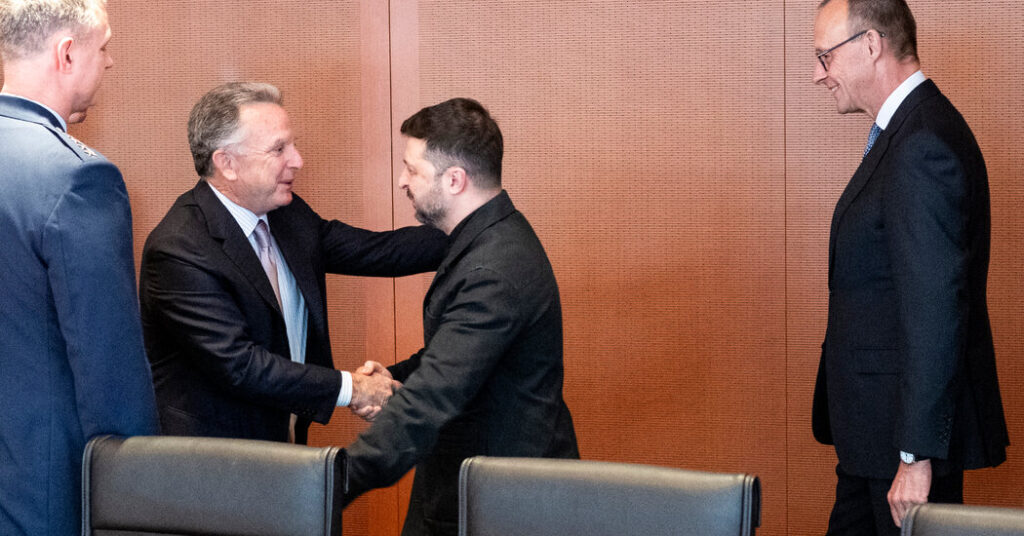
President Volodymyr Zelensky of Ukraine met in Germany on Sunday with President Trump’s negotiators in what was viewed as a critical round of talks to try to agree on a plan to end the war with Russia.
As Mr. Trump pushes Mr. Zelensky to take a deal, saying Ukraine is losing, Mr. Zelensky made it clear that the country was willing to compromise on certain issues.
He reiterated before the meeting that Ukraine would give up on its hopes to join NATO, at least for now, as long as it won strong security guarantees from the United States to prevent Russia from again invading if a peace deal was reached. But Mr. Zelensky also repeated that Ukraine did not want to cede territory that it now controls, as the Trump administration has suggested.
Mr. Zelensky told reporters that he expected to receive details on proposed American security guarantees.
The meeting lasted more than five hours, and it is to continue on Monday, according to Mr. Zelensky’s office. It said he would comment on the results of the meetings on Monday.
The Ukrainian president met with Steve Witkoff, Mr. Trump’s special envoy, and Jared Kushner, Mr. Trump’s son-in-law. They have shuttled between talks with Ukrainian officials, European leaders and President Vladimir V. Putin of Russia over the past three weeks to try to end the war launched by Russia’s full-scale invasion of Ukraine in February 2022.
“In my view, the most important thing is that the plan be as fair as possible — first and foremost for Ukraine, because it was Russia that started this war,” Mr. Zelensky told reporters before his meetings. “And above all, it must be workable. The plan truly should not be just a piece of paper, but a meaningful step toward ending the war.”
The meeting comes ahead of a week of intense diplomacy. On Monday, Mr. Zelensky is expected to meet with top European leaders and join Chancellor Friedrich Merz of Germany at the German-Ukrainian Business Forum. Later in the week, members of the European Union are expected to vote on whether to use part of the €210 billion in frozen Russian assets held in Europe, about $245 billion, as a loan to Ukraine in 2026 and 2027.
There are major gaps between the latest American and Ukrainian plans to try to end the war. They are the same gaps that have been there all year, leaving the United States and Ukraine far from a compromise.
The American plan pushes Ukraine to agree to trade land in eastern Ukraine for peace, including land it still controls in the eastern region of Donetsk, and to renounce its hopes to join NATO, the military and political alliance considered the bedrock of security linking Europe and North America. The Americans want to create a “free economic zone” in that area that would function as a kind of buffer zone between Ukrainian territory and the area of Ukraine controlled by Russia, Mr. Zelensky said last week.
.css-1mxer6r{max-width:600px;width:calc(100% – 40px);margin:1.5rem auto 1.75rem;height:auto;margin-left:auto;margin-right:auto;font-family:nyt-franklin;color:var(–color-content-secondary,#363636);border-top:1px solid var(–color-stroke-quaternary,#DFDFDF);border-bottom:1px solid var(–color-stroke-quaternary,#DFDFDF);padding-top:20px;padding-bottom:20px;}@media only screen and (min-width:1024px){.css-1mxer6r{width:600px;}}.css-1medn6k{font-family:nyt-franklin,helvetica,arial,sans-serif;font-weight:500;font-size:1.0625rem;line-height:1.5rem;}@media only screen and (max-width:480px){.css-1medn6k{font-size:1rem;line-height:1.375rem;}}.css-1f84s5v{font-weight:700;font-size:1.0625rem;}@media only screen and (max-width:480px){.css-1f84s5v{font-size:1rem;}}.css-1f84s5v a{color:var(–color-signal-editorial,#326891);-webkit-text-decoration:underline;text-decoration:underline;}.css-1f84s5v a:hover{-webkit-text-decoration:none;text-decoration:none;}.css-1hvpcve{font-size:17px;font-weight:300;line-height:25px;}.css-1hvpcve em{font-style:italic;}.css-1hvpcve strong{font-weight:bold;}.css-1hvpcve a{font-weight:500;color:var(–color-content-secondary,#363636);}.css-214jt4{margin-top:15px;margin-bottom:9px;}@media only screen and (max-width:480px){.css-214jt4{font-size:14px;margin-top:15px;margin-bottom:10px;}}.css-214jt4 a{color:var(–color-signal-editorial,#326891);-webkit-text-decoration:underline;text-decoration:underline;font-weight:500;font-size:16px;}@media only screen and (max-width:480px){.css-214jt4 a{font-size:13px;}}.css-214jt4 a:hover{-webkit-text-decoration:none;text-decoration:none;}.css-1mxer6r{max-width:600px;width:calc(100% – 40px);margin:1.5rem auto 1.75rem;height:auto;margin-left:auto;margin-right:auto;font-family:nyt-franklin;color:var(–color-content-secondary,#363636);border-top:1px solid var(–color-stroke-quaternary,#DFDFDF);border-bottom:1px solid var(–color-stroke-quaternary,#DFDFDF);padding-top:20px;padding-bottom:20px;}@media only screen and (min-width:1024px){.css-1mxer6r{width:600px;}}.css-1medn6k{font-family:nyt-franklin,helvetica,arial,sans-serif;font-weight:500;font-size:1.0625rem;line-height:1.5rem;}@media only screen and (max-width:480px){.css-1medn6k{font-size:1rem;line-height:1.375rem;}}.css-1f84s5v{font-weight:700;font-size:1.0625rem;}@media only screen and (max-width:480px){.css-1f84s5v{font-size:1rem;}}.css-1f84s5v a{color:var(–color-signal-editorial,#326891);-webkit-text-decoration:underline;text-decoration:underline;}.css-1f84s5v a:hover{-webkit-text-decoration:none;text-decoration:none;}.css-1hvpcve{font-size:17px;font-weight:300;line-height:25px;}.css-1hvpcve em{font-style:italic;}.css-1hvpcve strong{font-weight:bold;}.css-1hvpcve a{font-weight:500;color:var(–color-content-secondary,#363636);}.css-214jt4{margin-top:15px;margin-bottom:9px;}@media only screen and (max-width:480px){.css-214jt4{font-size:14px;margin-top:15px;margin-bottom:10px;}}.css-214jt4 a{color:var(–color-signal-editorial,#326891);-webkit-text-decoration:underline;text-decoration:underline;font-weight:500;font-size:16px;}@media only screen and (max-width:480px){.css-214jt4 a{font-size:13px;}}.css-214jt4 a:hover{-webkit-text-decoration:none;text-decoration:none;}
Got a confidential news tip? The New York Times would like to hear from readers who want to share messages and materials with our journalists.
See how to send a secure message at nytimes.com/tips
On Wednesday night, Ukraine submitted its own version of a peace plan to the United States that would not cede any land that it currently controls. It also removed the American measure prohibiting Ukraine from ever joining NATO. And the plan specified that any decision to give up Ukrainian territory would need to be put to a vote in Ukraine.
Mr. Zelensky told reporters Sunday before the meeting that he had not yet heard back from the American representatives on the Ukrainian version. He also indicated that Ukraine was open to reaching a cease-fire along the current front line.
“A fair and viable option is, ‘We stand where we stand,’” Mr. Zelensky said.
But Mr. Zelensky also voiced skepticism about a “free economic zone.” Ukrainian troops would be forced to withdraw from that zone, which includes important cities like Kramatorsk and Sloviansk. The Ukrainian president questioned why Russian troops would not have to withdraw from some areas that they hold.
“So this is a question that remains unanswered for now,” Mr. Zelensky said. “But it is extremely sensitive and very heated.”
Still, he also said that Ukraine was no longer insisting on NATO membership, which would require all NATO members to defend Ukraine if Russia invaded in the future. Ukraine had been on track for eventual NATO membership until the election of Mr. Trump, although some European members had also balked at the idea. While Mr. Zelensky has admitted in the past that NATO membership was unlikely unless Mr. Trump agreed, he expanded on his earlier comments on Sunday.
“Primarily, from the very beginning, Ukraine’s conditions — or perhaps more accurately, our ambition — was NATO membership,” Mr. Zelensky said. “And that would have provided real security guarantees.”
Late Sunday afternoon, Mr. Zelensky’s office posted photos and videos of him greeting Mr. Kushner and Mr. Witkoff. “Good to see you,” Mr. Zelensky told them, in the videos. In the photos, Mr. Zelensky hugged Mr. Witkoff and shook his hand, and shook the hand of Mr. Kushner, and the Ukrainians sat across from the Americans along a long oval table.
There is no indication yet that Mr. Putin is willing to agree to any plan to end the war. Mr. Putin says he is winning. And even as the peace talks have progressed, Russia has continued to attack Ukraine’s power grid and slowly grind forward along the front line in the country’s east.
But Mr. Zelensky is also trying to maintain the support of Mr. Trump, who has reversed decades of American foreign policy toward Russia and Europe since taking office and has at times echoed Russian talking points as he has tried to end the war.
On Sunday, Mr. Zelensky said that he believed that the United States could make Mr. Putin accept a deal.
“If the United States truly wants to end this war — as they are demonstrating today at a high level — I believe the Russians will have to make compromises,” he said.
Oleksandra Mykolyshyn, Maria Varenikova and Christopher F. Schuetze contributed reporting.
Kim Barker is a Times reporter writing in-depth stories about the war in Ukraine.
The post Zelensky Offers Compromise for New Round of Ukraine Peace Talks appeared first on New York Times.