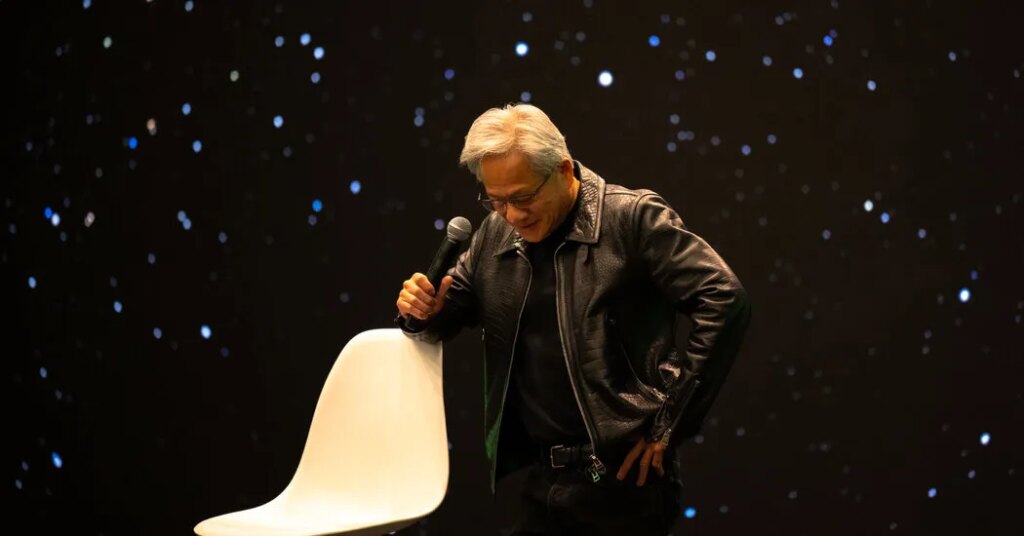
Jensen Huang was agitated.
It was September 2025, and The New York Times had just called his company about a Singaporean data center firm called Megaspeed that had been led by a Chinese woman named Alice Huang, or Huang Le. The Times was reporting that Mr. Huang, the chief executive of the chip maker Nvidia, had a close relationship with her.
Mr. Huang, who Nvidia employees say could have a volcanic temper, wanted to know what The Times was insinuating. Though he didn’t deny that he knew the woman, he was bothered by the suggestion that they might be close, people familiar with the discussion said.
Nvidia mounted an aggressive defense. Madison Huang, Mr. Huang’s daughter who acted as her father’s chief of staff, pressed the company’s communications team to push back forcefully. They also had reinforcements, a crisis communications firm called Heller.
They insisted that Mr. Huang and the woman from Megaspeed just had a business relationship.
Over the next 13 months, Mr. Huang stuck with his story, even after The Times reported last month that the U.S. had gathered intelligence showing that Ms. Huang was secretly working with China’s top spy agency.
But last weekend, facing new revelations about the relationship, Mr. Huang finally came clean to Nvidia’s general counsel. He had been having an affair with the woman, after all, said the people familiar with the discussions.
The relationship with the Megaspeed executive wasn’t Mr. Huang’s only secret.
On Wednesday, a Times reporter called Mr. Huang to ask him about a second extramarital relationship. This time, it was an affair with an executive who reported to him.
Nvidia’s board of directors soon convened an emergency meeting to discuss Mr. Huang’s future with his company. Still, it was unimaginable to think of Nvidia without him.
Less than 24 hours later, Mr. Huang resigned.
The revelations about Mr. Huang, 63, set off a cascade of events that have reverberated from Silicon Valley to Washington to Beijing. Administration officials are now reconsidering A.I. export regulations, which could hurt some Silicon Valley businesses but tilt the A.I. race with China decidedly in America’s favor.
It has also brought into public view a feud among several senior administration officials and Commerce Secretary Howard Lutnick. On Friday, Treasury Secretary Scott Bessent told CNBC that his department had been pushing Commerce for months to crack down on the flow of U.S. technology to China.
Now Nvidia, which was in many ways propping up the A.I. boom, which, in turn, was propping up the U.S. economy, is operating without a man many consider to be one of the most indispensable executives in the history of American business.
This is the story — based on a year of reporting, documents and discussions with more than 100 people, including current and former Nvidia executives and government officials who spoke on the condition of anonymity — of how Mr. Huang’s secret slowly spilled into the open.
What is Megaspeed?
Last fall, business was booming for Nvidia. Its soaring stock price had it within a whisper of becoming the world’s first $5 trillion company.
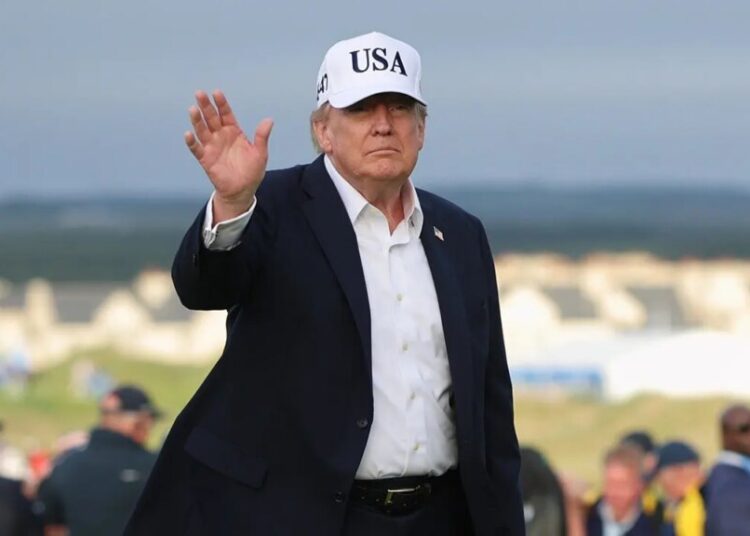
Mr. Huang joined Mr. Trump in September for a formal state dinner at Windsor Castle hosted by King Charles III. Mr. Trump lavished praise on Mr. Huang at a gathering of business and tech leaders hosted by Prime Minister Keir Starmer.
“You’re taking over the world, Jensen,” Mr. Trump said.
But at Nvidia’s headquarters in Santa Clara, Calif., some of Mr. Huang’s advisers were wrestling with The Times’s questions about Megaspeed. The company had purchased more than $2 billion of Nvidia technology in a year, making it one of the largest buyers of A.I. chips in Southeast Asia.
It was an example of the kind of middlemen popping up across the region. Companies like Megaspeed were legally buying American chips and building A.I. data centers that rented computing power to Chinese companies. But the U.S. government suspected that some, including Megaspeed, were breaking the law by funneling chips to China.
Nvidia’s sales from Singapore were swelling. By last summer, the island city-state accounted for 22 percent of the company’s quarterly total sales, or $10 billion, making it the second-largest chip buying region after the United States.
Over the previous two years, Mr. Huang had been seen twice with Ms. Huang in public at industry gatherings. She waited behind him patiently in a pink dress as he passed out noodles from a restaurant in Taipei to onlookers and spoke to the Taiwanese press. Then she climbed into the car with him to be shuttled away.
A senior Nvidia official told The Times that the dinner attended by Mr. Huang, Ms. Huang and several industry executives was a “business dinner.”
On another occasion, Ms. Huang was chatting at an industry party at a Taipei bar when she offered to ask Mr. Huang to join them. “She said, ‘I bet you guys I can get Jensen here,’ and then Jensen immediately showed up,” said Parker Schmitt, who is chief executive of NetThunder, a data software provider. Shortly after, Mr. Huang arrived and drank a whiskey shot with the group. He left the party, which he’d been invited to, shortly afterward with two other Nvidia executives who had joined him.
After the article about Megaspeed and Mr. Huang’s relationship with Alice Huang appeared that October, Nvidia changed how it reported geographic sales. Singapore vanished from its financial disclosures as it started reporting sales based on “customers’ headquarters” rather than “billing location.” The company had previously said that large customers billed through Singapore, where taxes can be lower, but that products “are almost always shipped elsewhere.”
Late that month, Mr. Huang took a convention center stage in Washington in his signature leather jacket and black jeans. He trumpeted his company’s lead in A.I. chips and praised Mr. Trump for focusing on increasing the nation’s energy supplies. He thanked everyone for their work “making America great again.”
The next day, as Mr. Trump was flying to South Korea to meet with China’s leader Xi Jinping, the president told reporters he was planning to speak to Mr. Xi about Nvidia’s most advanced A.I. chip, known as Blackwell.
Some people in government interpreted Mr. Trump’s comments as a signal that he might lift prohibitions on China’s access to America’s best technology — an outcome that could be a boon to Nvidia’s business, even as it flew in the face of longstanding policy goals to limit China’s access to American technology and protect America’s lead in artificial intelligence. (A White House spokesman declined to comment.)
The possibilities were huge for Mr. Huang. Though Mr. Trump had cleared the company to sell some of its lower-performing chips to China, Beijing had banned tech companies from buying them. The offer of Blackwell chips had the potential to break that impasse.
But after Cabinet officials, including Secretary of State Marco Rubio and the U.S. trade representative, Jamieson Greer, objected on national security grounds, Mr. Trump abandoned the idea.
Roughly a year ago, Mr. Trump was briefed about how American spy agencies had surveillance of Ms. Huang, the Megaspeed executive, whom they had determined was passing information to Chinese intelligence services. The surveillance revealed that she had developed a close relationship with Mr. Huang.
It was an alarming development for national security officials who long worried that Mr. Huang was too nonchalant about concerns that his chips could fall into the hands of the Chinese military or intelligence.
Though Mr. Trump chose not to do anything with the information, it raised questions inside the U.S. government about Mr. Huang’s judgment. It also raised the possibility that Ms. Huang may have gathered insight through Mr. Huang into Mr. Trump’s thinking on artificial intelligence, a vital issue of importance to Washington and Beijing.
For reasons that remain unknown, government officials didn’t tell Mr. Huang about the intelligence. Law enforcement officials sometimes warn Americans who are being targeted by a foreign government’s intelligence service — a practice known as a “defensive briefing.” In weighing whether to give such a warning, officials typically consider the risks of tipping off the target of their own surveillance, which in this case would have been Megaspeed’s Ms. Huang.
Chips for China
Mr. Huang didn’t abandon his vision of selling chips to China. He continued to argue that that would make Chinese companies depend on American technology and create competition for China’s tech giant, Huawei. It would also be good for his business.
In December, he returned to Washington to press his case. He met with Mr. Trump at the White House and proposed the selling a less powerful chip to China. Known as the H200, it was a generation older than the Blackwell, which was limited to the United States.
Mr. Trump was open to the idea, but he wanted something in return: a 25 percent cut for the U.S. government of any chips sold to China. Mr. Huang agreed.
By March, pre-purchase orders from Chinese customers were rolling in. At the company’s annual conference in San Jose, Calif., Mr. Huang told a hotel ballroom packed with more than 100 reporters and influencers, including a woman who refers to herself as the “A.I. princess,” that Nvidia was receiving purchase commitments from China and starting to manufacture chips to sell.
In Washington, Mr. Rubio started to put together an update about the surveillance of Ms. Huang. The classified memo, based on highly sensitive intelligence, outlined Ms. Huang’s close relationship with the Nvidia founder and her contacts with China’s civilian spy agency, the Ministry of State Security.
The memo was circulated to only a handful of Cabinet officials. It was sent as the administration made plans for the president to visit Beijing in May for a summit with Mr. Xi. When it came time to extend invitations to more than a dozen chief executives for the trip, Mr. Huang was left off the list.
But with little warning, Mr. Trump, who had seen news coverage of Mr. Huang’s exclusion, asked the Nvidia executive to meet up with Air Force One at a refueling stop in Alaska.
When Mr. Rubio learned of the invitation, while en route to Alaska, he briefed the president on the intelligence showing Mr. Huang had a relationship with a Chinese intelligence asset. Mr. Trump was not particularly moved by the information. Instead, he celebrated Mr. Huang with a social media post after the chief executive boarded the plane, saying it was an honor to have “the Great Jensen Huang” on the trip to China.
On the ground in Beijing, Mr. Trump said he discussed sales of Nvidia chips to China with Mr. Xi. The Chinese government had been reluctant to give its approval to purchases of the less advanced H200 chips. But the conversation didn’t appear to persuade China to allow its companies to buy the Nvidia chips.
Some officials in Washington worried that Mr. Huang, to break the impasse, would push for approval to sell the more advanced Blackwells.
During Nvidia’s company’s all-hands meeting in August, he was asked what he considered to be Nvidia’s greatest risk.
“It’s Washington, D.C.,” he said. “Policies that are made that are uninformed affect us, and they could affect us in a business way, and that could be irritating and frustrating.”
Midway through the meeting, his phone buzzed.
“There are only two people in the world that can call me,” he said. “One of them is President Trump.”
He picked up Mr. Trump’s call and stepped away.
The secret slips
Mr. Huang didn’t know it, but his secret was starting to spill.
Late last month, The Times reached out to Nvidia for comment on a report that would publicly reveal for the first time that Ms. Huang was being surveilled. U.S. intelligence had believed she was an asset for Chinese intelligence who was feeding information to Beijing and was in a close relationship with Mr. Huang. (Among U.S. intelligence and national security officials, the relationship was routinely described more pointedly as an affair. )
Even after The Times reported in October 2025 that Megaspeed was under investigation for smuggling chips into China, Nvidia had kept doing business with the company. And Mr. Huang had kept up his relationship with Ms. Huang, according to U.S. officials who reviewed the intelligence.
Megaspeed’s sister company in Malaysia bought at least $4.8 billion worth of advanced A.I. equipment containing Nvidia chips and technology from June 2024 to February 2026, according to trade records obtained from ImportGenius, a trade platform.
Mr. Huang told people around him that it was the first time he was learning that the U.S. government had been tracking his relationship with Ms. Huang.
Nvidia insisted that the company that employed Ms. Huang, Megaspeed, was like any other regional customer and that it had previously investigated and debunked claims that the Singaporean company was smuggling chips to China.
(China has rejected the espionage claims. Alice Huang, the Chinese executive accused of spying for Beijing, has not responded to requests for comment.)
Mr. Huang jumped to his own defense. In an interview with Bloomberg News, he said that his interactions with Ms. Huang had been “all completely normal and not unusual.”
Other outlets jumped on the story. Nvidia roped in Heller, the crisis communications firm that had been working for the Huang family since early 2025, to help once again. The company represents high-profile individuals, with past clients including Harvey Weinstein and Anthony Weiner, as well as the business side of The Times.
On Nov. 6, The Times reported on Mr. Rubio’s memo and said U.S. intelligence had identified her as working with the Chinese intelligence service.
Later that night, the Financial Times reported the U.S. government believed Mr. Huang’s relationship with the woman was romantic. Nvidia declined to comment.
Tim Teter, Nvidia’s general counsel, who had been defending Mr. Huang, went to Mr. Huang’s house in Woodside, Calif. Mr. Huang confessed, said people familiar with the events that night.
Madison, his daughter, was flying to South Korea at the time. She was scheduled to participate in an A.I. event and meet local dignitaries. But the moment she landed, she was told the news and encouraged to fly back home.
Mr. Huang’s betrayal caused deep pain inside Nvidia. His family — including Madison; his son, Spencer; and son-in-law Nico Caprez — worked in prominent roles at the company. He had been married to Lori Huang for more than 40 years.
After Mr. Huang’s confession, Mr. Teter urged Nvidia’s board to act. The board and Mr. Huang separately drafted public statements. The board said it “had full confidence in Jensen,” even as it planned to hire an outside law firm to investigate the matter.
Mr. Huang apologized in a message to the company. “I was unfaithful to my wife,” he said. “My actions hurt her and our children. There is no excuse for what I did. I am deeply sorry.”
He promised that he would earn back the confidence of employees and the board. Privately, he assured people around him, including Mr. Teter, who spoke with the board, that there were no other infidelities.
Bloomberg News earlier reported on Mr. Teter’s visit. The Information, a technology news site, earlier reported on the board’s deliberations.
Over the next few days, Mr. Huang received texts and calls of encouragement from friends, such as Elon Musk of Tesla and SpaceX, OpenAI’s Sam Altman and the financier Larry Fink. President Trump, also called him on Tuesday with a word of advice: Fight.
Some allies began to make plans to turn the tide. Mr. Huang told many of them that the woman wasn’t a spy. She was just a business customer.
But four days later, The Times contacted the company and Mr. Huang about another affair. This one was with a woman who directly reported to him, Kimberly Powell, a 48-year-old who led Nvidia’s health division. The two had been caught on camera in an affectionate moment during Nvidia’s annual conference in San Jose.
The company declined to comment. Mr. Huang, who was reached by phone, said, “I don’t think you should be talking to me directly.” Then, he hung up.
After the news broke, the 10-member board called an emergency meeting. Members called in from remote locations and deliberated over a decision none of them ever thought they would have to make.
The revelation of another infidelity showed that Mr. Huang, who had extolled the company’s code of conduct rules over the years, had been violating them. First, there was the relationship with a customer. Then, there was the relationship with an employee.
But in the world of corporate governance, the worst thing a chief executive can do is lie, especially in a crisis. It is a reason they get fired.
On Thursday morning, the company said Mr. Huang had resigned. The board had named Colette Kress, the company’s chief financial officer, as interim chief executive officer.
Mr. Huang would have to surrender his life’s work.
In a series of extensive interviews last month with Emily Chang of Bloomberg TV, Mr. Huang acknowledged it was a high pressure role that required sacrifice.
“It should not be an easy job,” he said. “It shouldn’t be a job you take for granted.”
He added that he hoped to be with the company for another 20 years.
Ryan Mac, Georgia Gee andKalley Huang contributed reporting.
The post Jensen Huang Carried a Secret for More Than a Year. It Led to His Downfall. appeared first on New York Times.