Microsoft’s Outlook email and America’s air traffic control communications system have at least two things in common: they are not supposed to go down.
This week, they both went down.
There is no evidence that the global Microsoft outage and the nationwide ground stop were related — or that they were cyberattacks or linked to some sort of artificial intelligence threat. Officials on Saturday said maintenance on old copper wiring led to the flight disruptions and that there was no sign of a bad actor or AI threat.
Yet the high-profile outages come after a wave of tech disruptions hit institutions, companies and systems in the United States and around the world, raising visibility about the vulnerabilities facing important technology that people rely on for their daily lives and work.
“Welcome to Friday the 13th,” said Homeland Security Secretary Markwayne Mullin, before addressing speculation about possible links at the start of remarks outside the White House on Friday.
“I want to make sure everybody understands that there is no connection between this and Microsoft. I know a lot of people are making that jump.”
Outages and hacks, attempted or successful, have always been a feature of software. Yet cybersecurity experts have warned at increasing pitch in recent months that AI tools adept at finding and exploiting software bugs could supercharge hacking attempts, as countries blame nation-states for widening digital attacks on infrastructure.
Cybersecurity experts termed last month “Black October” for the sheer volume of high-profile vulnerability disclosures and cyberattacks. In October, researchers used AI to find a severe vulnerability in software in as many as 70 percent of the world’s websites (in the end, many websites were able to fix the exploit).
Earlier this week, France blamed Iran for a cyberattack on supermarket refrigerators across the country, with the country’s foreign minister saying nearly 700 food-distribution sites were targeted across France over two days in “an attack of unprecedented scope and aggressiveness.” Major grocery stores had to throw out spoiled goods last month after hackers changed temperature settings remotely.
French Foreign Minister Jean-Noël Barrot said at a meeting of the Group of Seven nations on Monday that the attack “marks the first large-scale cyberattack aimed at sabotage on our national territory.” While he was referring specifically to the cases in France, grocery stores in several European countries including Belgium, Italy and Sweden have since reported hacks.
Other recent high-profile incidents have also been linked to state activity. In October, Binance, an exchange site for cryptocurrency, was hacked for a record $6.3 billion — among the largest single financial heists in history. The attack was attributed to North Korean hackers, who Binance said gained access by luring one of the exchange’s engineers into a bogus job interview and tricking them into downloading malicious code.
Early evidence in both the Microsoft and air system outages pointed to issues during maintenance: Microsoft said it had recently upgraded its server capacity. And Transportation Secretary Sean P. Duffy said Saturday that the air travel problem was caused by either bad equipment or an error as a contractor sought to replace old copper telecommunications lines with fiber at a remote Federal Aviation Administration facility.
The systems have since been restored. But they have still disrupted the work days and travel plans of millions of people.
The Outlook outage — which included calendars and other Microsoft products — disrupted work days ranging from bail bonds processing to an organization that tracks humpback whales.
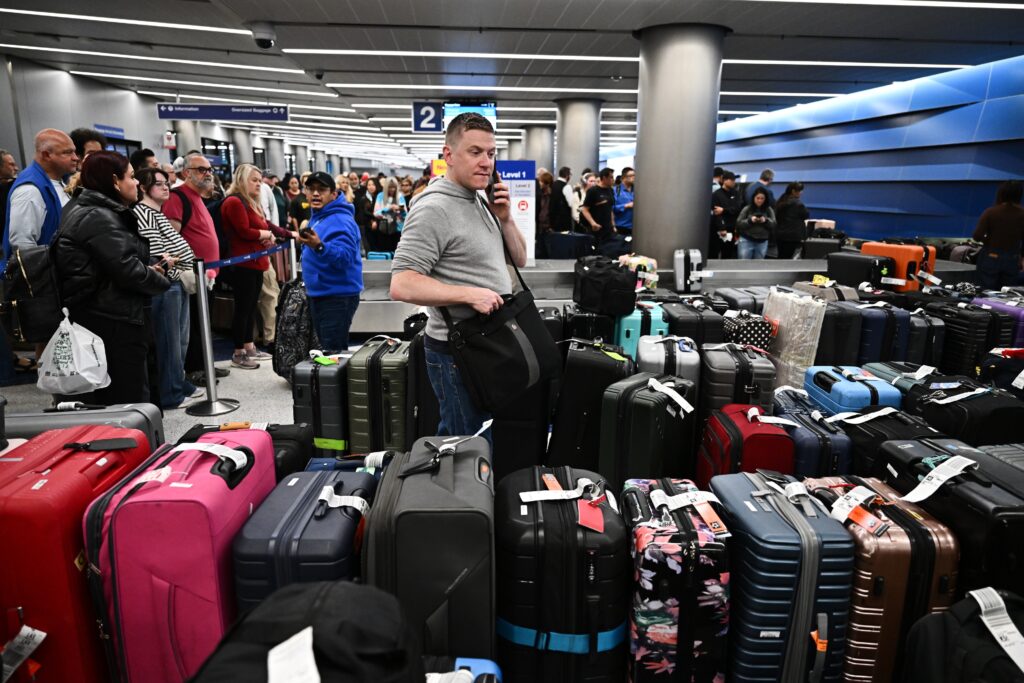
At least 5,000 flights in the United States were canceled Saturday, in addition to about 9,000 Friday, leaving passengers to sleep in major airports and wait to be rebooked.
To cap off a stretch in which federal officials held multiple news conferences sharing updates as the nation’s air traffic ground to a halt, Duffy contended with more benign — and lower-stakes — tech issues.
The Transportation Department’s briefing was temporarily derailed after what appeared to be microphone feedback.
“This is our kind of, um, day,” Duffy said.
Ellen Francis contributed to this report.
The post Outlook went down, then air traffic systems. It’s been a bad week of outages. appeared first on Washington Post.