It began at little after 4 p.m., when a masked man burst into a lecture hall at Brown University with a rifle, yelled something incomprehensible, and began spraying bullets at the 60 or so students that were there for an economics study session ahead of final exams.
Some students were able to escape through the side doors of the hall. Others could only hide, ducking under chairs and behind desks. Two were killed, and nine wounded.
Joseph Oduro, a 21-year-old senior and teaching assistant who was leading the study session, said he took cover behind a desk with about 20 others. “The students in the middle were impacted the most,” he said. “Many of them were lying there and they were not moving.”
Twelve hours after the shooting began, U.S. marshals and local officers detained a suspect, a man in his 20s, at a hotel in Coventry, R.I., about 15 miles south of campus.
For most students, the night of terror began as a phone alert, at 4:22 p.m., a few minutes after sunset on a wintry day, while many of them were studying for final exams. The alert blared a shocking warning: There was an active shooter at the Barus and Holley engineering and physics building. The alert directed people on the Providence, R.I., campus to shelter in place.
John Goncalves, a Brown alumnus who represents the neighborhood on the Providence City Council, said he was at a public event Saturday when his phone was overwhelmed with incoming messages. As he pieced together the startling information about what had happened, “it was almost impossible to process,” he said. “This is a community where people feel safe.”
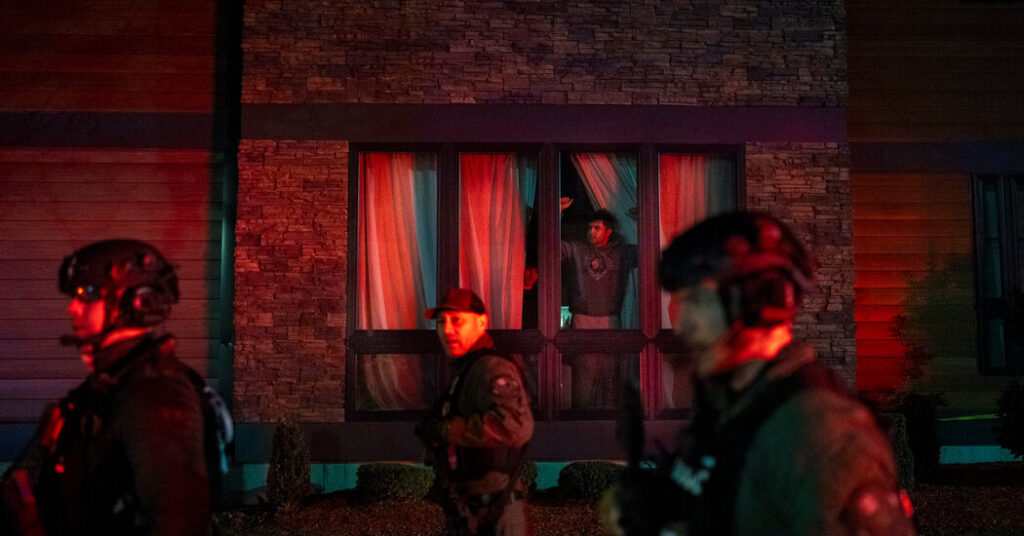
But on Saturday night, students and nearby residents on lockdown peeked from their windows to see an overwhelming police response, with officers wearing armor and helmets and toting weapons, something entirely out of character for their neighborhood.
The streets near the school are a popular entertainment spot for both students and residents of Providence, who come for restaurants, bars and a theater. The neighborhood, decked out for the holidays, was transformed on Saturday, abandoned by residents and swarming, instead, with armed police.
Military-style vehicles idled in intersections. Circling helicopters thrummed overhead. The hundreds of officers stood out in particular for the rifles and shotguns they carried — fearsome weaponry not often seen on the streets of an Ivy League college town. The officers fanned out through the neighborhood, searching for the shooter, shining powerful lights down alleyways and into parked cars.
Dozens of ambulances, lights flashing, queued up ominously in long lines on side streets, in case there were more shooting and more victims.
Providence Mayor Brett Smiley said he met with a wounded student at the hospital who was thankful for active shooter drills in high school. “We shouldn’t have to do active shooter drills, but it helped,” the mayor said, “and the reason it helped, and the reason we do these drills, is because it’s so damn frequent.”
Spencer Yang, 18, who was shot in the leg in the science lecture hall, recalled little about the shooter, who entered at the rear of the auditorium-style classroom. He remembered vividly, though, that at the bang of gunshots, students began to run toward the front of the downward-sloping classroom.
“I didn’t make it all the way to the front — I just laid down between some seats,” Mr. Yang said.
“After the shots rang out, it was kind of silent,” he said. “Once he was gone, I just remember a bunch of people started screaming.”
Many sheltered in place for hours after the initial alert, until the police arrived to search them and their buildings. Some 2,000 students were evacuated; many ended up initially at a nearby athletic center, before being relocated to stay with friends or in hotels.
Annelise Mages, 17, a first-year pre-med student from San Diego, was studying for her chemistry final in the high-rise Sciences Library, which overlooks the building where the shooting took place. She first noticed police lights, and then received the university alert.
From the windows on the fourth floor, she and other students watched emergency medical teams tend to injured people; one student was brought out on a stretcher, holding his arm.
She and dozens of other students barricaded doors with white boards and chairs. Some hid in bathrooms.
Two or three hours later, about seven police officers broke down the barricades. With the shooter still at large, the police evacuated the students at gunpoint, screaming at them to hold their hands up, Ms. Mages said. Some students were in tears.
The group then spent another four to five hours in the building’s basement, before they were bused to the university’s athletic center. There, they were split into male and female lines and patted down. Hundreds of students waited in a line for food.
When Ms. Mages exited the athletic center on Sunday morning around 3 a.m., after nearly 12 hours of lockdown in several different locations, the first thing she noticed was the newly fallen snow.
“The first snow of the year,” she said. “We’re all in mourning, and it’s winter, and I’m not sure what the spring at Brown will look like.”
Dana Goldstein covers education and families for The Times.
The post Gunshots, Then 12 Hours of Fear at Brown University appeared first on New York Times.