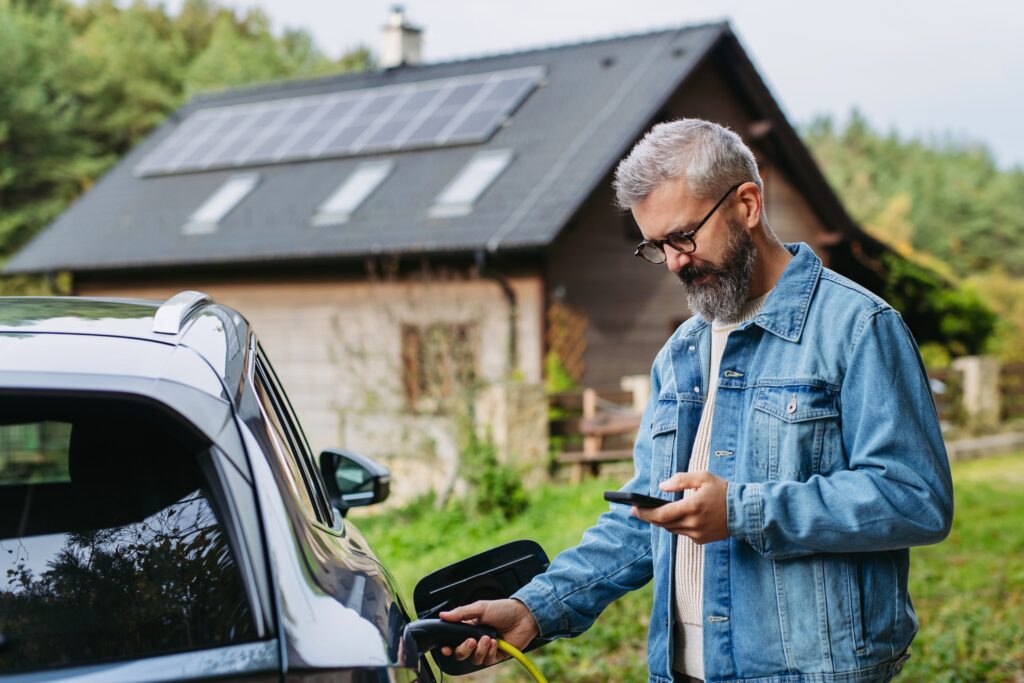
Owning a home has long been one of the most effective ways to build long-term wealth. And now homeowners have a new financial advantage that has nothing to do with equity or rising property values: electrification.
Homeowners who take advantage of green energy to power their homes and cars can potentially save money on electricity bills and transportation costs. But for renters, this benefit might be out of reach.
Data recently released by the Census Bureau show that 6.4 percent of homeowner households have an electric or plug-in hybrid vehicle, compared with only 3.6 percent of renter households. Another Census finding shows that 7 percent of owner-occupied homes have solar panels, compared with 2.8 percent of renter-occupied homes.
While using solar panels or an EV can help, the real financial advantage comes from using them together.
Getting more out of the same investment
Say a homeowner installs solar panels to cut their electric bill. During the day, those panels might generate more electricity than the home needs, with the rest going back to the utility company.
The catch is that the utility might pay considerably less for that electricity than it charges customers to buy it back.
In California, for example, state regulators say compensation for excess solar electricity under the state’s newer billing system is generally lower than retail electricity rates.
That’s where owning an EV can pay off.
“The less your utility pays you for exported solar, the more it’s worth to keep that energy and put it in your car,” said Alexis Abramson, dean of Columbia University’s Climate School.
If you’re paying 20 cents per kilowatt hour to use electricity, for example, but the utility buys your excess solar-generated power for only 5 cents, you’re on the losing end of that trade. By using that electricity to charge up your EV, you could get an additional 15 cents of value per kilowatt hour.
Jesslyn Pei, a former infrastructure investment and asset management professional, estimated that a $24,000 solar installation could pay for itself in about 10 years if the homeowner uses the solar-generated electricity to charge an electric vehicle at home, assuming favorable conditions. Solar alone, she said, might take 13 to 14 years.
But if homeowners use the electricity they generate instead of selling it to the grid at a low rate, they can recoup the high upfront cost of a solar installation much more rapidly. “The more use cases for utilization, the shorter the payback period,” Pei said.
Making the numbers work
Of course, homeowners don’t necessarily have to make two expensive purchases at once to start saving money.
The Department of Energy says some EVs can add two to five miles of driving range per hour using an ordinary household outlet. For drivers with shorter commutes, that might eliminate the need for a more expensive charging installation.
Other opportunities include charging during cheaper overnight hours, checking utility discounts for EV owners and comparing the value of using solar electricity against selling it back to the grid.
But going electric isn’t automatically a good financial decision. Abramson cautioned that a shaded roof, an aging roof that may soon need replacing or particularly low electricity prices in a community can make solar a poor investment. Financing costs can also eat into any savings.
She recommended running the numbers with a local installer, including the cost of financing and any available state or local incentives, before committing to a system.
What about renters?
As renters by definition don’t own their properties, they’re usually limited in how they can modify them. For example, renters generally can’t install rooftop solar panels or home chargers without their landlord’s cooperation.
Other options might be available, however.
Abramson says community solar subscriptions can reduce electricity bills by 5 percent to 15 percent, with potentially greater savings for qualifying low-income households. Renters with an EV can benefit from workplace chargers, potentially cheaper overnight charging rates and buying an affordable used EV to lower the upfront cost.
More innovative solutions might be coming. Abramson pointed to plug-in balcony solar systems, which are gaining attention as a lower-cost alternative to traditional rooftop installations. They can be used with regular wall plugs and are portable. While not eliminating the benefit gap with homeowners, these types of options provide renters with choices.
Before spending thousands of dollars, homeowners should compare the total upfront costs against their expected annual savings, including financing expenses and any available incentives. They should also consider how long they plan to stay in the home. The longer you plan on staying put, the bigger the potential savings.
The post Why homeowners who go electric have a secret advantage appeared first on Washington Post.