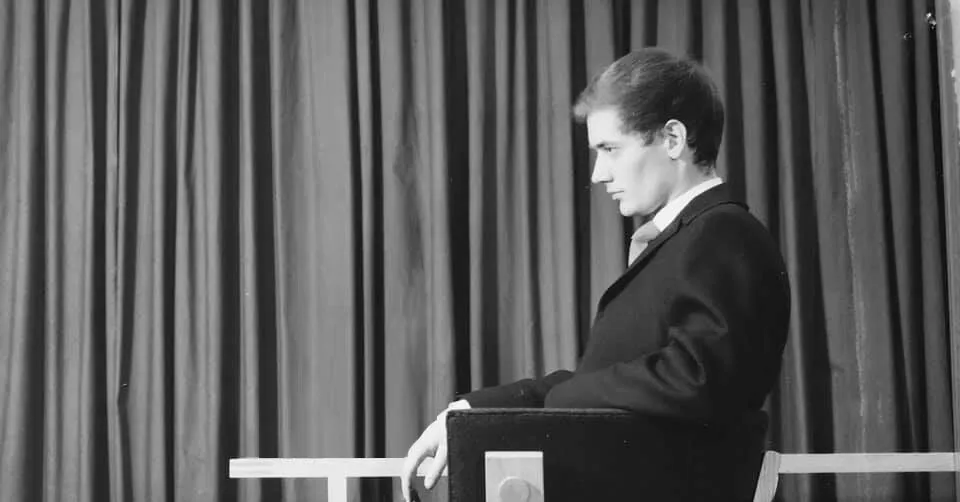
Steen Ostergaard, the Danish designer who used experimental materials and up-to-the-moment technology to create space-age furniture that appeared in “Star Trek” and James Bond films, as well as numerous homes and at least one jailhouse, died on Oct. 13 in Harlev, a suburb of Aarhus, in eastern Denmark. He was 90.
His death, at a nursing home, was announced by his family.
Though he designed almost anything that caught his interest — kitchen appliances, windmills, shoes, watches, firepits, a life-size chess set, a bus shelter seen all over Denmark — Mr. Ostergaard was best known for creating affordable furniture that solved problems stylishly. He designed a folding chair that he called the Wall-Hanger — because when you weren’t sitting on it, you could hang it on the wall — and the Add-It, a modular bookshelf that could be assembled without tools.
But he was most famously associated with a cantilevered, stackable plastic chair called the Model 290, which looked like sculpture and cradled the body like a sling.
Developed with the chemical company BASF in 1966 as the A-Line Model 290 (and later known as the Cado 290 and Modo 290, depending on the manufacturer), Mr. Ostergaard’s streamlined chair wasn’t the first of its kind. His countryman Verner Panton had worked on a cantilevered plastic chair in the late 1950s that was brought to market in 1967. But Mr. Ostergaard’s version — which manufacturers described as emerging as a single piece from an injection mold in a mere 132 seconds — was in the vanguard of designs that were seen as embodying the future.
The chair’s modern lines, which flowed through his subsequent work, sparked the imagination of Hollywood set designers.
The Model 265 President chair was a close relative produced two years later. The deeply inclined, upholstered plastic lounge was cast as an “antique” in Admiral James T. Kirk’s 23rd-century San Francisco apartment in the 1982 film “Star Trek II: The Wrath of Khan.” (Dr. McCoy sinks into it with a drink in his hand, putting his booted feet up on the matching ottoman.)
Mr. Ostergaard’s daughter, Sanja Ostergaard, said her father was indifferent to the cameo roles his furniture played in movies. She learned of his contribution to “Star Trek” through an online fan site and recalled watching every James Bond film starring Sean Connery because her mother had the foggy impression that an armchair version of the Model 290 appeared in one of them. (She eventually spotted it in “The Spy Who Loved Me,” but in that 1977 film Bond was played by Roger Moore.)
Real-world settings for Ostergaard chairs had their own dramatic flair. In the 1970s, his daughter said, NASA furnished the Johnson Space Center in Houston with President lounges.
Similarly, the Fairfax County jail in Virginia, which opened in 1978, had a practical reason for putting Model 290s in its cells and communal rooms: The chairs didn’t have legs that could be broken off and used as weapons.
Several Ostergaard designs have been revived in the 21st century. In 2013, the Danish furniture manufacturer Nielaus reissued the Model 290 chair as Modo 290. Last year, CB2 introduced several new pieces based on Mr. Ostergaard’s creations: versions of a 1960 leather armchair, now called Boks; a 1981 tufted leather armchair, renamed Ripple; and a 1983 white-lacquer storage cabinet. This year, the company released a modified reproduction of a 1962 barrel-backed armchair.
Mr. Ostergaard was born on Dec. 21, 1935, in Faaborg, on the island of Funen in Denmark, and grew up in Sig, a village in West Jutland. His father, Thorvald Ostergaard, managed a dairy and later owned a local grocery store. His mother, Alma (Tange) Ostergaard, was a nurse.
“He was an odd child and wanted to do anything but be a farmer,” his daughter said.
On leaving school in his teens, he apprenticed as a cabinetmaker and woodcarver. In 1957, he enrolled at the School of Arts and Crafts in Copenhagen (now the Royal Danish Academy’s School of Design), where he studied architecture and furniture making. Three years later, he won a competition sponsored by the city’s Museum of Art and Design (now the Designmuseum Danmark) for a steel-frame sofa and easy chair called the Jubii 500.
After graduating that same year, he could have worked for any of Denmark’s modern furniture masters, like Hans Wegner, Borge Mogensen, Poul Kjaerholm or Finn Juhl. In 1962, following military service, he accepted Mr. Juhl’s invitation. As he recalled in a 2025 interview for Vital, a Danish magazine, Mr. Juhl taught him that “furniture should not merely be visually appealing; it must also be comfortable and functional.”
While working for Mr. Juhl, Mr. Ostergaard was named the designer of “the furniture of the future” by the Copenhagen Cabinetmakers’ Guild.” In 1966, he opened his own studio.
“I think he figured out he could do fine by himself,” his daughter said.
A collaboration with the Finnish designer Poul Cadovius’s company, Cado, from 1970 to 1975, led to the manufacture of several of his designs, including the Model 290, renamed Cado 290.
At the Juhl studio, Mr. Ostergaard met Ina Buchhave, an architect who would later work as an editor at a Danish shelter magazine. They married in 1969. She died in 2020.
In addition to their daughter, a fashion and interior designer, Mr. Ostergaard is survived by their son, Tim, an engineer; four grandchildren; and a brother, Finn.
In 1986, reasoning that he could design anywhere, Mr. Ostergaard moved his family to Oxford, England, so his children could study English, which would allow them to work internationally. The next year, he decided it was time to immerse his family in the German language, and they moved to Flensburg, near the Danish border.
A decade later, he and Ina relocated to Monaco. They returned to Denmark in 2016 and settled in Harlev, where Mr. Ostergaard dedicated himself to caring for his wife, who had Alzheimer’s disease. He continued living in the community after her death — and kept designing furniture.
“I just went to the patent office two weeks ago,” his daughter said recently, with an idea her father had for a new way of making chairs.
She added: “It’s still a secret. I still need to find someone who would want to produce the thing.”
The post Steen Ostergaard Has Died. You Might Know His Chairs, If Not His Name. appeared first on New York Times.