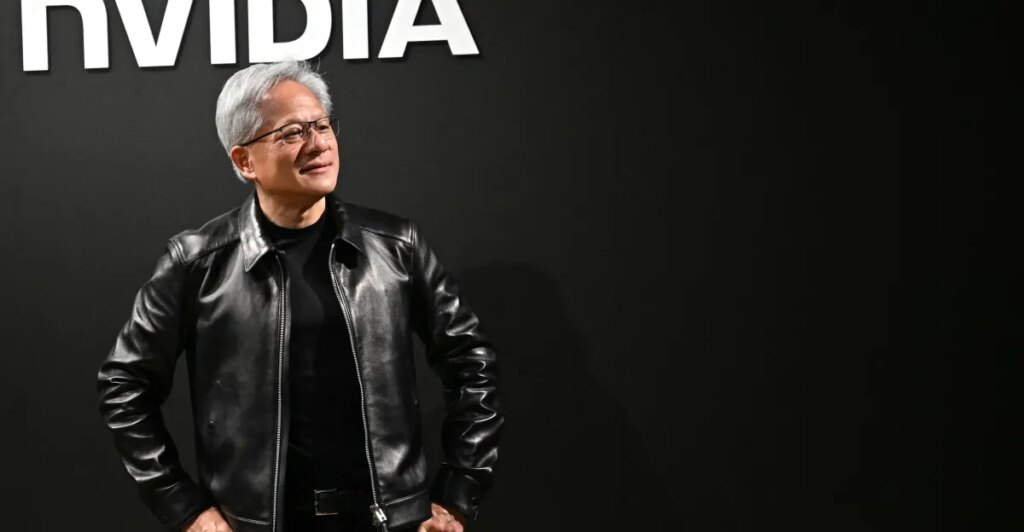
Former Nvidia CEO Jensen Huang’s sudden downfall is in a sense shocking, considering his wealth, global fame, and role leading what was until recently the world’s most valuable company.
But Huang’s immense influence in Washington — and particularly in President Donald Trump’s Washington — has long been intensely controversial among a surprisingly diverse cross-section of the political, business, and tech advocacy world. And his ouster not only drives a wedge through Trump’s second-term coalition, it could usher in a major change in how the US steers the AI revolution.
Huang — who resigned this week after allegations he’d had affairs with two Nvidia employees and one Chinese businesswoman who some US officials claim was spying on him for the Chinese government — has been crucial in helping shape the Trump administration’s AI policies. That’s perhaps no surprise, given that Nvidia’s advanced chips are crucial to the AI revolution.
His many critics, however, say Huang’s influence has been deeply harmful. Their main objection? They believe the Trump administration hasn’t been doing enough to stop China from getting or accessing advanced AI chips — in part because of Huang’s lobbying and sway with the president.
This coalition of Huang critics spans the political spectrum. It includes right-wing China hawks and the bipartisan foreign policy establishment, who want to win an AI race against China. It includes economic populists in both parties, who resent China’s economic sway. It even includes some leading members of the Trump administration itself — Secretary of State Marco Rubio and Treasury Secretary Scott Bessent have reportedly pushed for tighter chip restrictions.
It also contains some even odder bedfellows. The coalition includes people who want to slow down the AI race, like the tech safety advocates who warn that advanced AI could cause human extinction. Yet it also includes two major US frontier AI companies, OpenAI and Anthropic, who hope to impede the growth of Chinese competitors by limiting their access to chips.
All of these disparate groups come together around the core idea that the US urgently needs to do more to stop advanced chips from getting to China. Selling AI chips to China is like “selling nuclear weapons to North Korea,” Anthropic CEO Dario Amodei has said.
Standing against them all — and often getting his way with Trump — has been Jensen Huang.
Beyond the obvious — Nvidia’s business is selling chips, and Huang wants to be able to sell more chips in more places — Huang is associated with a camp in the AI policy debate that some have dubbed with “let it rip.” Along with former White House AI czar David Sacks, Huang has scoffed at warnings that AI could cause human extinction, calling them “irresponsible” and “doomsday narratives.” He’s also dismissed some national security concerns, saying that being a “China hawk” was a “badge of shame” and said that the bigger risk to American influence over AI would be US companies losing market share around the world.
So Huang’s ouster and the claims of Chinese espionage around it have opened up an opportunity for a shakeup in US policy — and a rare chance for those China hawks to potentially investigate, undermine, and push out their rivals, while seizing the policy reins around chip exports.
Trump administration officials who want tougher restrictions have their knives out for Commerce Secretary Howard Lutnick, a frequent ally of Huang’s. There’s a bipartisan push in Congress for new export controls legislation before the end of the year. Congressional Republican committee chairs are demanding Huang and Lutnick come in and testify in the coming weeks, before Democrats take over Congress.
Plus, there are the partisan incentives for Democrats to dig into the question of what Trump knew about all this (he was reportedly briefed on the spy concerns last fall). And there are political incentives for ambitious Republicans to find an issue on which they can distance themselves from an unpopular administration without antagonizing their conservative base.
With so many different forces invested in the outcome, you can bet this topic will continue to dominate headlines for months to come — with unpredictable results for both the new Democratic Congress, the future of the GOP, and the AI boom.
The many critics of Jensen Huang’s influence on the Trump administration
In Washington itself, the most influential faction opposed to Huang is the bipartisan national security establishment, most of whom strongly believe in the necessity of competing with China for global influence.
These “China hawks” were influential in the Biden administration and have historically been dominant in GOP administrations and on GOP-controlled congressional committees. And many of them have been flabbergasted at Trump’s policies toward China and Chips this term.
“I don’t think we should be using any American technology to uplift China’s capabilities in AI given how era-defining this technology will be in national security and in our economy,” Vivek Chilukuri of the Center for a New American Security, a center-left think tank, told me. “A company’s going to argue for this, that’s what companies do. But the interest of any one company should not be trumping the national security of the United States.
Moving further right, there’s a MAGA-aligned faction that is skeptical of foreign wars such as Trump’s conflict in Iran — but even some of them are still quite antagonistic to China.
Take, for instance, Trump’s onetime campaign manager and White House adviser Steve Bannon. He’s been furiously protesting Huang’s influence on the administration for more than a year — in September 2025, he argued that Huang should be arrested for being “an agent of influence of the Chinese Communist Party,” and argued we needed to “shut down” China’s “access to technology, chips, and training.”
Advocates and politicians focused on economic issues and reining in corporate power also have long criticized Nvidia. Oren Cass of the center-right group American Compass wrote an article titled “Break up Nvidia” last year, arguing that “its excessive concentration of power is exactly what antitrust law intends to combat.”
Meanwhile, the left, Sen. Elizabeth Warren (D-MA), a longtime critic of Big Tech, has frequently suggested Huang was corruptly influencing the Trump administration. At a hearing in June, she mentioned that Huang or his company had donated to Trump’s inauguration and his White House ballroom project. “If it’s not plain old-fashioned bribery, it sure smells like it,” she said.
Many in the AI safety advocacy world have also long criticized — and feared — Nvidia. That’s in part because they hope slowing down sales of AI chips abroad could slow what they view as a dangerous race to superintelligence. Additionally, after AI safety fears hit the mainstream in September due to Anthropic researcher Jacob Coxon’s resignation and viral warnings, Huang took an increasingly public role in dismissing such fears.
Other AI safety advocates cite the company as having a chilling effect on public debate. “For months now, I’ve heard about widespread fear among think tank researchers and policy experts who publish work against Nvidia’s interests,” AI safety researcher Steven Adler wrote last year. “If you speak with people in-the-know at AI companies, fear of retaliation from Nvidia is a major concern when staking out policy positions.”
Indeed, OpenAI and Anthropic are highly dependent on Nvidia for its chips, so open criticism of the company is not common. Yet those big two US AI labs have been at odds with Nvidia in urging the Trump administration to do more to crack down on Chinese access to advanced chips, and to more heavily scrutinize Chinese “open source” AI models.
But to Huang and others in his camp, the growth of Chinese AI is a feature, not a bug. Sacks, for instance, has repeatedly argued that “open weight” or “open source” models — which make their parameters publicly available, in contrast to the proprietary models of OpenAI and Anthropic — would help avert “an unsafe and dystopian future where advanced AI capabilities are centralized and controlled by only a few hands.” The leading open weight models are currently from Chinese companies.
Huang has also used a more straightforward argument: that what’s good for Nvidia is good for the United States of America.
“American technology has to win across the world at every single layer,” he said in May. “If we can export chips, we should.”
Now it will be left to Nvidia’s interim CEO, Colette Kress, to carry that message, instead of a rock-star founder with a global cult following that’s drawn comparisons to Steve Jobs at his peak at Apple. Her first task: taking stock of all the powerful actors across the political, advocacy, and business world rooting for her to fail. Perhaps DeepSeek could help make a list?
The post Why the left and right are both cheering Jensen Huang’s downfall appeared first on Vox.