After the carnage of World War I, Americans grieved particularly for the soldiers whose bodies were left behind in France, and for the several thousand whose remains were never identified. It was a political issue, a cultural wound and it changed how we memorialized the fallen, from a local to a national duty. The Tomb of the Unknowns at Arlington National Cemetery, where Defense Secretary Pete Hegseth and his entourage were admonished Tuesday for acting disrespectfully, was a response to that trauma.
The slaughter of the Great War, a fratricidal conflict of European monarchies, created overwhelming public disgust in England and France. Governments there responded to the outrage with a postwar show of egalitarianism, honoring an anonymous soldier with the highest honors and burial at Westminster Abbey in England and at the Arc de Triomphe in France. The United States, which hired its best architects to create cemeteries in France and considered creating a memorial forest north of Washington, followed the lead of its European allies and honored the unidentified dead with its own Tomb of the Unknown Soldier in 1921.
That’s where Hegseth, his wife and a gaggle of senior staff laughed, joked and bantered as if they were at a garden party, on the 11th day of the 11th month, once known as Armistice Day and now the day set aside to honor America’s veterans. Their boorish behavior, at a place where silence is strictly enjoined, was reprimanded by one of the army sentinels from The Old Guard, who upbraided them with the usual formula: “All visitors will maintain an atmosphere of silence and respect at all times.”
Hegseth responded to that reprimand Thursday by honoring the soldier who shouted it, Spc. Thomas Iglesias, with the Joint Service Commendation Medal, commending the “execution of his duties at the Tomb of the Unknowns on November 11, 2026.”
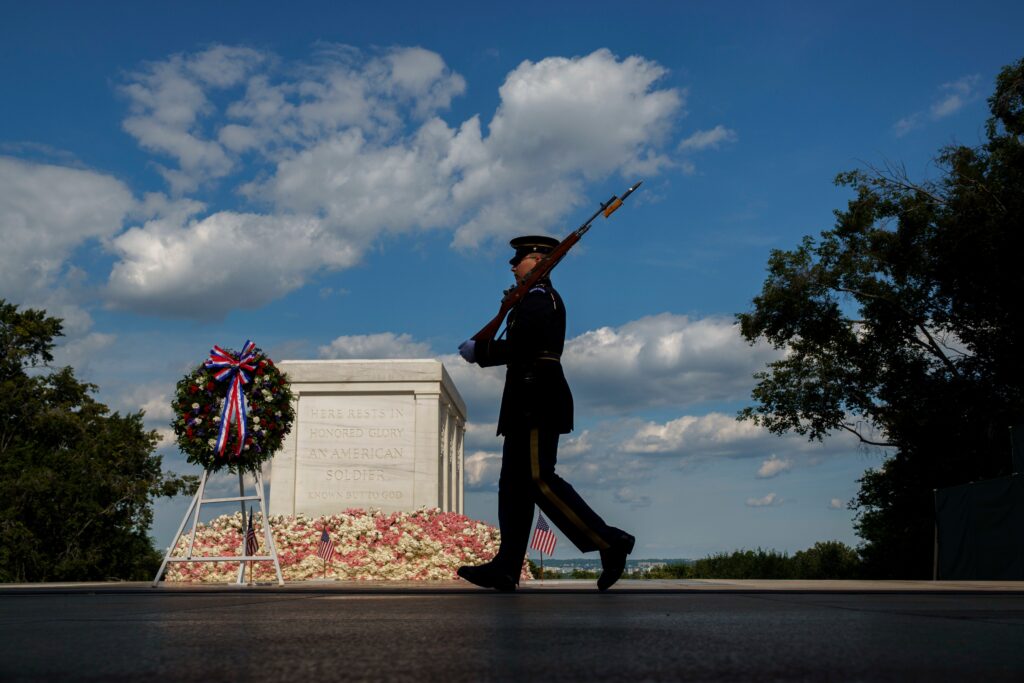
The Tomb of the Unknowns, which now includes remains from later conflicts, sits on a plaza in front of the imposing facade of Arlington Memorial Amphitheater. The stone paving and the masonry building amplify the sound of the guards, whose dress shoes have metal plates that make a sharp clicking sound as they finish their 21-step ceremonial march. The changing of the guard, every half hour during the warm months of the year, has its own sonic profile, with sharp taps on stone and the percussive sounds of the Relief Commander inspecting the sentinel’s rifle.
These are “earcons,” an idea discussed in a book about architecture and sound, “Spaces Speak, Are you Listening?” by Barry Blesser, a former MIT professor, and independent scholar Linda-Ruth Salter. An earcon is “the aural analogue of a visual icon,” they write, “a sonic event that contains special symbolic meaning not present in the sound wave.” An earcon might be the family dinner bell, or the particular resonance of a cathedral or the crowing of a cock at sunrise.
And most certainly, it is the sharp but subtle sound of the guards at the Tomb of the Unknowns, where the vast majority of onlookers feel a sense of awe and gratitude and need no reminder that silence is the highest form of respect. Social media is full of video of crowds gathered to watch the sentinel’s stately march and the changing of the guard. They are often tourists, dressed like tourists, with the tourist’s restless stance and compulsive need to take pictures. And yet, even in these amateur videos, the earcon of the sentinels creates a quasi-sacred sonic space, a rhythmic sound set against silence, conjuring both the repose of the dead and the passage of time.
Video of Hegseth’s ill-mannered display doesn’t capture the full impact of its disruption because the voices are too far from the camera’s microphone. But it does capture the full resonance of the sentinel’s booming response, which is deeply moving. An ordinary soldier, on behalf of those who have died for their country, demands respect from the man who styles himself the Secretary of War, a man who administers the executive’s life or death power over those who serve, no matter their rank.
Since the first tombs that honored a symbolic, nameless soldier after World War I, countries around the world, democratic, autocratic and totalitarian, have created tombs for the unknown dead. It’s reassuring that in America, despite its flirtation with authoritarianism, would-be authoritarians are still subject to the rules of decorum at Arlington National Cemetery.
Silence, as a form of respect, is particularly social, selfless and engaged. Raising a flag — or wearing one as a pocket square — is performative. Like singing the anthem or saying the Pledge of Allegiance, it is easily done. One can always put out more flags. These are acts made for public display and to some degree they are designed to call attention to one’s own show of patriotism.
Silence is other-oriented. A respectful silence — at a place of worship, in a concert hall or at the Tomb in Arlington — shifts the focus from the individual to the collective. Silence is created by multiple small acts of self-discipline, which become an analogue for self-sacrifice; yet that silence can be shattered by a single lout, narcissist or buffoon.
That Hegseth didn’t care enough on Veterans Day to honor veterans with just a little silence at Arlington should surprise no one. He is a showman who enacts a parody of masculine bravado and bellicosity for an increasingly small audience. Laughing and chatting in front of the tomb was not an isolated lapse of protocol or decorum; it was a display of power, the power of people indifferent to rules, through noise and spectacle, a power so self-conceited it can’t hear the silence that others hold sacred.
One might extend that to the entire Trump administration, to the giant triumphal arch with which President Donald Trump would assert his personal presence at the edge of Arlington to the visual cacophony he has made of the now ornamented and gilded Oval Office, or the UFC match and car race last summer that made the nation’s monuments mere backdrop for noisy spectacle. Silence is simply a vacuum, a space to be filled; it is the darkness before someone turns on the spotlight and the show begins.
In the dreadful 2020 movie based on Vice President JD Vance’s memoir “Hillbilly Elegy,” the young JD asks his Mamaw why the townsfolk are quietly saluting his grandfather’s funeral procession: “Because, honey, we’re hill people. And we respect our dead.”
It isn’t just hill people who respect their dead. And those who have served and died for their country deserve a particular respect. It’s good to have a reminder of what respect means, when and to whom it is owed, what it sounds like, and what kind of man considers himself above the obligation.
No one should expect any better of Hegseth, who is what he is. But as the nation turns a corner and Trumpism begins to wane, we can be thankful for this: The last two years have been an astonishing civics lesson.
The post At the Tomb, Hegseth could not hear the silence that others hold sacred appeared first on Washington Post.