As the U.S.-Israel war in Iran raged earlier this year, a man linked to Iranian criminal networks perched in front of a computer, on a video call with a teenager in London. The man wanted to make sure the teen, who was moments away from setting fire to a synagogue, carried out his plans.
“Light it up like a Christman tree,” the man, an Iraqi named Mohammad Ali al-Hassani, urged the 17-year-old, according to U.S. prosecutors. The teen climbed over a wall and tossed a bomb through a broken window. “J’s mic is muted,” read the text on Mr. al-Hassani’s computer screen.
The synagogue arson in April was a small, violent part of Iran’s efforts to force an end to the bombing campaign that was pummeling the country, according to American investigators.
The attack was described in a federal indictment filed in New York this week. It revealed extensive new details about a wave of violence against Jewish institutions in Europe and U.S. targets, including a British air base used by American bombers. Prosecutors hold Iran’s agents responsible for the assaults.
Within days of the war starting, Mr. al-Hassani and at least two associates, including an operative for Iran’s powerful Islamic Revolutionary Guard Corps, began plotting the attacks in Europe, prosecutors said. The men talked about procuring drones and missiles from contacts in Iran. They pored over a map of London, with one saying they should “get focused” on targeting the British capital. Soon after, attacks hit temples and other Jewish sites in London.
In the fight against much stronger conventional forces, Iran has found ways to impose costs on its adversaries without inviting a full military response. One major aspect of Iran’s strategy is its embrace of small-time criminals to conduct low-cost assaults against vulnerable targets that are part of everyday life.
Since the U.S.-Israeli war began, Iran and its proxies — who sometimes act on their own — have stepped up such attacks, particularly in Britain, which has allowed the United States to use its military bases to strike Iranian forces. By hitting American allies, Iran aims to sow fear and try to weaken their support for the U.S. and Israeli military deployments, experts said.
“What we are seeing right now is the application of a playbook Iran has refined over decades,” said Adrian Shtuni, an associate fellow with the International Center for Counter-Terrorism. In addition to the criminal attacks, he also cited Iran’s efforts to build proxy militant networks outside Iran and enhance its abilities to carry out cyberattacks.
The threat persists. This week, as many as a dozen U.S. military aircraft based at R.A.F. Mildenhall in England were evacuated to other bases in Europe, including in Germany, after intelligence officials detected an Iran-backed drone plot against the base, three American officials said.
The Mildenhall air base, about 70 miles northeast of London in Suffolk, is a major hub for U.S. Air Force operations in Europe. It has a large air refueling wing and a Special Operations wing, with about 1,000 military personnel there.
The officials, who spoke on condition of anonymity to discuss operational matters, said analysts had received a general warning, but commanders were not taking chances. Mohsen Rezaei, Iran’s national security adviser, threatened in an interview on Lebanese television this week to hit U.S. bases in Europe if they are used for attacks against his country.
At the center of Iran’s operations this year in Europe, prosecutors said, is an Iraqi sitting in a Brooklyn jail named Mohammad Baqer Saad Dawood al-Saadi. He is a high-ranking commander in Kataib Hezbollah, one of Iran’s most powerful proxies in Iraq. He was captured in Turkey and charged in May with carrying out attacks in Europe and plotting to attack Jewish sites in the United States.
Prosecutors said he also has close ties to the I.R.G.C., the long arm of Iran’s terrorist apparatus.
Mr. al Saadi implored two associates to help him target Europe, investigators said. The I.R.G.C. operative, Mohsen Mohajeri, is an Iranian national. The other, Mr. al-Hassani, is known as “Ali” and has extensive criminal ties according to American court documents.
Days into the war, Mr. al-Saadi and Mr. Mohajeri began conspiring, prosecutors said. It was Mr. Mohajeri who mentioned acquiring drones and missiles from contacts in Iran. He sent Mr. al-Saadi a bank account number to buy “equipment for jihad.”
He said he would join Mr. al-Saadi so they could direct the attacks together in Iraq, pledging, “I will not return to Iran until we take revenge.” Mr. Mohajeri traveled to Iraq a couple of days later, and the attacks began in Europe shortly after.
Seven were in Britain, the most of any country. “We need to get focused on London,” Mr. Mohajeri told Mr. al-Hassani in early April while they studied a map of the city on a laptop, according to prosecutors.
Mr. al-Hassani, investigators said, had previously lived in the United Kingdom and had contacts there whom he tapped to carry out attacks.
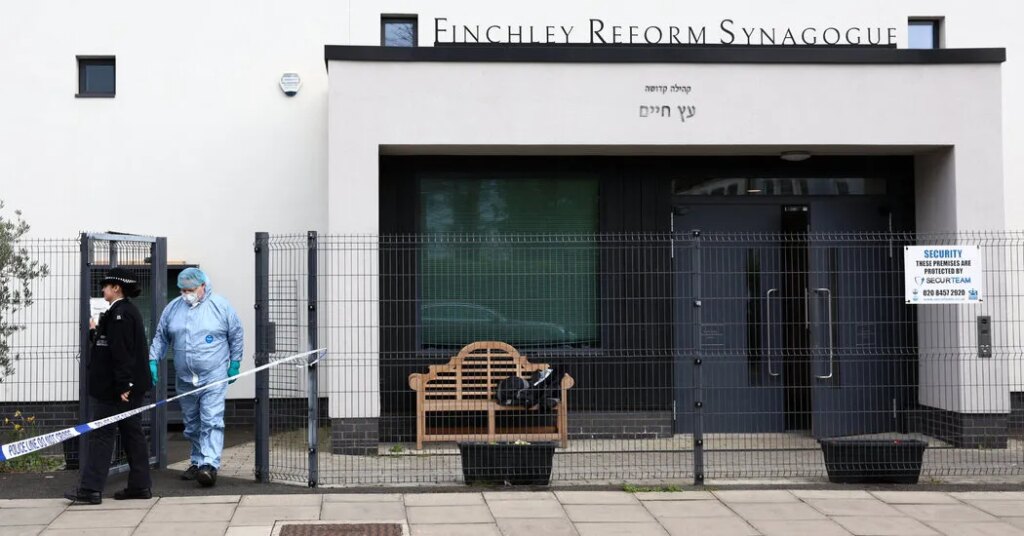
In an April 15 arson attempt on a synagogue in the London neighborhood of Finchley, investigators said, Mr. al-Hassani spoke over video with a mask-wearing perpetrator. “Go as close as the gate as you can,” he said.
On April 17, all three men were in a room together and on a FaceTime video call with an assailant while he attacked a Jewish charity organization. While the call was projected onto a large screen, Mr. al-Hassani coached the perpetrator to light an incendiary device.
“Light one in your hand,” he said.
“Light it.”
“Throw the fourth one.”
While he directed the attack, Mr. Al-Saadi recorded it. Mr. Mohajeri filmed them both.
The men were behind a new group calling itself HAYI that claimed responsibility for at least six terrorist attacks in and around London, according to court filings. Perhaps the most notorious was the burning of four ambulances belonging to a Jewish volunteer service in Golders Green, a heavily Jewish neighborhood.
In the teenager’s synagogue arson attack in late April, nobody was injured, and the damage was minor. The teen later pleaded guilty and said he did not know it was a temple and that he did not hate Jews.
HAYI has claimed responsibility for about 18 attacks or plots across Europe and the United States in the spring. Mr. al-Saadi also directed blasts against U.S. bank branches in Amsterdam and Paris before he was arrested in May.
As he sat in a jail cell in Brooklyn, Mr. al-Saadi apparently had contingency plans. In conversations with his family in Iraq over the summer, he passed coded messages intended for his two associates, prosecutors said.
In late July, Mr. al-Saadi asked his sister, “What are they doing about all our old work?” and she replied that it was ongoing.
By August, according to investigators, Mr. al-Hassani was paying accomplices in Britain to initiate an attack on R.A.F. Fairford, the air base that hosted American bombers that flew sorties to Iran. The men — at least five of them — secured vans and barrels of fuel. They researched chemical accelerants and metallic objects that could be used as shrapnel.
Mr. al-Hassani took care to make sure they did the job correctly. He told the men to place custom-made decals on the three vans so they looked like they were part of fuel delivery and swimming pool supply businesses.
They waited for the green light. Investigators say Mr. al-Saadi gave it on Sept. 24, again through his family.
A couple of nights later, Mr. al-Hassani directed the men to drive to the base, talking with them during their journey. But the authorities had been aware of a vague threat to the base. At least two of the vans encountered a security roadblock, blocking the route that Mr. al-Hassani was instructing them to take.
Early in the morning of Sept. 27, the police apprehended the five men and recovered the vans. They never penetrated the base.
But the close call highlighted vulnerabilities in Europe’s security and played into Iran’s effort to raise the cost of Western support for the U.S.-Israeli war.
“They are playing the long game,” Mr. Shtuni said of Iran, “the only one they can.”
Eric Schmitt contributed reporting from Washington.
The post ‘Get Focused on London’: How Iran’s Agents Attacked European Targets appeared first on New York Times.