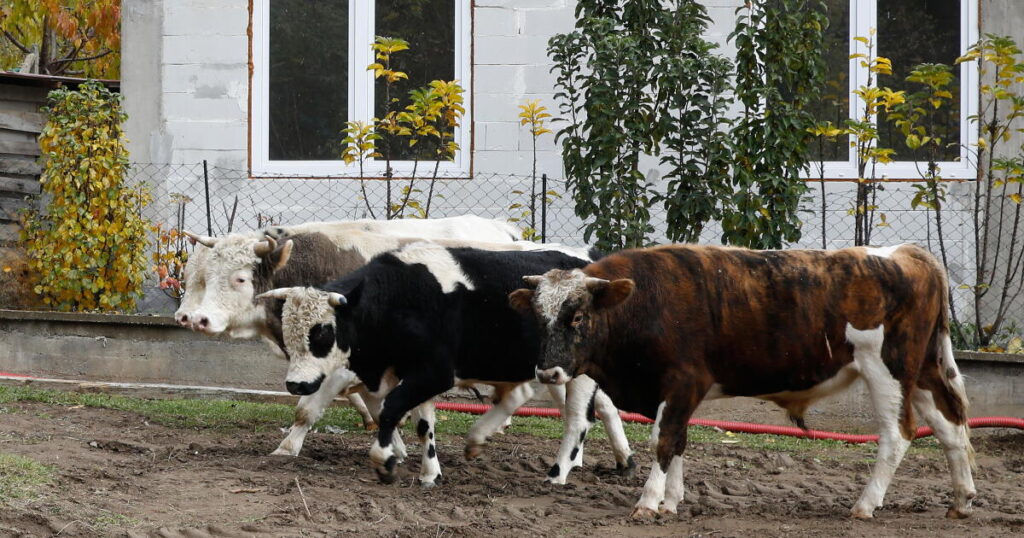
KRIVA PALANKA, North Macedonia — They descend from the surrounding hills, mostly at night, chomping their way through gardens and crops to satiate their hunger.
For years, residents of Kriva Palanka, a farming town of about 19,000 people in northeastern North Macedonia, have struggled with a herd of roaming cattle that has grown to more than 1,000 animals, destroying property and threatening their livelihood.
It’s not just crops. The wandering cows pose a serious risk to the town’s water supply and to drivers on a road that leads to neighboring Bulgaria, residents say.
Many fault the country’s bureaucratic maze for failing to enforce a 2024 Food and Veterinary Agency order to seize the herd from their three owners.
And even when authorities took legal action against one of the owners, bureaucratic failures derailed the case and allowed the owner to walk free, Kriva Palanka Mayor Sashko Mitovski said.
Mitovski said residents have had enough and are staging protests to urge authorities to take action.
He is asking the conservative government of Prime Minister Hristijan Mickoski to declare a 30-day state of emergency in the municipality for authorities to resolve the bovine problem once and for all.
“The number of cattle has increased from 400 four years ago to more than 1,000 today,” Mitovski told The Associated Press.
“We convened a crisis management headquarters because we concluded that, for years, none of the responsible institutions had shown either the willingness, commitment or capacity and resources to resolve the problem.”
Cows go unchecked
Pensioner Lazo Stamenkovski, 71, who lives on the town’s outskirts, said the cattle have destroyed more than 150 trees in his orchard.
“They constantly destroy the produce in my garden, wander onto the highway and endanger traffic safety on the road leading to Bulgaria,” Stamenkovski told the AP.
Several residents of a neighborhood on the town’s outskirts said the animals were not to blame, but the system was. They said some angry residents have beaten the cows and in some cases even slaughtered them.
“The government is responsible for everything that is happening to us. Not just this government, but all previous governments as well,” Venka Nikolovska, 59, a housewife from Kriva Palanka, told the AP. “We are all suffering — both people and animals.”
Despite their frustration, residents haven’t lost their sense of humor.
One man standing on the bridge over the Kriva Reka river that runs through the town said that the cows had gorged on the flowers in his backyard.
“Next time, I’ll prepare a flower salad and invite the cows to a party,” he said.
Authorities balk at the problem
Mitovski said the cows roam freely through 34 surrounding villages and he blamed the Food and Veterinary Agency for not enforcing its own order to seize the cattle from its three owners.
“Since 2024, the herd has been the property of the Food and Veterinary Agency. The absurdity is that the agency issued the seizure order but has failed to enforce it,” he said, adding that the municipality has no legal authority to intervene.
The mayor said some cattle died near the town’s main water sources last year, potentially poisoning the supply. He again faulted the Food and Veterinary Agency for failing to take action.
A government spokesperson did not immediately respond to an AP request for comment Friday evening.
One of the cattle owners was charged and detained last year for obstructing an agency operation to seize the animals. But Mitovski said the owner was released from custody after an agency inspector testified in court that he hadn’t obstructed the attempted seizure.
“What I am saying is that this is an interconnected system involving serious wrongdoing by numerous people, and it is difficult to determine where it ends,” Mitovski said.
He said a government declaration of a temporary state of emergency would provide authorities with the money and resources needed to resolve the problem permanently.
Some suggest putting the cattle up for sale
Based on current livestock market prices, the value of the herd is estimated at between $385,000 to $610,000.
Some residents point out that the government could put the cattle up for sale at an affordable price so people could buy them and take care of them.
That could help many in the country of 1.8 million people, at least one-third of whom live in poverty.
“North Macedonia imports meat, milk, vegetables and fruit, while 1,000 cows roam unchecked across the country and destroy the farms,” Nikolovska said. “It makes no sense.”
Testorides writes for the Associated Press.
The post Hundreds of roaming cows wreak havoc in North Macedonian town, frustrating farmers appeared first on Los Angeles Times.