Brian Weitz and Kyle Simon befriended each other in sixth grade at Sandy Run Middle School in the Philadelphia suburbs. They were both into music: Nirvana’s “Smells Like Teen Spirit” would hit a year after they met, and Guns N’ Roses was popular at their lunch table. And they relished time spent in the county’s planetarium, which happened to be at their school.
“Other schools would go there to do field trips, but we were just lucky it was in our school,” says Weitz, who records and performs under the stage name Geologist. “When we were in sixth grade, if you were going to have your day at the planetarium, the kids wore dark clothing, and it was like, could you sneak around on the floor without the teacher knowing?”
“It was the most memorable part of middle school to me,” says Simon, an artist and printmaker who now lives in Joshua Tree, California.
Weitz moved to Baltimore in ninth grade (and would go on to form the influential Baltimore-bred indie band Animal Collective), but the two stayed friends, trading cassette tapes and catching up when Weitz would return home to visit family.
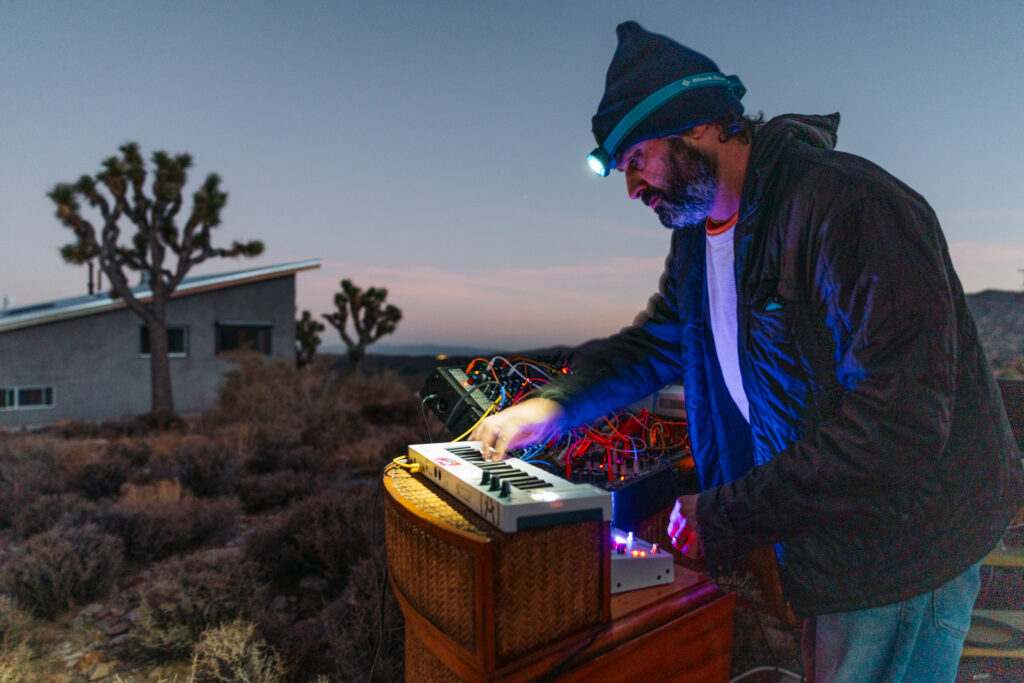
Three decades later, Weitz and Simon’s friendship has come full circle. Last month, they released “The Sirens,” a collaborative live album that uses a telescope to translate the light of the moon into a signal that powers a modular synthesizer, creating far-out ambient and atonal drones.
Weitz will present a recording of the album, which was released by experimental D.C. record label Outside Time, on Thursday inside the Planetarium at Montgomery College in Takoma Park, Maryland. The performance will even include projections of the moon in Joshua Tree from the night they made “The Sirens” during an intimate live performance in 2024.
The seeds for “The Sirens” date back to 2018, when Simon took over Farrington Observatory, a remote, abandoned station in Joshua Tree. As Simon began refurbishing Farrington, he also started building and learning about telescopes — including one, he says, that could “translate light into sound” through modular synths.
“I would do the shows by myself, but I couldn’t really do it properly,” he says, “and so who better to make the music of the stars than Brian?”
When Simon reached out to Weitz, who has long been on the vanguard of experimental music, he just happened to have recently started using a modular synthesizer. “If Kyle had called with this cool idea [a year earlier], I would have been like, ‘No,’ just because I wouldn’t have had the confidence or even, like, the technical know-how to know what he was proposing would be possible,” Weitz says. “It had all been building up to this moment.”
Though it sounds heady and complicated (and it is), the idea behind this project is fairly simple. First, Simon looks at a light source through the Farrington Observatory telescope. The light is translated into electricity that feeds into Weitz’s modular synthesizer as voltage, which he can then manipulate as sound. And they can really only do a performance when there’s a consistent light source, such as a full moon. (Simon likens the process to the magic trick of a theremin.)
To get more technical:
“There’s different diodes that I put onto the telescope,” Simon says. “Basically, it works like a solar cell works. Light comes in, and voltage, or electricity, goes out. … They run through an amplifier, which then goes into Brian’s modular setup as a voltage control.”
“Analog synthesizers work with voltage,” Weitz adds. “So you’re inputting voltage into something, you’re deciding where the voltage is going and what parameters that affects, and at the core of it is usually an oscillator that’s producing a tone. And then through voltage control you shape that tone.”
Simon moving the telescope to look at different parts of the moon changes the voltage sent to Weitz’s synth, which changes the sound it produces. “I’ll play a keyboard line, but you won’t necessarily hear it unless Kyle moves the telescope in a way that the voltage opens up that channel,” Weitz says. “The keyboard itself isn’t making noise; it’s just sending voltage to the same synthesizer that the machine is sending voltage to.”
“I look at it almost like my role is to journey around the moon and take everyone with me on the journey,” Simon adds. “And then Brian translates that into something that’s not going to smack you in the face too hard.”
While Weitz and Simon can do more concerts at Farrington Observatory in this format, they can’t re-create the music from that night or tour behind it, which is why they’re hosting this planetarium listening party in Takoma Park. “It’s a way of showing people, as best as you can,” says Weitz, who now lives in D.C. “You can’t really create the magic of being up on Kyle’s Hill in Joshua Tree with not much else around.”
Animal Collective once sampled radio emissions from Saturn’s rings recorded by NASA’s Cassini-Huygens spacecraft for the 2009 single “My Girls,” but Weitz had never made music this close to what space actually sounds like.
“I think these are the natural sounds,” Simon says. “It’s taking light and translating it into something that has this eerie quality to it.”
Simon called the album “The Sirens” as a nod to the sirens from Greek mythology and “The Odyssey.”
“When I first moved to Joshua Tree and would look up at the stars, your brain starts going wild about the possibilities,” Simon says. “Where do we fit in? All this stuff. At a certain point I’d be, like, ‘Stop thinking.’ And I saw a similarity to the sirens, this thing that is calling to you in this beautiful voice, but also is kind of driving you crazy.”
Thursday at 7:30 p.m. at the Planetarium at Montgomery College, Catherine & Isiah Leggett Math and Science Building, 7615 Fenton St., Takoma Park, Maryland. Free with registration.
The post How these childhood friends turned the moon into music appeared first on Washington Post.