Steven Ujifusa is the author of “A Man and His Ship: America’s Greatest Naval Architect and His Quest to Build the SS United States.”
On Nov. 11, the SS United States, the greatest ocean liner ever built in the U.S. and a triumph of mid-century American design, was deliberately sunk 22 nautical miles off the Florida coast to become the world’s largest artificial reef. The sinking represents the death of one man’s quest to achieve a certain type of immortality.
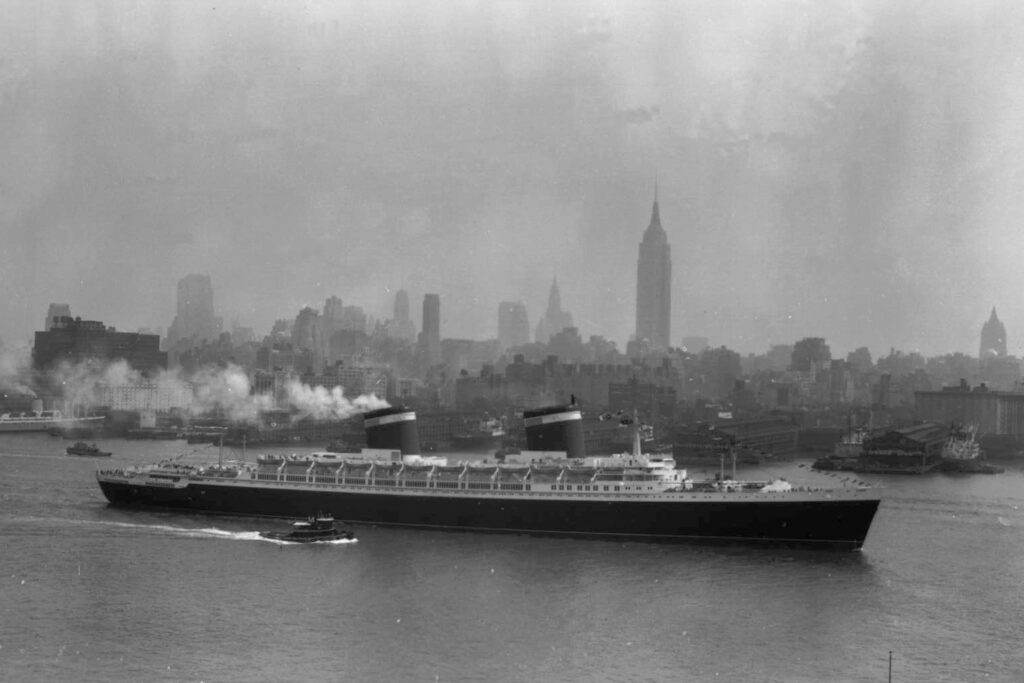
As a naval architect, William Francis Gibbs strove for perfection. Of his 990-foot-long superliner — able to carry 2,000 passengers in peacetime or 14,000 troops in war — he declared, “You can’t set her on fire, you can’t sink her, and you can’t catch her.” He thought he’d created a ship that would last forever.
The superliner’s maiden voyage in 1952 attracted publicity on both sides of the Atlantic. During the 1950s and early 1960s, the SS United States sailed at or near capacity, making roughly two round trips a month between New York, England and France. It also gave Gibbs something he had long avoided: fame.
In 1964, the 77-year-old Gibbs was the subject of a long feature in the New Yorker. In it, he opened up about his privileged Philadelphia childhood that ended in his father’s financial ruin, his burning desire to become a naval architect in spite of his legal training, and his iron will to do things his way — the best way — regardless of cost. “I studied engineering at night out of books,” he explained. “That’s the way to really learn things — by yourself.”
Almost without fail, Gibbs would get in his limousine and watch his ship arrive in New York Harbor. He would call the captain every day, yet he sailed on his ship only once, on its maiden voyage.
Gibbs came up with the initial concept for a 1,000-foot American superliner when he was a young man, but two world wars and the Great Depression got in the way. In the intervening years, his firm Gibbs & Cox designed hundreds of high-quality passenger and military vessels, including the Liberty ship and the D-Day landing craft.
His 40-year quest to build the SS United States came with personal costs. A workaholic, he was hard on his two sons and one stepson. Of his wife, the daughter of New York lawyer Paul Cravath, he said: “My wife is beautiful, intelligent, and considerate. We get along fine. She goes her way and I go mine, so we don’t see much of each other — maybe that’s why.” When a journalist asserted that Gibbs loved his ship more than his wife, he responded, “You are a thousand percent correct.”
Gibbs died on Sept. 6, 1967. Two years after his death, the SS United States was pulled from service and laid up. Once the last word in American technology, it had been rendered obsolete and unprofitable by jet planes and crew strikes.
Over the next 57 years, the SS United States would be sold multiple times, stripped of its interior fittings and furniture, towed across the Atlantic and back for asbestos removal, and left to sit at a pier in Philadelphia, its designer’s hometown. In 2024, faced with escalating docking fees, the clock ran out on the ship built to last forever. It was sold to Okaloosa County, Florida, to be used as an artificial reef.
On Wednesday afternoon, the hulk of the SS United States began doing the exact opposite of what its designer intended. Its funnels and mast were removed, and it went the way of all ships lost at sea. Its hull and mighty turbine engines will become encrusted in marine life; its public rooms will host fish rather than passengers. As the years go by, the ship that graced magazines and drew so much admiration will slowly collapse into a pile of rusted metal.
Perhaps there’s another way to look at the ship’s end: a sort of preservation. The ship has lasted 74 years, only 17 of which have been in regular passenger service. Now, in a final defiance of fate, it hasn’t been scrapped like scores of great transatlantic liners before it but given a Viking’s funeral — one that was watched in person or live-streamed by tens of thousands of people.
As the SS United States neared completion in Newport News, Virginia, Gibbs surveyed the vessel on one of his many inspection tours. Amid the clatter of the shipyard, he turned to a friend with an enormous grin on his face. “Boy!” he shouted, “Don’t we have fun!” Creators like Gibbs spend countless hours striving for perfection, in steel, stone, paint or print. They must make peace with the fact that the afterlives of their creations are far from perfect or predictable.
The post He created a ship to last forever. Now it’s at the bottom of the ocean. appeared first on Washington Post.