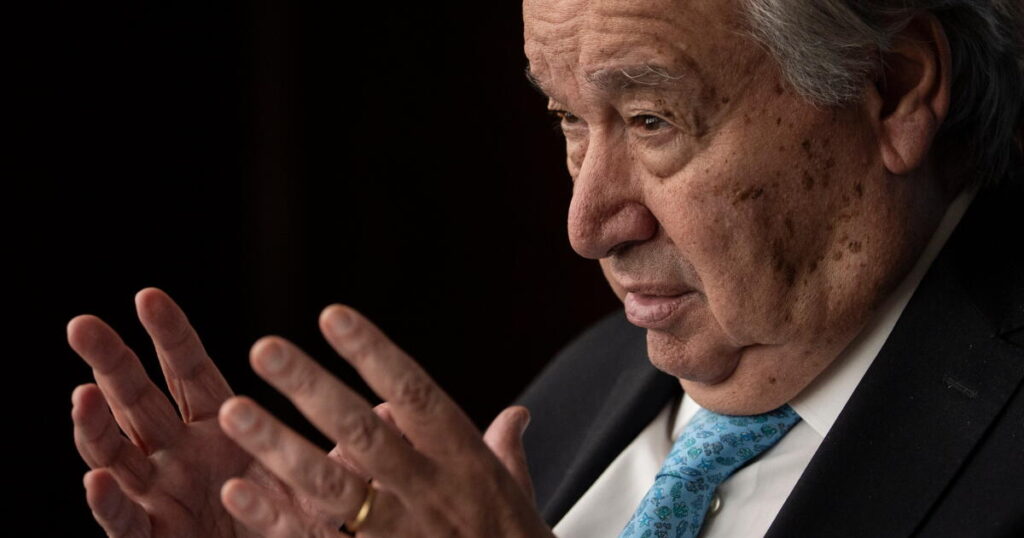
Energy sector profits that swelled alongside global conflicts are “morally unjustifiable” and should face additional taxes to fund climate measures, according to United Nations Secretary-General António Guterres.
“There’s something fundamentally wrong,” Guterres said Thursday in an interview with Bloomberg Television at the annual U.N. climate summit in Antalya, Turkey. “They are making these profits with an activity that is causing severe damage to the global environment and severe damage in the acceleration of climate change.”
Guterres has held discussions with governments about an additional levy on oil and gas companies, and told global leaders at the COP31 talks that a group of nine major producers had reported collective profits of $95 billion in the last quarter — many multiples higher than funding available to respond to climate disasters.
“Those taxes should be used to alleviate the situation of those that are suffering,” Guterres said in the interview. Nations have existing mechanisms “able to tax windfall profits — it’s a political decision, it’s not a technical problem,” he said.
European fossil fuel producers faced additional levies after Russia’s invasion of Ukraine sent fuel prices soaring, and tax collectors have been studying potential similar responses to the volatility triggered by the Iran war. The U.K. announced in May it would close a loophole that would prevent overseas oil and gas firms from paying little or no corporation tax in the country, and Poland’s government has imposed a further tax on producers of liquid fuel.
The European Commission, the bloc’s executive branch, is analyzing the potential effects of imposing a tax on windfall energy profits. It would be a “good idea” to use any such levy to finance climate adaptation measures, said Teresa Ribera, the EU’s antitrust chief.
Global leaders and diplomats gathered at the COP31 summit in Turkey are aiming to reinvigorate efforts on reducing emissions, delivering climate finance and the transition away from fossil fuels, particularly after a series of deadly heat waves and wildfires this year. Greenhouse gas emissions caused by human activity have led the planet’s temperature to rise 1.47 degrees Celsius above the average of preindustrial times for the first nine months of 2026, according to the U.N.’s World Meteorological Organization.
Debate around taxing energy profits is gaining traction in some quarters as other sources of climate funding have dried up. “If this isn’t the moment for governments to act, when will it be,” said Fanny Petitbon, a policy analyst with environmental nonprofit 350.org.
The Fund for Responding to Loss and Damage, created to help developing nations cope with climate disasters, currently stands at only $600 million, according to Guterres. “This looks like a joke,” he said.
Even so, many governments are reluctant to act on company profits. “The power of the oil and gas lobby is very high,” Guterres said.
In addition to climate change, artificial intelligence is also a potential “existential threat” to humanity and requires a “multilateral system of oversight of the safety risks,” Guterres said.
“I believe it’s in the interests of the companies to make sure that those risks are eliminated,” he said. “It’s also the guarantee of their own future, because if the companies lose control of their products, they will also not be able to make profits with those products.”
Millan and Zabasajja write for Bloomberg. Bloomberg writer John Ainger contributed to this report.
The post U.N. chief calls for windfall taxes on ‘unjustifiable’ energy profits appeared first on Los Angeles Times.