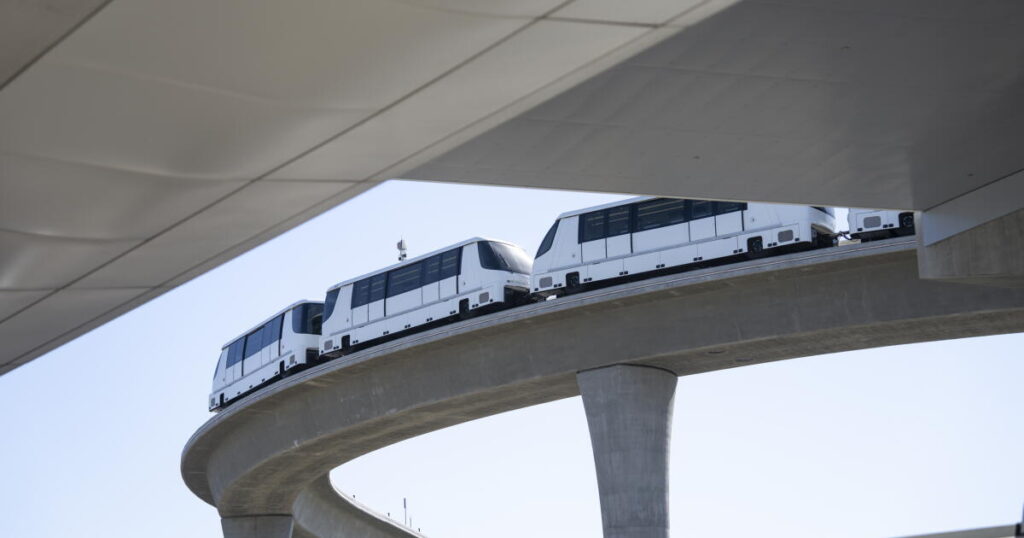
Credit agency Fitch Ratings has dealt another blow to the troubled Skylink people mover train at Los Angeles International Airport, downgrading the project’s debt deeper into junk bond territory over the continued inability of the contractor and city’s airport department to complete the project.
The downgrade — to B-, from BB four months ago — “reflects the near certainty”that contractor LINXS won’t have the 2.25-mile train running by Dec. 8, leading to a “technical event of default and could give rights to either LINXS or Los Angeles World Airports … to issue project termination notices,” Fitch said in a report this week.
“It’s an uncommon action of severity,” Fitch analyst Seth Lehman told The Times. “We were under the view that there was a fair amount of cushion for LAWA and LINXS to settle on disputes, or for LINXS to show that they can have the trains run safely per this reliability test.”
The contractor has already said the train won’t be ready until February 2027 — or even later. In a statement to The Times Thursday, a spokesperson said that “LINXS remains committed to working with LAWA to successfully deliver the Automated People Mover and provide a world-class transportation system for the Los Angeles region.”
LINXS, an acronym for LAX Integrated Express Solutions, is a consortium that includes Fluor, Balfour Beatty, Alstom Transport USA, ACS Infrastructure Development, HNTB, Dragaos USA. LINXS declined comment beyond the statement.
LAWA officials had no immediate comment on the latest bond downgrade.
The deadline for the train’s completion is Dec. 8. While the airport or the contractor could technically terminate the contract at that time, Lehman noted that there’s a 120-day buffering period to allow for additional time to settle issues.
“After you get past that date, then the question becomes: Will both sides still want to work with each other, or just decide to find a path toward separation?” Lehman said about the months-long grace period.
The contractor and city airport officials have long been at odds.
LINXS filed a complaint against the city over the summer blaming the airport for the delays. Last month, the airport disputed multiple claims that the contractor made in its monthly brief on the project. And meetings between chief executives for the contractor, airport officials and others that began last year stopped in August.
Though officials say the project is 99% done, there are multiple unresolved issues. Agreements to implement solar energy on the projecthave not been signed with the city’s water and power departments, and the cause of technical problems with the train are still under investigation, according to a recent report from the contractor’s technical advisor.
In order for the train to run, it must undergo 30-days of consecutive testing without substantial issues and get sign-off from the airport and an outside assessor. That month-long testing period has continued to restart.
The $3.3 billion train is the most-anticipated feature of the airport’s $30 billion overhaul. It was initially slated to open in 2023 — before the World Cup and the Super Bowl and long before the 2028 Olympics. It’s now three years behind schedule and more than $1 billion beyond its original construction budget. When it does open, the airport said it will shuttle travelers between terminals, parking lots, the LAX/Metro Transit Center and a new rideshare lot.
Lehman noted that the train is hardly a novel project as many major airports have one, making the delays at LAX all the more confounding.
“Each time there’s a path towards opening, there’s a setback,” he said.
The post Junk bond ratings on troubled LAX people mover drop again as key deadline nears appeared first on Los Angeles Times.