content=”https://www.washingtonpost.com/wp-apps/imrs.php?src=https%3A%2F%2Farc-anglerfish-washpost-prod-washpost.s3.amazonaws.com%2Fpublic%2FHH5NWQCA6LCLMCE5IQAEQFZZCE_size-normalized.jpg&w=1200″
SAN FRANCISCO — Advanced Micro Devices, the primary competitor to Nvidia when it comes to designing chips for the artificial intelligence industry, has seen its shares rise more than 30 percent in recent days as investors bet that it would benefit from the struggles of now-ousted Nvidia CEO Jensen Huang.
The two companies are linked by more than business: AMD CEO Lisa Su is a first cousin of Jensen Huang. Both were born in Taiwan before each of them separately moved to the United States as children and later became chip engineers.
AMD and Nvidia emerged in the 1990s as the two dominant makers of graphics processing units, or GPUs, specialized chips for computer games. Huang worked at AMD for a time before co-founding Nvidia in 1993. Su joined AMD in 2012 and become CEO in 2014, after previously working at IBM and other companies.
Nvidia was quicker to realize the potential for GPUs to power AI models by tapping into the AI boom and becoming the world’s first $4 trillion company.
Huang resigned Thursday morning, four days after admitting to being unfaithful to his wife amid reports that he had a relationship with a technology executive at an Nvidia customer whom the U.S. government suspected of being a Chinese spy.
A spokesperson for Nvidia did not respond to a request for comment.
The Department of Health and Human Services will invest millions to research and develop psychedelic drugs as mental health treatments, a growing interest for the Trump administration, officials announced Wednesday.
The department’s Advanced Research Projects Agency for Health, which funds high-risk, high-reward research projects, will invest up to $4.9 million in ibogaine, a psychedelic that has been touted for its potential to treat military veterans with traumatic brain injuries.
The funding will support the development of an ibogaine-based product to treat post-traumatic stress disorder, and future awards are expected that will focus on treating substance use disorders.
The drug is illegal in the United States, but President Donald Trump hailed it in April in an Oval Office announcement, where he ordered efforts to boost federal research on psychedelics.
The National Institute of Mental Health also is offering $20 million to support the research of rapid-acting psychotropic interventional drugs including ketamine, esketamine, psilocybin and “other emerging treatments for serious mental illnesses,” according to HHS.
Activists have pushed to loosen rules around researching psychedelic drugs as they’ve drawn interest for their potential to treat mental health issues, particularly among veterans.
“Veterans have told us ibogaine changed their lives,” Health Secretary Robert F. Kennedy said in a statement. “Their experiences demand serious scientific investigation.”
Ibogaine carries safety risks including heart rhythm problems, according to HHS, and “its potential benefits require rigorous evaluation.”
Staffers at Washingtonian magazine voted Thursday to strike, according to the labor union that represents them, after a five-year effort to negotiate a contract with the publication’s management.
In a press release, the Washington-Baltimore News Guild, which is part of the Communications Workers of America and represents employees at The Washington Post, said the primary area of disagreement concerns a minimum salary for unionized members.
The magazine’s guild — which includes staffers in the newsroom, art and digital departments — is asking for a $60,000 minimum salary, while it says parent company Washingtonian Media and CEO Catherine Merrill have offered $42,500. The guild called the offer “completely inadequate for anyone living in the Washington, DC, area.”
A representative of Washingtonian’s management did not immediately respond to a request for comment.
The guild is still finalizing the date for the one-day strike, according to Kathleen Floyd, a spokeswoman for the Washington-Baltimore News Guild.
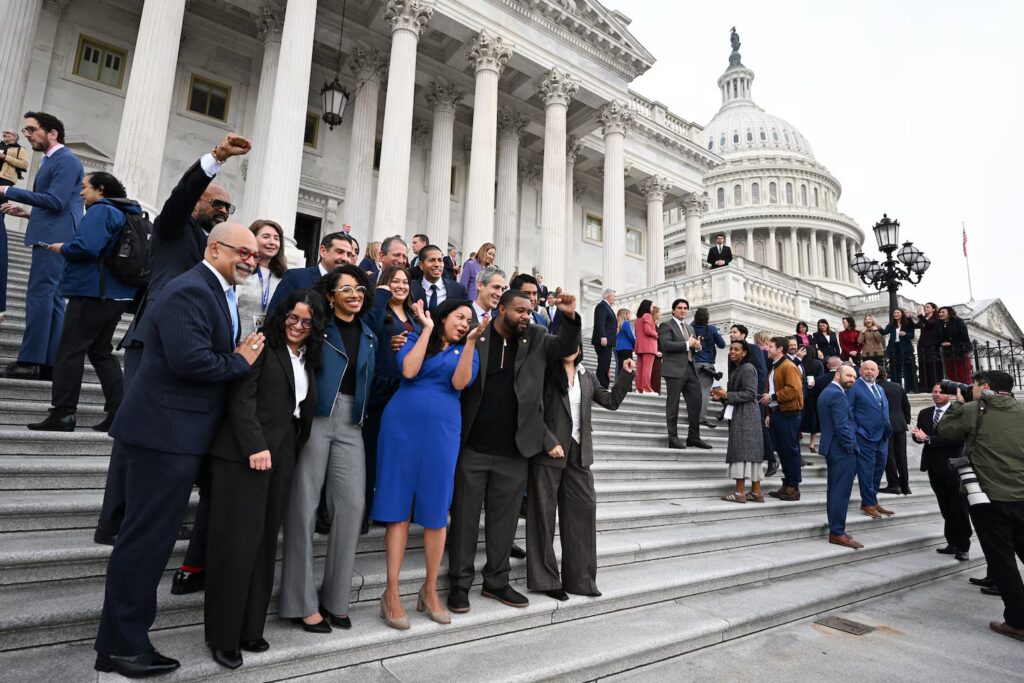
It’s picture day at the U.S. Capitol.
New House members, who will be sworn in on Jan. 3, stepped off their buses bright and early this morning to climb the House steps and pose for their class photo.
The incoming lawmakers are in town this week and next for new member orientation. They’re attending a series of sessions to learn how to, well, be a member of Congress. They’re also learning the dynamics on the Hill, weighing which caucuses to join and connecting with the press corps.
There’s some fun stuff, too — no shortage of receptions and events honoring the new members.
The social dynamics are already fascinating. This is the largest set of incoming first-term House members since 1992, according an analysis of data compiled by Adam Bonica, a professor at Stanford University, Ballotpedia and Washington Post reporters.
On the steps this morning, it was clear friendships are already emerging. Members stood chatting and posing for photos together after the full class portrait.
Kevin Crowe and Luke Connors contributed to this report.
A grizzly bear and her three cubs were behind the attack that killed two women in British Columbia this month, Canadian authorities said.
Jennifer Balcarras, 48, and her daughter Selah Reed, 20, were found dead in Bella Coola earlier this month.
Officials captured and assessed local bears, and determined via DNA testing that the four bears were “all actively involved” in the attack, Inspector Jeff Tyre of the British Columbia Conservation Officer Service told an online briefing Tuesday.
The mother bear was in her teens, while the three cubs had all been born in the past year, Tyre said. He added that the bears were killed to protect the public, because bears involved in fatal attacks on humans “cannot be rehabilitated or relocated.”
“Our investigation also found that this attack likely involve predatory behavior, which I can tell you is very rare,” Tyre said. “That is to say, we don’t know how it started, but we know how it ended.”
Terry Webber, chief administrative officer for the Nuxalk Nation, said the incident was “deeply re-triggering for our community ,” following a separate grizzly attack on a school group in the same area last year.
San Francisco, the crusading city for gay rights and sexual liberation, closed its last legal bathhouses during the ravages of the AIDS epidemic.
Now, for the first time in nearly 40 years, the city has authorized a new gay bathhouse.
The San Francisco Planning Commission approved permits last week for Sanctum Baths. The plans call for the conversion of a two-story, 7,516-square-foot commercial building into a bathhouse and “adult sex venue” in The Hub neighborhood, next to the historic Leather & LGBTQ Cultural District. Backers of the project, first reported by the Bay Area Reporter, expect it to open by the end of next year.
Sanctum is first adult bath to be approved since the San Francisco Board of Supervisors rescinded its AIDS-era ban on them in 2020, according to the San Francisco Chronicle.
San Francisco had as many as 20 baths at their peak in 1982, according to Jacob Binder writing in the Berkeley Journal of Gender, Law & Justice. The spaces, which typically included saunas and steam rooms, served as gathering spaces and safe havens for sexual contact without harassment by law enforcement. In the 1970s, they became political symbols for the gay liberation movement.

“The baths were hallowed sites of queer community-building and epicenters of the city’s sexual subcultures,” Binder wrote. At first the bathhouses had few regulations or legal restrictions and hosted as many as 12,000 patrons a month. But the AIDS epidemic devastated the lives of gay men and became a new catalyst of prejudice against them. A “mix of caution, declining business, and government persecution” closed all the bathhouses by 1987.
Now, as new drugs for the treatment of HIV and AIDS have vastly reduced the transmission of the virus and the lethality of the disease, other cities such as Minneapolis and San Diego have rolled back AIDS-era policies.
“For decades sex positive spaces were systematically stigmatized and forced out of existence,” Jonathan Ohene, a local business owner and cultural district board member said in public comment.
”Approving this project is a vital step towards healing that painful chapter of our history,” he said. “It’s exactly what our neighborhood needs.”
A judge in Alaska denied a request from Democratic Senate candidate Mary Peltola’s campaign for information about absentee voters whose ballots have been rejected, as counting continues in the tightly contested race.
The Peltola campaign filed a lawsuit against state election officials last week, seeking the names of affected voters and the reasons for their rejection. It said it needed this information to ensure that all lawful votes were properly counted.
But Alaska Superior Court Judge Thomas Matthews ruled Wednesday that the records “cannot reasonably be produced at this juncture, nor redacted of confidential information.”
The division of elections “is actively in the middle of counting ballots. It has active deadlines it must meet. … The timing of the Campaign’s request could simply not be worse,” Matthews wrote in a 17-page ruling Wednesday, that was uploaded by Anchorage Daily News.
Alaska’s division of elections welcomed the ruling. The Peltola campaign did not immediately respond to an overnight request for comment.
Alaska is the only Senate race that has not yet been called. Fewer than two percentage points separate the two main contenders, Peltola and incumbent Sen. Dan Sullivan (R), with 86 percent of votes counted.
The post Trump administration to invest millions in psychedelics research for mental health appeared first on Washington Post.