A month after its opening in 1913, the Théâtre des Champs-Élysées in Paris was the site of what was then described as a riot or near riot in reaction to the debut of Igor Stravinsky’s ballet and orchestral work “Rite of Spring.”
The piece, depicting a pagan ritual that includes a woman’s sacrifice — all set to Stravinsky’s dissonant and jolting score — divided the highbrow Parisian audience, but is now considered a turning point in modern dance and music. But stories of fistfights and flying objects have endured for more than a century.
The newly built theater — designed in the Art Deco style that became a global phenomenon in the 1920s — quickly became known as a place of groundbreaking works. Josephine Baker debuted her “Danse Sauvage” there in 1925, a milestone as the Jazz Age redefined Parisian high society.
For his inaugural season as general director, Baptiste Charroing isn’t anticipating riots or defining milestones, per se, but he’s hoping for some audience reactions nonetheless.
With its usual lineup of orchestral works and concert stagings of operas, the theater is currently presenting its first fully staged opera of the season with Giacomo Puccini’s “Manon Lescaut,” through Nov. 15, which hasn’t been seen on the Paris stage for 30 years, Charroing said.
“I believe Paris is now the world capital of classical music and especially opera because you have two venues with the Opéra de Paris, but also the Opéra-Comique. And here at the Théâtre des Champs-Élysées, we are doing four or five operas every season, but also 22 operas in concert versions,” Charroing said in a video interview. “At the moment you can spend a week in Paris and experience opera in a different venue almost every day.”
For Charroing, who is a trained violist and served as the theater’s director of production starting in 2020, it’s about honoring the theater’s legacy of presenting overlooked works as well as quality stagings of standard repertory.
“Before I assumed this position, we had many baroque projects and now I’m trying to balance that with classical romanticism and modern repertoire,” he said. “We have a strong identity with French music. The very first concert at the theater in 1913 you had Paul Dukas and Camille Saint-Saëns conducting their own works.”
Charroing pointed to a production of “Orphée,” Hector Berlioz’s adaptation of the opera by Christoph Willibald Gluck, planned for April, with one of the top orchestras in France in the pit, as a highlight of the season.
“I’m lucky because I don’t have an established orchestra at the theater, so I can work with different orchestras in Paris and get the best orchestra for the repertoire I need,” he said. “I have Les Siècles doing ‘Orphée’ and this orchestra is absolutely the best for this type of music.”
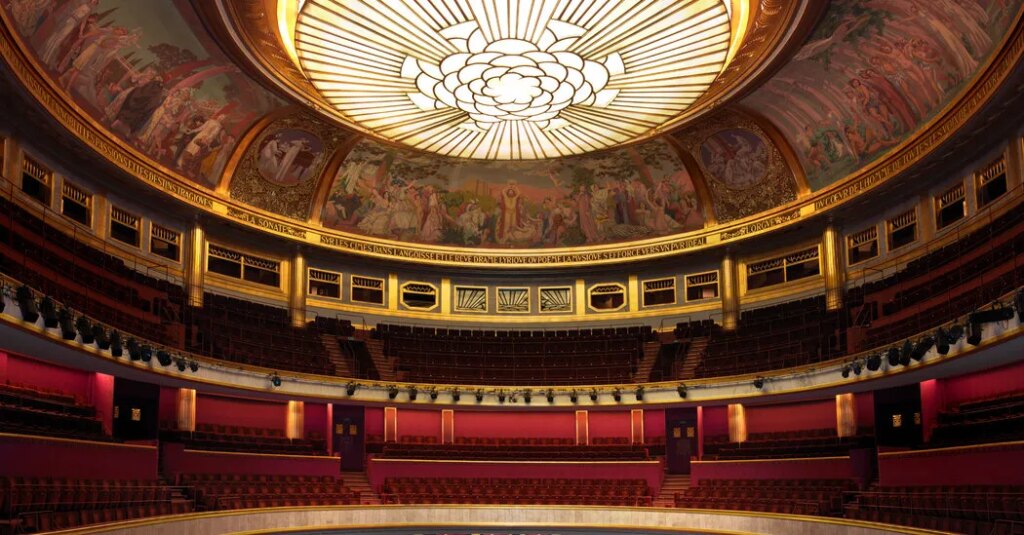
The roughly 1,900-seat theater, designed by Henry van de Velde, along with Auguste and Gustave Perret, brothers known for their revolutionary use of reinforced concrete, is celebrated for its acoustics, its lush ceiling murals designed by the French artist Maurice Denis and its red and gold colored seats. There are supertitles, in French and English, above and on the sides of the stage, and some of the common areas have been expanded for intermission mingling.
“If people are coming back to the Théâtre des Champs-Élysées, they will see a completely different space, and we have extended the intermission time to 30 minutes,” he said. “This is a very important time for people.”
For the Samoan-born tenor Amitai Pati, the theater is one of the finest places to sing. He and his brother Pene Pati, also a tenor, will both sing at the theater this fall in separate productions (Pene will sing in a concert version of Puccini’s “La Rondine” on Nov. 19.)
“Before I even set foot in the theater, I knew a lot about it because I had heard about the level of the performances, the concerts, the operas,” Amitai, who will sing the role of Nadir in a new production of the Georges Bizet opera “The Pearl Fishers” in December, said in a video interview. “This theater is iconic in its history but also in the very high quality of the performers.”
For the well-heeled Parisian audiences, the musical landscape of the city has changed over the decades, but the Théâtre des Champs-Élysées has remained a constant.
“I see it as a major venue in the musical life in Paris,” Alain Lanceron, chairman emeritus of Warner Classics and Erato and a longtime Paris resident, said in a video interview. “Years ago, before the Bastille Opera opened in 1989, you had the Opéra Garnier, Salle Pleyel and Théâtre des Champs-Élysées. Those were the big three.”
Salle Pleyel, once the pinnacle home of classical music, is now mostly for pop music, he said, and La Cité de la Musique, home of the Paris Philharmonic, was constructed in 1995 north of the city. That leaves the Paris Opera’s two opera houses and the Théâtre des Champs-Élysées in the city center.
“The Théâtre des Champs-Élysées is special because it’s intimate and you are in direct contact with the stage wherever you are seated, which is very important,” Lanceron said. “And the location, of course, is on the Avenue Montaigne, so it’s a chic audience.”
As a young man, Lanceron saw the soprano Maria Callas perform at the theater on her farewell tour with the tenor Giuseppe Di Stefano in December 1973, just a short distance from her Paris apartment where she died at age 53 four years later.
Lanceron was also in the house when the pianist Vladimir Horowitz, who was born in the Russian Empire (present-day Kyiv, Ukraine) and had been in a self-imposed exile, played two concerts at the theater in October 1985 before returning to the Soviet Union after 61 years for performances in 1986.
For Charroing, that’s an example of how each person experiences something distinct at the theater.
“What is the experience you live when you arrive at the theater, when you are at the intermission and what you do after?” he asked. “We share something together. In French, we have a word for it: convivialité.”
It is reflected in one composer’s assessment of the Théâtre des Champs-Élysées, Charroing added.
“The name of this theater is the house of music,” he said. “And it was given to us by Debussy. And I can’t argue with Debussy.”
The post A Glamorous Paris Theater Where a Ballet in 1913 Caused a Riot appeared first on New York Times.