Walter Stahr is the author of “William Howard Taft: A Great American Life.”
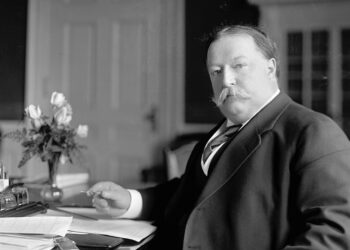
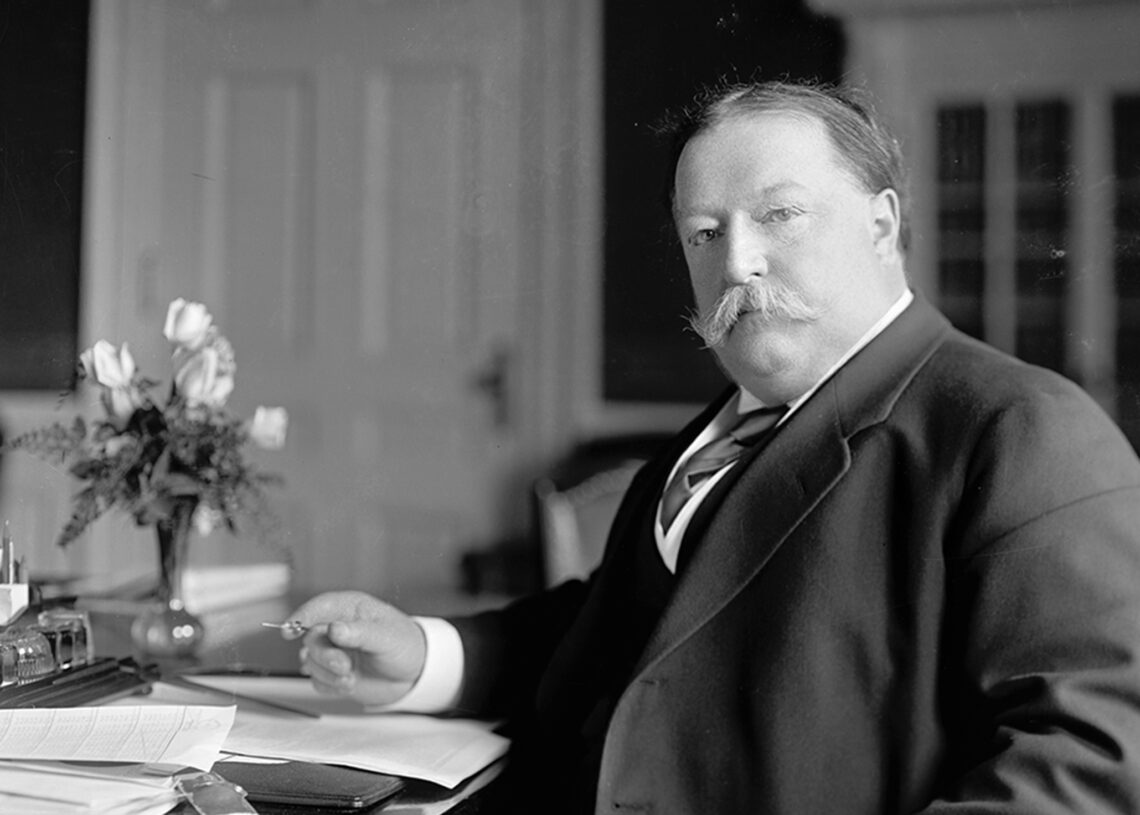
In an executive order last week establishing the Oval Office as a national monument — making it more difficult to modify the room — Donald Trump cited President William Howard Taft. It was under Taft, the nation’s 27th president, that the corner-less office was first constructed. Under Trump, it has undergone a golden makeover, one that he apparently wants sealed in amber after he leaves office.
Perhaps the respectability of precedent is why the president wants to hitch himself to Taft, who was in office from 1909 to 1913. Indeed, there are some superficial similarities between Trump and Taft. Both Republican. Both overweight. Both golfers — though there was never a hint that Taft cheated on the golf course.
The differences, however, are far more significant.
Taft was a modest, decent man, beloved even by those with whom he differed. Responding to a flattering 1907 profile during his presidential campaign, Taft wrote to the reporter that he hardly recognized the man described, “knowing his defects as I do.”
Taft’s principal legislative accomplishment in his first year as president was a bill that reduced many import tariffs and, in some cases, eliminated them. At a time when most Republicans favored high tariffs as a way to protect American industries, Taft understood that they increase consumer prices.
The federal budget deficit in fiscal year 1909, during which Taft became president, was $89 million. Through strict fiscal discipline, Taft trimmed it in the next year to $18 million, and in the following year, the federal government had a surplus of $11 million.
Taft appreciated the role of immigrants. In 1913, he vetoed a bill that would have restricted immigration by imposing a strict literacy test. One of the bill’s proponents claimed that it would keep out “thugs, desperados … anarchists and criminals.” Taft disagreed, arguing that the test would merely keep out those who could not read because they had been denied educational opportunities.
Taft loved Washington — its parks, open spaces and classical buildings. He signed the bill creating the Fine Arts Commission. Unlike Trump, who has stacked the commission with his allies, Taft appointed leading architects such as Daniel Burnham and artists such as Daniel Chester French. Taft also signed the bill creating the Lincoln Memorial Commission in 1911 and then served more than a decade as its chairman. Taft was intimately involved in the memorial, supporting rather than undermining the architects and artists. For example, when architects advised using a Colorado marble and Southern politicians pressed for a Georgia marble, Taft insisted on Colorado and prevailed.
Overseas, Taft avoided foreign wars and worked closely with key allies. More than once in Taft’s term, papers reported that Americans had been killed in the crossfire of the Mexican Civil War. After deaths in Douglas, Arizona, in 1911, the territorial governor sent an urgent message to Taft, pleading with him to take “radical measures.” Taft responded that although he might be legally justified in sending troops into Mexico, it would lead to war, putting at risk not only troops but American residents of Mexico.
One of Taft’s key foreign priorities was an agreement to reduce trade barriers with Canada. For Taft, this was not only about economics; it was about strengthening bonds between two kindred nations. Taft succeeded in getting both houses of Congress to approve the agreement before it was rejected by the Canadian voters — some of whom feared it might be a first step toward annexation.
Taft worked full time as a federal judge for eight years before becoming president; eight years after leaving the White House, he became chief justice of the United States. He had an almost religious reverence for the Constitution. When some suggested disregarding federal laws to save western forests, Taft disagreed. “We have a government of limited power under the Constitution,” he wrote in 1909, “and we have to work out our problems on the basis of [the] law.”
After he left the White House, Taft and his predecessor, Theodore Roosevelt, disagreed about the proper role of the president. Roosevelt, in his 1913 autobiography, mocked Taft’s narrow view that the president could do only what was granted by federal statutes and the Constitution. Taft warned, in his 1916 book about the presidency, that “ascribing an undefined residuum of power to the President” could “lead under emergencies to results of an arbitrary character, doing irremediable injuries to private rights.”
Taft’s original version of the Oval Office was modest and austere, with dark green walls and no trophies. It was consistent with his view of his role. In 1912, in the midst of the presidential campaign in which he would suffer the worst defeat of any incumbent president, Taft described his administration to his wife as a “very humdrum, uninteresting administration,” one that “does not attract the enthusiasm of anybody.” He was nevertheless proud of having “done something of benefit for the public.”
Taft’s approach to the presidency, doing the “humdrum” work of administering the laws and observing the Constitution, looks far more appealing today than it did at the time.
The post Trump’s golden Oval Office defies the president who created it appeared first on Washington Post.