Abed Abu Shehadeh, a 38-year-old journalist and a Palestinian citizen of Israel, said he was putting on his pajamas on the evening of Nov. 3 when police officers and intelligence agents burst into his family’s third-floor apartment in Jaffa.
They strip-searched him, confiscated his phone, allowed him to dress and then whisked him away, he said in an interview at a restaurant in the city.
Five days later, after interrogations by Israel’s domestic security agency, the Shin Bet, Mr. Abu Shehadeh, who lives with his wife and two young children, was let go.
A former elected member of the Tel Aviv-Jaffa City Council, Mr. Abu Shehadeh has not been charged with a crime. The Israeli authorities have not publicly offered a reason for his arrest, though court records reviewed by The New York Times show that he was accused of being in contact with an unnamed “foreign agent.”
His highly publicized arrest — a week after Israel’s national elections — came as Prime Minister Benjamin Netanyahu and his allies have claimed that foreign actors illegally funneled large amounts of money to bribe Arab citizens to vote for Arab political parties.
Critics say that Mr. Netanyahu and his allies are seeking to undermine the legitimacy of the record gains by Arab parties in the Parliament, or the Knesset, by contending without basis that Arab voters stole the election.
Mr. Abu Shehadeh’s arrest has intensified warnings from prominent analysts and former security officials that the Israeli security services are overstepping their authority and becoming dangerously politicized in trying to promote the prime minister’s objectives.
The Shin Bet is “smearing a broad, legitimate segment of citizens fighting for their rights,” Adm. Ami Ayalon, a former director of the security agency, said last week after meeting with its current leadership. He added that the Shin Bet was “failing in its most critical duty: defending the democratic system and its institutions.”
The Shin Bet did not respond to a request for comment. The police did not immediately respond for a request for comment.
Arab voters turned out during the election last month in huge numbers, delivering 19 seats in Israel’s Parliament to two Arab parties.
Mr. Netanyahu and his allies’ share of Knesset seats declined and their path to forming a new governing coalition narrowed. The leader of the anti-Netanyahu opposition, Gadi Eisenkot, is trying to assemble a coalition and could turn to the Arab parties for support.
During a speech on Tuesday in Parliament, Mr. Netanyahu repeated demands to investigate claims that foreign actors influenced the election results and called Arab lawmakers “terror supporters” and “Israel haters.”
Police and intelligence investigators have not publicly shared any evidence to back up the allegations. Last week, Noam Sohlberg, a Supreme Court justice chairing the Central Elections Committee, certified the final vote tally and dismissed attempts to cast doubt on Arab votes.
A day after his release, Mr. Abu Shehadeh said he was confident that the Israeli authorities would not have arrested him if Arab voter turnout had been lower.
“It’s political persecution to delegitimize Arab voters,” he said, while munching on pizza as a steady stream of well-wishers stopped to embrace him.
Mr. Abu Shehadeh said that his interrogators centered their questioning on his work as a journalist, specifically a podcast interview he conducted in Qatar last month ahead of the election with Azmi Bishara, a former member of the Israeli Parliament.
Mr. Bishara, a prominent Arab intellectual now based in Qatar, was accused by Israel in 2007 of spying for Hezbollah, the Iran-backed militant group in Lebanon.
Mr. Bishara has denied any wrongdoing and said in a statement on Tuesday that he has not returned to Israel since he was accused because he lacks “faith in the fairness of the Israeli judicial system when it comes to security-related charges.”
Mr. Bishara rejected any suggestion he was a “foreign agent” and emphasized that he is a “researcher, writer, and a progressive, liberal democrat.” He said that he granted the interview to Mr. Abu Shehadeh in hopes of sharing his analysis of “the situation with Arab citizens within Israel” and “to help increase voter turnout, which is essential for ousting Netanyahu’s current coalition.”
He added, “I hope my interview has had some impact.”
Israeli journalists routinely speak with people that the Israeli government considers adversaries without facing legal consequences. Some have even stayed in contact with Hamas officials, including after the group’s Oct. 7, 2023, attack against Israel.
Mr. Abu Shehadeh, who was born in Jaffa, had worked as an auto mechanic until, he said, the murder of a close friend motivated him to finish high school and enroll in university. In 2018, running on the slate of Balad, a Palestinian nationalist party in Israel, he won a seat on the Tel Aviv-Jaffa City Council, where he worked on several initiatives promoting Arab-Jewish understanding.
When violence broke out between Arab and Jewish citizens in some Israeli cities in 2021, Mr. Abu Shehadeh worked with young Arabs to ease the tension.
After leaving the City Council, he has worked as a journalist, both as a podcast host for Arab 48, a local news site focusing on Palestinian issues, and as a political commentator on television.
Mr. Abu Shehadeh said he worried that his detention marked a dangerous turn by the Israel authorities toward persecuting political dissidents. “First they will come for us, the Arabs,” he said. “Then they will come for anyone who opposes the government.”
While held last week in a windowless jail cell, Mr. Abu Shehadeh said, he feared he would be locked away for a long time.
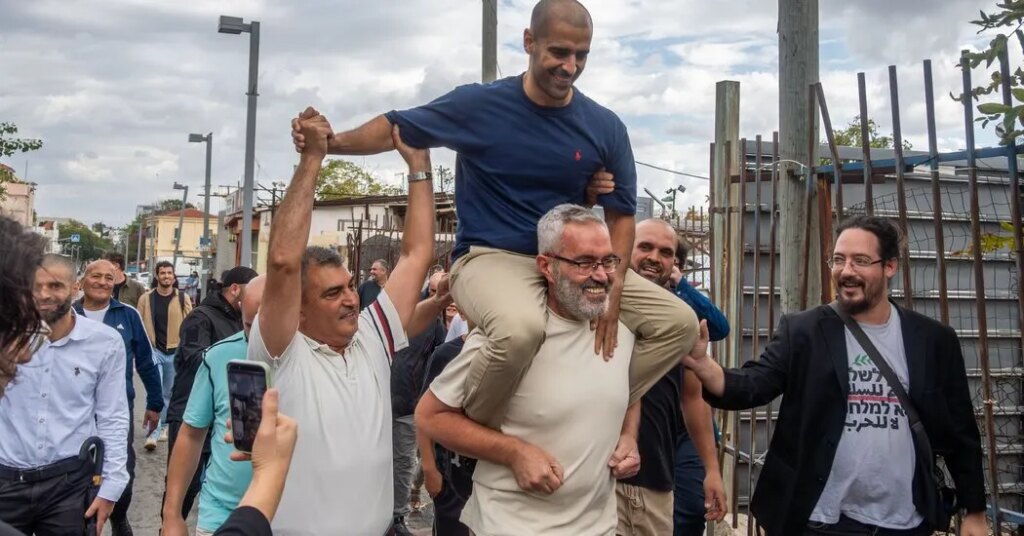
Hours after his release on Sunday, he urged more than 100 Jews and Arabs, who had gathered in a community center to welcome him home, to speak out.
“Don’t be fearful,” he told the cheering crowd, saying that history changes for the better when people refuse to be intimidated.
“We are fighting for a better future to both nations,” he said, referring to Israelis and Palestinians, “because that’s the right thing to do.”
Ronen Bergman contributed reporting to this article.
The post Journalist’s Arrest Adds to Fears Israeli Security Agency Is Being Politicized appeared first on New York Times.