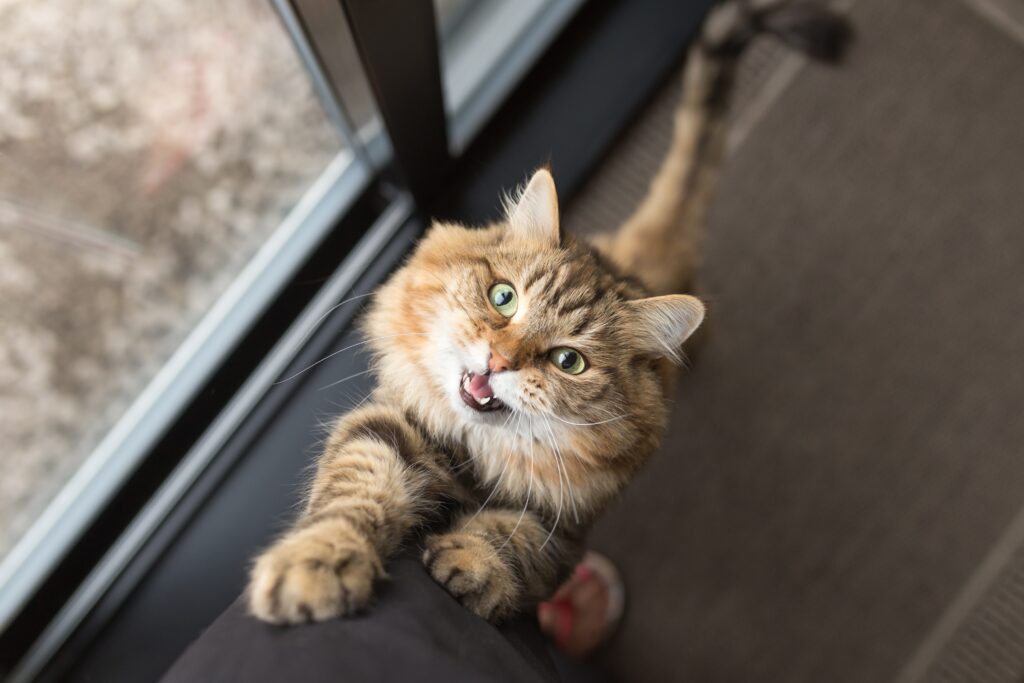
I have a 13-year-old spayed tabby cat that does not go outdoors. Lately she has been meowing incessantly. She starts about 5 a.m. and wakes up everyone in the house. After I feed her, she stops, but she starts again at bed time. Recently, her meow has turned into a persistent, guttural wail, and it can continue for more than an hour. I’ve tried ignoring her and feeding her at the same time of day, but it hasn’t helped; in fact, it just seems to reinforce the behavior. I’ve also tried a late-night snack to reduce early morning hunger. No luck!
Through long-standing interactions with humans, domestic cats have developed a complex repertoire of calls to communicate with humans and other cats. Use of cutting-edge acoustic analysis tools has recently allowed scientists to identify several different categories of cat vocalizations — chirps, tonal meows, noisy meows and shrieks/trills. Even within a category, there is variability from one cat to another. To complicate matters further, the same cat “meow type” can be interpreted to mean different things from one human listener to another.
This being said, what you’re describing might be a loud meow or a sound that is often referred to as a caterwaul: a harsh, drawn-out wailing noise that differs from the short, chatty meows that cats make when they’re asking for something or being affectionate toward people.
Cats can caterwaul or howl when defending their territory or as part of mating behavior, but indoor cats that are neutered more often howl or meow loudly and persistently because they want attention or they’re bored. If there’s a new pet in the house or disruption to the normal household routine, your cat might also be vocalizing as a sign of anxiety.
However, loud meowing or yowling can also be a sign of underlying health problems, especially if the behavior gets worse with age. Here are some of the conditions that can lead to constant meowing, and how you can try to resolve it so that your cat feels better and everyone in your house gets more sleep.
What medical issues can cause constant meowing and howling?
As mentioned, when constant meowing or howling gets worse with age, it’s more likely to indicate a health problem. But cats of any age could have a medical issue that makes them more vocal than normal. The main ones vets worry about include:
- Pain and anxiety. Pain in older cats can be due to arthritis, dental problems, blood clots and other common medical conditions like pancreatitis and lower urinary tract disease. Anxiety that results from vision and hearing disorders can also lead to increased meowing; if your cat is deaf, it might yowl all the louder.
- Hormonal disorders. The most common hormonal disorder of older cats that leads to increased vocalization is a condition called hyperthyroidism. Hyperthyroidism occurs when a nodule in the thyroid gland produces too much thyroid hormone, which can lead to behavioral changes such as increased activity and aggression, weight loss, increased appetite and increased thirst.
- Brain damage due to infections, cancer or high blood pressure. In addition to meowing often, cats with these problems usually also have neurological signs like walking in circles, apparent blindness, not eating or falling over.
- Dementia. Just like dogs can develop dementia, cats can experience an age-related senile condition known as feline cognitive dysfunction syndrome (CDS). A 2010 study found that 35 percent of cats aged 11 years or older had signs of CDS, which include excessive vocalization, house soiling, disorientation, aimless wandering, restlessness, decreased grooming, irritability and aggression. Excessive vocalization is one of the most common owner complaints. If your cat is eating normally, not losing weight and only howls around dinner time, it’s quite possible it has CDS.
Is there anything I can do to stop my cat from howling?
It’s best to first have your cat evaluated by a vet to rule out underlying medical conditions. To catch medical problems early, twice yearly health examinations are recommended for senior cats (those over 10 years of age).
It’s helpful if you can bring documentation of abnormal behavior, such as a daily journal and audio or video recordings. Bring any medications and supplements with you and be prepared to provide information on your cat’s diet, daily routine, water intake, food intake and any problems urinating or defecating.
Your vet will do a thorough exam for vision problems, hearing problems, dental disease, arthritis, signs of hyperthyroidism and abdominal pain — among other things. They might also measure your cat’s blood pressure; often this is done before a physical exam and while you are in the room, when your cat is as calm as possible.
Based on what they find during the exam, your vet may also take a blood sample to run various tests including a complete blood cell count, a thyroid hormone test, kidney and liver function tests and certain infectious-disease tests. Your vet might also use a needle and syringe to collect a urine sample from the bladder, often with the help of ultrasound.
A variety of medications can be used in cats to successfully treat pain, hyperthyroidism and high blood pressure. However, it’s important that you don’t try to treat these with over-the-counter medications for humans. Cats break down drugs very differently to humans and can experience life-threatening side effects when given drugs used for humans like acetaminophen or ibuprofen.
If there’s no obvious underlying medical cause, here are some things you can try.
- If possible, ignore your cat when it is howling and instead pay attention to it when it is calm. Try to anticipate your cat’s needs before howling starts. Consider trying a timed feeding machine to dissociate your presence with feeding.
- Offer environmental enrichment for your cat during the day through play and by providing toys, perches and new resting areas. Try toys that contain catnip or puzzle toys that you can fill with food. Make any environmental changes gradually, because big changes might increase anxiety and make the problem worse.
- Keep the litter box clean and make sure your cat has access to it as well as plenty of clean water. If you think your cat might have vision problems, try leaving a night light on at night, and remove any clutter that might be creating stress.
- Talk to your vet about supplements that might reduce anxiety, such as a pheromone spray. Your vet might also suggest certain antianxiety prescription medications.
It’s best to only change one thing at a time, and then wait a week or two to assess the results before trying something new. Too much change can not only cause anxiety but it can also lead to other behavioral problems, like urinating outside the litterbox or disinterest in food. Also, if your cat is very overweight and stops eating because of stress, a life-threatening liver problem called hepatic lipidosis (fatty liver) can develop.
Because cats can hide their health problems until disease is very advanced, if in doubt, it’s best to seek vet care earlier rather than later.
The post 4 reasons your cat won’t stop meowing — and what to do about it appeared first on Washington Post.