Halfway through the morning, I’m being tossed around like a popcorn kernel in the back of a troop carrier playing an eclectic medley of Backstreet Boys and Papua New Guinean jams.
We’re traveling along what feels more like a collection of loose rocks, arranged to be roughly vehicle width, than a road. I’ve lost count of the number of river crossings, including one where the water lapped a few inches from the car’s windows. And this is during a dry spell.
Our caravan is headed for an unlikely tourist destination deep in the jungle on Bougainville Island, an autonomous region of Papua New Guinea in the Solomon Sea.
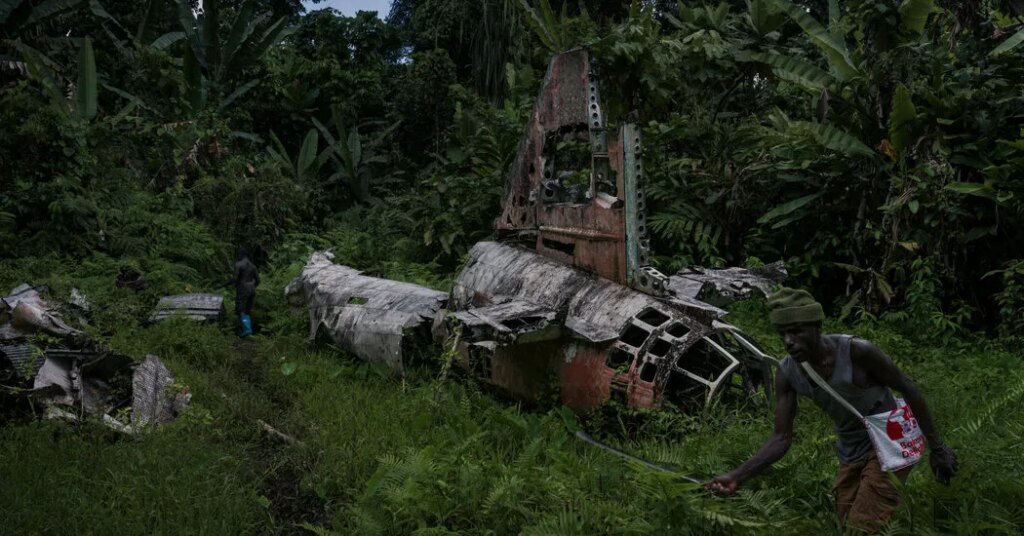
The piecemeal remnants of a Mitsubishi G4M1 — Betty, as the planes were code-named by the Allies in World War II — have remained for some 80 years at the crash site of Japanese Navy Adm. Isoroku Yamamoto. This is the spot where Admiral Yamamoto, mastermind of the Pearl Harbor attack, archvillain to Americans in the war, a respected and memorialized figure to the Japanese, met his end in 1943.
Bougainville was occupied by the Japanese in early 1942, in the months after Pearl Harbor, as the Imperial Navy pushed into the South Pacific, with Admiral Yamamoto at the helm. In April 1943, Allied forces intercepted and deciphered Japanese communication on the admiral’s travels, and American P-38 Lightning fighters gunned down his plane over southern Bougainville, a feat the Americans triumphantly dubbed Operation Vengeance.
Visiting the relic is not for one faint of heart, time or expense. And yet, war history buffs, Japanese pilgrims, a Chicago hot dog baron and lately, YouTubers, have made the journey, bringing a mix of curiosity, complicated feelings on war and, for many, the desire for bragging rights over going where few have gone.
So far, my journey has involved a flight to Port Moresby, the capital of Papua New Guinea, then a domestic leg to Buka, in the Autonomous Region of Bougainville. From there, it’s a ferry ride across a narrow strait, then four hours by rough, unsealed roads to the coastal town of Arawa. Then, another four hours by even rougher roads, up and over the fog-shrouded Crown Prince Range — to get to the start of the trek into the jungle.
I was in Bougainville with the photographer Matt Abbott to report on the region’s quest for independence, and the lasting legacy of a decade-long civil war that broke out in 1988. On our final day, we made a visit to Admiral Yamamoto’s plane.
I was curious why people would go to such lengths to reach the site. I imagined I might encounter Japanese visitors reflecting on their country’s legacy in World War II, or American or Australian tourists who knew of the place through family lore passed down by Allied servicemen.
As it happened, when I contacted Zhon Bosco Miriona, who runs Bougainville Experience Tours, the group scheduled to make the trip that day was made up of Chinese tourists.
So there we were in three cars — seven Chinese visitors, two journalists, a handful of guides and drivers — making our way to the crash site. As I learned on the bumpy ride, members of the group had found each other online, looking for others game to go off the beaten path.
They were from wildly different walks of life — a cook, a modeling agent, a tech reviewer, a human resources professional, a banker, a woman on a career hiatus and a chemical engineer. Xiaoyu Xu, the engineer, told me he had been to 110 countries, and was making his way through a list of 330 destinations.
Along the way, we got into a minor standoff with villagers over a Japanese tank along the side of the road. The tourists climbed onto the turret, and people from the surrounding village requested 100 kina, about $22. The group balked, and we got back on the road without paying.
“Yumi flow tasol,” I said back in the car, to the amusement of Luke Raupeto, our guide. The Tok Pisin phrase I’d picked up seemed fitting: Just go with it.
Around 2 p.m., the cars made an abrupt turn at a small trading hut. We’d arrived at an idyllic village with thatched roofs, lovingly tended flowers and cocoa beans laid out to dry.
We had reached Kokopo, a hamlet of a few dozen families, ready to begin the trek.
Leading us on the walk was the village chief, Robert Nunu. He said his father was among the people from the village who rushed to the crash site in 1943.
In the immediate aftermath of Admiral Yamamoto’s death, the account told in Japan was that he had perished as a dedicated soldier, found seated upright in the wreckage with a white-gloved hand on his sword. Mr. Nunu said his father had told a different story: that villagers had extracted the admiral badly burned, but still alive. He died later that day, he said.
Historical assessments of the Japanese admiral have also grown more complicated in the intervening years, as it became known how strongly he opposed going to war with the United States, and how he foresaw Japan’s eventual fate in the conflict.
Mr. Nunu was shirtless, in teal-colored galoshes with a machete as long as his arm. We would shortly come to see the wisdom of both. Within 10 minutes, we came across a knee-deep stream. I stripped off socks and boots and rolled up my pants, mosquitoes immediately flocking to my shins. At the next crossing, I gave in and waded, muddy stream water filling my boots, squishing and sloshing with each step. Yumi flow tasol.
A dozen people from Kokopo, including a couple of gleeful children, were along for the trek. We walked through potato fields and among pineapple trees. Our path soon became an overgrown blur of green. Every few steps, one of the villagers equipped with a machete hacked away at a banana leaf or a patch of tall grass.
None of the villagers, save for Mr. Nunu, wore shoes. One of the two women in the tourist group was in a miniskirt and white sneakers that didn’t stay white for long — the other, the agent, sported an orange crop top. (She finished the trek with no mosquito bites on her stomach. I asked.)
Mr. Xu, the engineer, brought three cameras in a large backpack, an action cam strapped to his chest, and a drone in another bag, which one of the villagers carried. The weight wasn’t too much trouble, he said. He’d been to Mount Everest.
After an hour and a half slogging through the vegetation, we came upon a small, unimpressive pile of metal. Don’t worry, this isn’t all of it, Mr. Raupeto said.
A minute later, we came to the main attraction: the crumbling fuselage of the plane, the engine that had broken apart and other fragments strewn through a glade surrounded by encroaching jungle.
Since 1984, the centennial of Admiral Yamamoto’s birth, members of the Yamamoto Admiration Society have been making pilgrimages to the wreck from his birthplace of Nagaoka. They held modest rites of remembrance, with sake and food placed atop a cloth draped over the plane’s remains. Some villagers carried the Japanese visitors piggyback across the streams, recalled Mathias Pihei, who was a regional administrator for the Buin District at the time and facilitated the visits during the 1980s.
“Through them I learned a lot about this man, Yamamoto,” said Mr. Pihei, 74. “As soon as we approached the crash site, they would shout, to greet the spirit.”
If his spirit was there with us, it didn’t make itself known. The tourists busied themselves taking photos of the aircraft, the engine, the interior of the fuselage, climbing the body to pose by the tail fin. The plane’s severed left wing, with the red sun of the Japanese flag, was missing. It was taken from the site to Nagaoka in the late 1980s, and now sits on display in a museum on Admiral Yamamoto. After about a half-hour, Mr. Raupeto started urging us to begin the trek back.
About halfway back, what had been sunny blue skies grew darker and fat droplets of rain started to fall. The villagers hacked off elephant ear fronds to use as umbrellas.
Roc He, 37, the tech reviewer, who has a following of more than 200,000 on Bilibili, one of China’s most popular video platforms, said he didn’t think most Chinese people would understand the desire to come to a place like Bougainville. They would say the money would be better spent on education or on children, he said. He had not told his parents about this trip.
As for the admiral and the plane wreckage, he said the Chinese generally had negative views of the Japanese in World War II, and it made him think about how far their war effort had reached.
I told him having grown up in South Korea myself, the history I was taught was predominantly concerned with the travails of having been colonized by the Japanese and our struggle for independence, and less with the battles far beyond our shores. Not unlike Bougainville, we had been at the mercy of land grabs by outsiders and their contests for dominion, with little heed for the fate of people living in these places.
It was nearly 6 p.m. by the time we were back at the cars. Vinsa Hu, the agent, had logged the return journey on her Apple Watch — 1.5 hours, 240 calories, 4 meters of elevation, 4.3 kilometers (2.7 miles).
Mr. Pihei, the former administrator, said he wished the plane were shielded from the elements so it could stand as a symbol with a message to visitors to Bougainville. The admiral may be associated with Japan’s wartime atrocities for many, but Mr. Pihei said that in the context of Bougainville, still reeling from its own war, the plane could stand for something different.
“When they see the plane, they see peace, because the person who died in the plane was a man of peace. He did not want war,” Mr. Pihei said. “Bougainville, too, does not war anymore. That plane and Bougainville are one. That’s the way I see it.”
The post A Sweaty, Muddy Jungle Trek to a Famed World War II Wreck appeared first on New York Times.