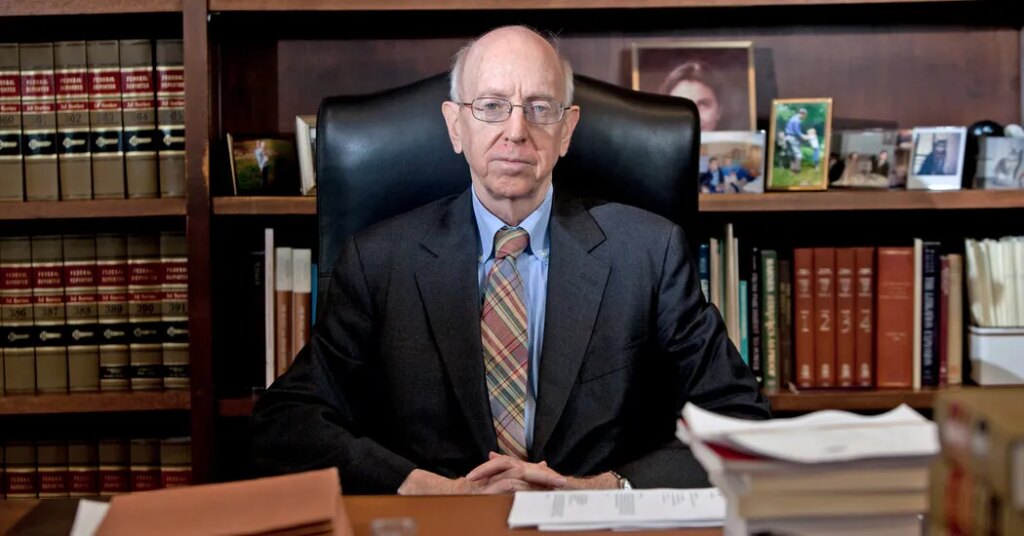
Judge Richard A. Posner, whose protean intellect, relentless work ethic and startling candor made him a towering figure in the law, died on Tuesday in Chicago. He was 87.
His son Eric confirmed the death.
Judge Posner, who served from 1981 to 2017 on the United States Court of Appeals for the Seventh Circuit, in Chicago, wrote thousands of judicial opinions and more than 50 books on a vast array of topics, along with countless scholarly articles, essays, book reviews and blog posts.
He was, the journalist Gary Rosen wrote in The Wall Street Journal in 2002, “a one-man think tank.”
Judge Posner was the most-cited legal scholar in the second half of the 20th century, according to a 2000 study conducted by Fred R. Shapiro, beating the runner-up, Ronald Dworkin, by a factor of almost two.
In the casebooks that collect excerpts from judicial opinions and are the basis for much of legal education, Judge Posner’s work was featured for many years more often than that of any other judge. “The differential in terms of total influence on the casebooks between Posner and almost all the other judges is staggering,” the authors of a second study, Mitu Gulati and Veronica Sanchez wrote in 2002.
When Professor Gulati and Stephen J. Choi updated the study this year, they found that little had changed. Judge Posner’s lead remained “astonishing,” they wrote.
Only two other American judges who did not serve on the Supreme Court had his stature: Judges Learned Hand and Henry J. Friendly, who both sat on the federal appeals court in New York.
Judge Posner’s admirers said he had no real competition in the annals of American jurisprudence. They regarded him as a superb writer, with a limpid, conversational style and a sure command of tone. He wrote with self-confidence and authority, qualities his critics said were not always entirely deserved. Most important, in a field that overvalues tradition and formalism, he was known as a brilliantly original iconoclast.
“Posner was the greatest and most skilled judge in American history,” Saul Levmore, a former dean of the University of Chicago Law School, wrote in an email. “Part of his influence was his willingness to think aloud, and in print, about what law may be trying to accomplish and how it might go about it.”
Judge Posner called his approach to judging pragmatic. His critics called it lawless. “I pay very little attention to legal rules, statutes, constitutional provisions,” Judge Posner said in a 2017 interview. “A case is just a dispute. The first thing you do is ask yourself — forget about the law — what is a sensible resolution of this dispute?”
He was among the leading figures in the movement to analyze legal problems using economics. In looking to social utility rather than abstract moral values like fairness or equality, he gained a reputation as a cold, calculating conservative.
He was just 33 when he published “Economic Analysis of Law,” a tour de force that helped establish the field, in 1972. He went on to write many books, among them ones about antitrust, law and literature, sex and reason, the impeachment of President Bill Clinton, the 2000 election recount and, after the Sept. 11 attacks, national security.
President Ronald Reagan appointed him to the Seventh Circuit in 1981, at the age of 42, and there was occasional talk of a Supreme Court nomination. Some of Judge Posner’s more extreme thought experiments — applying free-market principles to adoptions, or, as his critics would have it, “selling babies,” was the example most often cited — made other candidates more attractive.
In person, he was mild, a little distant and sometimes seemingly indifferent to ordinary social niceties. He was the first to acknowledge his own oddities. “I have exactly the same personality as my cat,” Judge Posner said in a memorable New Yorker profile. “I am cold, furtive, callous, snobbish, selfish and playful, but with a streak of cruelty.”
Judge Posner had no patience for the formalism of most legal reasoning and the jargon in most legal writing. Nor was he a fan of originalism, the mode of constitutional interpretation that seeks to unearth the original public meaning of the text of the Constitution. He was more interested in the practical consequences of his decisions.
Breaking with the norms of appellate adjudication, in which judges are expected to confine themselves to the record prepared in the trial court, Judge Posner conducted internet research and even experiments in his chambers.
For most of his judicial career, Judge Posner’s opinions generally reached conservative results, though often through routes at odds with the interpretive methods preferred by the increasingly influential conservative legal movement. He was interested in finding the sensible answer to the dispute before him and in announcing an efficient and workable legal principle to govern similar ones.
In later years, he drifted left, issuing opinions on voter ID laws, abortion, same-sex marriage and workplace discrimination based on sexual orientation that were markedly liberal.
His methodology remained largely unchanged. In 2013, for instance, he wrote an opinion blocking a Wisconsin law restricting abortions. Anticipating a 2016 Supreme Court decision, he wrote that courts must balance the supposed health benefits of abortion restrictions against the burdens they impose on access to abortion.
He was capable of changing his mind.
In 2007, he wrote a majority opinion upholding an Indiana voter ID law. In a 2013 book, “Reflections on Judging,” he confessed error. “I plead guilty,” he wrote, “to having written the majority opinion (affirmed by the Supreme Court) upholding Indiana’s requirement that prospective voters prove their identity with a photo ID — a type of law now widely regarded as a means of voter suppression rather than of fraud prevention.”
He elaborated in a 2014 dissent in a case on Wisconsin’s voter ID requirement, writing that such laws are “a mere fig leaf for efforts to disenfranchise voters likely to vote for the political party that does not control the state government.”
When he followed what he said were the Supreme Court’s commands, he sometimes appeared to do so grudgingly. In 2012, he wrote a majority opinion blocking an Illinois law that banned carrying guns in public, saying the result was required by a 2008 Supreme Court decision, District of Columbia v. Heller, which established an individual right for law-abiding citizens to keep guns in their homes for self-defense.
Judge Posner reviewed the empirical literature about the practical consequences for crime and safety of bans on carrying guns in public, and he found it inconclusive. “Anyway,” Judge Posner wrote, “the Supreme Court made clear in Heller that it wasn’t going to make the right to bear arms depend on casualty counts.”
He retired abruptly from the appeals court in 2017 after clashes with colleagues over what he said was the court’s mistreatment of litigants without lawyers.
Richard Allen Posner, an only child, was born in Manhattan on Jan. 11, 1939, to Max and Blanche (Hofrichter) Posner, both immigrants from Europe. They were, Judge Posner told a biographer, nonobservant Jews sympathetic to communism.
His father was a criminal lawyer but switched to a career in business, working as a mortgage lender for commercial properties, according to William Domnarski’s biography of Judge Posner.
The family moved to Scarsdale, N.Y., an affluent suburb of New York City, in 1948, and young Dick thrived in its public schools. He entered Yale University at 16, becoming an English major and producing a 321-page study of William Butler Yeats’s late poetry under the supervision of Cleanth Brooks, a prominent literary critic.
After receiving his Yale degree in 1959, he attended Harvard Law School, graduating first in his class in 1962 and serving as president of its law review. The experience made him a lifelong enemy of the The Bluebook, an elaborate style manual that sets out detailed rules about how to cite judicial decisions, law review articles and the like.
“The vacuity and tendentiousness of so much legal reasoning are concealed by the awesome scrupulousness with which a set of intricate rules governing the form of citations is observed,” Judge Posner wrote in a review of The Bluebook’s 1986 edition.
After law school, he served as a U.S. Supreme Court law clerk to Justice William J. Brennan Jr. from 1962 to 1963. The justice’s liberal views matched those of the young clerk, and the two men forged a warm relationship. Justice Brennan was a master strategist, but he left the details to his clerks, and Mr. Posner drafted several important opinions, including N.A.A.C.P. v. Button, which protected the civil rights group’s membership lists.
From 1963 to 1965, Mr. Posner worked at the Federal Trade Commission, then was an assistant to the U.S. solicitor general, Thurgood Marshall, and argued six cases in the Supreme Court. He left that job after two years, later writing that the quality of the lawyers’ arguments did not seem to influence the justices’ decisions.
Mr. Posner spent a year on a presidential task force on communications policy before joining the legal academy, first at Stanford and then, starting in 1969, at the University of Chicago, where he would teach for many decades and play a prominent role in the founding and promotion of the law and economics movement.
While at the law school, he and two colleagues formed Lexecon, a successful consulting firm that advised companies on antitrust and regulatory matters. He left the firm in 1981, with his partners buying out his share, when Mr. Reagan nominated him to the Seventh Circuit. Judge Posner continued to teach at the law school after joining the appeals court.
On the bench, Judge Posner could be impatient and intimidating. In chambers, he was informal, telling his clerks to call him Dick. He wrote his own opinions, which is unusual for a modern federal appeals court judge.
In 1962, Judge Posner married Charlene Horn. In addition to his wife and son Eric, a law professor at the University of Chicago, he is survived by another son, Kenneth, an investment banker in New York; and four grandchildren.
Asked in 2017 by The New York Times about his many critics, Judge Posner said they fell into two camps.
Some, he said, simply have a different view of the proper role of the judge. “There is a very strong formalist tradition in the law,” he said, summarizing it as: “Judges are simply applying rules, and the rules come from somewhere else, like the Constitution, and the Constitution is sacred. And statutes, unless they’re unconstitutional, are sacred also.”
“A lot of the people who say that are sincere,” he said. “That’s their conception of law. That’s fine.”
He said he had less sympathy for the second camp. “There are others who are just, you know, reactionary beasts,” he said. “They’re reactionary beasts because they want to manipulate the statutes and the Constitution in their own way.”
The post Judge Richard A. Posner Has Died. His Influence in Law Was Beyond Compare. appeared first on New York Times.