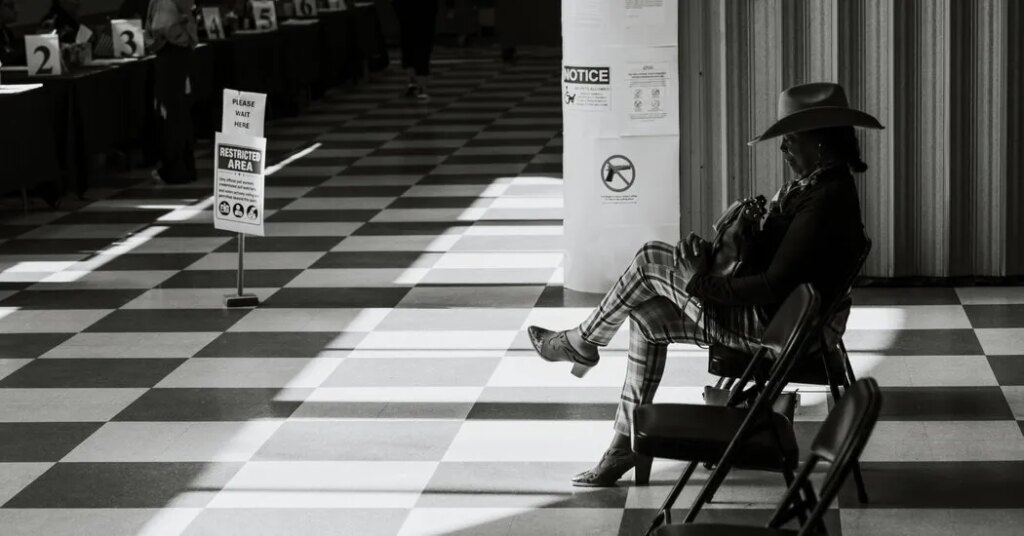
You need only glance at the recent political history of the states of the Deep South to get a sense of the magnitude of the political earthquake that shook the region in last week’s elections.
South Carolina, which elected a Democrat, Annie Andrews, to fill the seat held by Lindsey Graham, last sent a Democrat to the Senate in 1998, when Fritz Hollings won his sixth and final term. For that matter, Andrews now holds a position once occupied by Strom Thurmond, “Pitchfork” Ben Tillman and John C. Calhoun.
The last time Democrats held all three of Georgia’s top statewide offices — governor, lieutenant governor and secretary of state — George W. Bush was still in his first term. And Mississippi, which is on the verge of sending Scott Colom to Washington, has not elected a Democrat statewide since 2015. Its last Democratic senator, the long-serving John C. Stennis, left office in 1989 a more or less unreconstructed segregationist. Despite its large Black population, Mississippi has not sent a Black lawmaker to the Senate since Blanche K. Bruce was elected by the state legislature to a single term in 1875.
The South has not been this competitive in national politics since the 1970s and ’80s, when the Voting Rights Act opened up meaningful partisan competition in the region for the first time since the 1870s and 1880s.
And it is the demise of the Voting Rights Act, and the resulting threat to Black representation and political equality in the region, that has fueled such a seething backlash to the Republican Party that it has transformed national politics.
In April, the Supreme Court issued its decision in Louisiana v. Callais. In his majority opinion for the court, Justice Samuel Alito eviscerated what was left of the Voting Rights Act of 1965, the conclusion to more than a decade of jurisprudence dismantling the landmark civil rights law.
Appropriating the Equal Protection Clause of the 14th Amendment in a move reminiscent of that of an earlier court in Plessy v. Ferguson, Alito claimed that it was a kind of invidious racial discrimination to mandate majority-minority districts under Section 2 of the Voting Rights Act. States, Alito argued, had a legitimate interest in partisan gerrymandering and may “target partisan distribution of voters, a specific margin of victory for certain incumbents or any other goal not prohibited by the Constitution.” If that “goal” happened to destroy representation for Black voters, then it was merely an unfortunate coincidence.
Alito even went as far as to state that it was illegitimate for lower courts to take account of the stark racial polarization of voting in much of the South. If you simply controlled for race, he wrote, there was no racial polarization. It was all partisan.
This was entirely too clever by half, a C-minus rhetorical move that should embarrass an undergraduate, to say nothing of a Supreme Court justice. Voting in the South doesn’t simply happen to be racially polarized — a coincidence without cause. No, the racial polarization of voting in the region is a direct product of its history of racial subordination; a legacy of slavery, Reconstruction and then eventually Jim Crow. It was in fact that polarization, and the threat posed to Black voters by white Democrats in the post-Civil War South, that prompted congressional Republicans to draft and pass the 15th Amendment prohibiting racial discrimination in voting in the first place.
Historically, in states such as Alabama, bloc voting by white voters was one of the means through which an unequal political order was maintained. It was the way that the racial majority shut Black voters out of federal and even state representation despite their numbers. Recall that until 2021, Mississippi even maintained an electoral college-like system for statewide offices, a provision of its 1890 Jim Crow Constitution.
To control for race — or more accurately, to control for racial inequality in political power — is to obscure the very thing that needs to be remedied. It’s as if an oncologist told a patient that she was perfectly healthy, a malignant and fast-growing tumor notwithstanding. Control for it, says our hypothetical Dr. Sam Alito, and you have no problem at all.
Virtually anyone with a cursory knowledge of Southern politics could tell you what would come next after the court handed down its decision. Republican lawmakers moved immediately to redraw maps and obliterate what little representation Black Americans had in their states, even canceling ongoing elections to make the most of the moment. Tennessee Republicans, for example, broke Memphis into small segments spread among predominantly rural districts, diluting its voters so that the majority-Black city could never hope to elect a Democrat. Republicans in Louisiana, Mississippi and Alabama made similar moves. Republicans reacted to the Callais decision like it was a gold rush — an opportunity to rid themselves of the burden of responding to or representing the concerns and demands of their Black constituents.
In the name of the equal protection of the laws, Alito had put the South on course to have the largest single decline in Black representation in Congress since the end of Reconstruction, when “redeemed” Southern legislatures began to systematically disenfranchise Black voters.
Here, it is important to remember that most Black Americans are just one or two generations removed from segregation. And although the generation that lived most of its adulthood under Jim Crow authoritarianism has begun to pass into memory, their children are still with us. Ruby Bridges, who helped desegregate New Orleans schools as a child, is younger than the president. Tens of millions of Black Americans, whether from direct experience or through received wisdom from elders, have knowledge of what it’s like to live subject to the whims of an unaccountable government.
Recognizing the stakes, Black voters and their allies mobilized. They made clear that the elections would be make or break for the future of voting rights in the South. And they connected all of this to material questions. Economic relief, whether in the form of affordable health care or higher wages, would not be possible without meaningful political representation. Nor would communities be able to stop corporations from building data centers and exploiting the land.
This mass mobilization brought explosive turnout at the ballot box. Across the Deep South, according to a Strength in Numbers analysis, Black Americans voted at a whopping 96 percent of the presidential turnout.
Without this surge of Black voters, both South Carolina and Mississippi might have fallen just out of reach. Democrats might not have won their sweeping victories in Georgia and North Carolina, and both Louisiana and Florida — where Democratic candidates came within a few feet of the finish line — would have been safe in Republican hands.
It is possible that these victories are a one-off, a highly contingent response to a ruinously unpopular president. One might even want to assume that this is the case. And yet it is difficult to overstate the extent of the opportunity here. Democrats have every reason to fully invest in the region and to abandon the pessimism, fatalism — and in some cases, chauvinism — that led the party to write off the Deep South as a truly lost cause. If Democrats take full advantage of the moment, they could build a durable coalition that is able to contest the region when the electoral environment is not as favorable.
The Deep South could be the next battleground in a new Southern strategy that has already produced success. It has been more than 20 years, for example, since Virginia backed a Republican for president, while both Georgia and North Carolina are swing states.
But while the electoral implications of this development are important, the Democratic Party should not forget that its success in the South demands real action.
In the face of a Supreme Court that has relied on congressional inaction to further its agenda, Democrats must pass a new Voting Rights Act to protect the right of all Americans to fair participation and political representation. They must also end the partisan gerrymandering that has enabled state legislatures to deny large parts of the public the ability to pick a representative of their choosing.
That Americans of all stripes can overcome obstacles to voting does not mean that they should have to. And high Black turnout does not obviate the need for legislation to secure the right to vote.
The fact of the matter is that the history of the nation means that some Americans will always see it as their right and entitlement to deny the voting rights of other Americans. And as our history also shows, the only force that can secure the political and civil rights of all Americans is the federal government, empowered under the 14th and 15th Amendments to the Constitution to protect those rights from those who would try to abridge or nullify them.
The midterm elections in the South were, to a large extent, a demand from Black Americans to restore and expand on what was destroyed by Republicans on the court and in Congress. And while there is virtually no chance that President Trump would sign a voting rights bill, Democrats must still make it a priority ahead of the chance of a White House win in 2028.
The party can either honor the work of the voters who made their success possible or see whatever advantage they now have dissipate in disappointment and anger.
The Times is committed to publishing a diversity of letters to the editor. We’d like to hear what you think about this or any of our articles. Here are some tips. And here’s our email: [email protected].
Follow the New York Times Opinion section on Facebook, Instagram, TikTok, Bluesky, WhatsApp and Threads.
The post Look Who Has a Southern Strategy appeared first on New York Times.