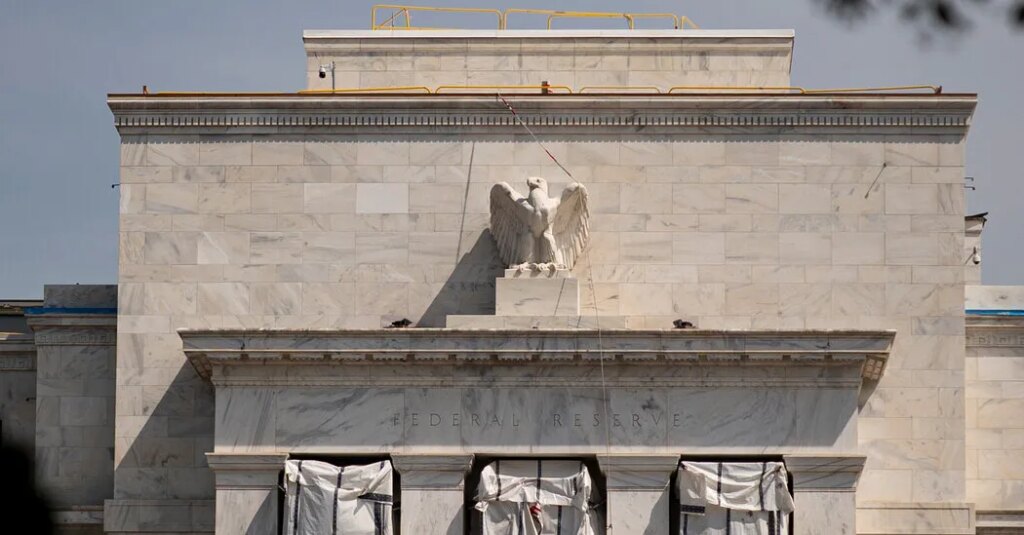
Officials at the Federal Reserve are in broad agreement that interest rates need to rise in order to tame inflation that continued to accelerate this year.
Less settled is the pace of those increases and how aggressive the Fed will need to be in order to return inflation to its 2 percent target, which has overshot that level for nearly six years.
The debate deepened on Tuesday after new data released by the Bureau of Labor Statistics showed that price pressures broadened out in October, resulting in a swifter pickup in inflation than was expected.
The central bank, which embraced a gradual approach to raising rates just a few weeks ago, must now decide whether to ratchet up its response — either by delivering a big move when it next meets in December, or signaling increases at back-to-back meetings going forward.
Financial markets have for now leaned into the latter option, penciling in more rate increases in 2027 than previously. So too have many economists, who have largely downplayed the idea that the Fed will raise rates by half a percentage point next month even as they affirm the need for a faster pace of tightening.
“The latest inflation data reinforced the idea that price pressures remain sticky and elevated and are not just due to one-off shocks,” said Matthew Luzzetti, chief U.S. economist at Deutsche Bank. “Therefore, the Fed probably has more work to do and in order to balance the risks better, it makes sense to do that at a somewhat quicker pace than we were previously anticipating.”
Mr. Luzzetti now expects the Fed to raise rates by a quarter-point not only in December, but also in January and March.
The fraught path ahead for the Fed was evident on Tuesday following a speech by Christopher J. Waller, a Fed governor who spoke before the latest inflation report was published. He floated the possibility of a half-point move in December and even went so far as to offer a precise threshold that would warrant such a move.
Mr. Waller said that if October’s Consumer Price Index report showed that “core” prices, which exclude volatile food and energy items, rose around 0.3 percent or more, a “stronger policy move may be needed.”
Sticking to the central bank’s typical quarter-point pace would “put our credibility at risk, a risk I am not eager to take,” he said.
October’s data met Mr. Waller’s threshold. Core prices rose 0.3 percent for the month, while overall prices rose 0.4 percent. Shortly thereafter, two-year Treasury yields, which are highly sensitive to shifts in interest rate expectations, shot higher, notching the biggest one-day increase in more than a year. The 10-year Treasury yield, which underpins mortgages, business loans and many other types of debt, also jumped, rising above 5 percent.
The moves were further exacerbated by remarks from Lorie K. Logan, who as president of the Federal Reserve Bank of Dallas is a voting member on this year’s policy-setting committee. In a speech on Tuesday after the C.P.I. report was released, she warned that the Fed may need to accelerate the pace of additional rate increases.
The comments from Mr. Waller and Ms. Logan caused such a jolt because the central bank just weeks before had opted against raising rates despite a worrying turn in the inflation data. The rationale for most officials was that after taking action in September, there was little urgency to raise rates at back-to-back meetings. Moving gradually, they argued, would give households and businesses more time to adjust to higher borrowing costs, reducing the risk that the Fed would unnecessarily harm the economy.
Some policymakers at the Fed have yet to abandon this strategy. On Tuesday, Michelle W. Bowman, the Fed’s vice chair for supervision, acknowledged in a speech that price pressures were persisting longer than she had hoped, but warned that “the benefit of additional policy tightening has to be carefully weighed against its costs for interest-rate-sensitive sectors.” Ms. Bowman also emphasized recent volatility in financial markets amid concerns about the sustainability of the artificial intelligence investment boom. She stressed that financial conditions, or the ease at which companies and households can access funding, had tightened.
Anna L. Paulson, president of the Philadelphia Fed, also on Tuesday offered her full-throated endorsement of the Fed’s gradual approach. And just a day before the inflation report, Thomas I. Barkin, president of the Richmond Fed and a voting member next year, said the central bank needed to adjust its policy settings “with care” given potential risks to the labor market.
What is hard to discern is whether October’s inflation report will be deemed worrisome enough by the majority of the policy-setting committee to usher in a change in strategy. One complicating factor is that Kevin M. Warsh, the chairman, has opted to obscure his own views about the outlook. He has rejected the notion that officials should provide guidance about where rates might be headed and has stopped short of providing his own detailed diagnosis of the inflation problem. That has stoked uncertainty about how much more tightening he believes is necessary to stamp out price pressures.
According to October’s inflation report, those price pressures appear to be spreading to a wider range of goods and services. Energy prices saw more muted gains for the month, but that was overtaken by increases in other categories, such as food, appliances, recreation and motor vehicle insurance.
One feature of recent inflation reports is that the categories driving the bulk of the monthly increase have been somewhat “random” and often reversed course shortly after, said Tom Porcelli, chief economist at Wells Fargo. In August, it was wireless telephone services. In September, it was tuition and toys. But instead of giving the Fed comfort, Mr. Porcelli warned that this dynamic could actually prove problematic.
“It’s probably going to be a source of discomfort for the Fed because it suggests that while these components may not be uniformly driving inflation higher month-after-month, the fact that the breadth of the inflation gains is so deep is the troubling part,” he said.
So far, even the most hawkish of Fed officials suggest that it will take only a few more rate increases to get price pressures under control. Ms. Logan on Tuesday affirmed her view that the central bank will need to deliver at least two more quarter-point increases before pausing to “examine economic and financial developments to determine what further action may be appropriate.”
One wild card is if there is a substantive sell-off in stocks that materially changes the outlook for consumer spending. A sharp rise in U.S. borrowing costs that significantly constrains lending to companies and households could also limit what the Fed needs to do.
Barring that, Neil Dutta, head of economic research at Renaissance Macro, said it is more likely than not that the Fed will end up having to raise rates more substantially than policymakers currently project. Mr. Dutta is bracing for housing inflation to accelerate in the year ahead, as rental prices pick up. He also expects the unemployment rate to continue edging lower as the labor market strengthens, helping to boost wages and, in turn, inflationary pressures.
Mr. Warsh last month said the Fed’s goal “isn’t to throw sand in the gears of the economy and throw people out of work.” But Mr. Dutta warned that some weakening of the labor market is likely to be necessary if Mr. Warsh wants to achieve his inflation goal.
“If they’re not willing to hurt the labor market to bring inflation back to 2 percent, then they’re not willing to bring inflation back to 2 percent,” said Mr. Dutta. “It’s really that simple.”
The post The Fed Has to Raise Rates. How Fast to Go Has Officials Divided. appeared first on New York Times.