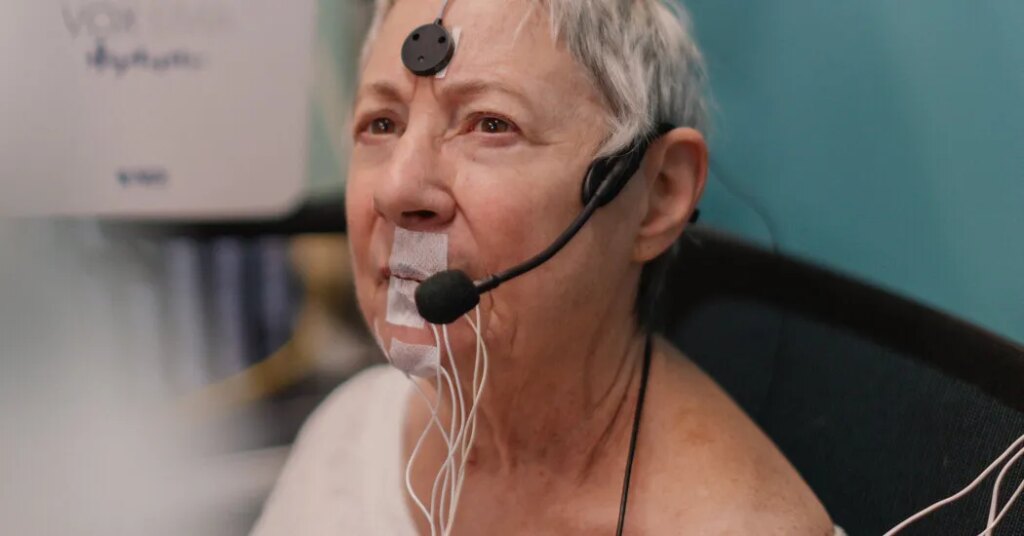
It’s not every day that a 76-year-old woman is asked to talk nonsense — repeating “ga ba da” and “ka pa ta” as fast as she can.
All with sensors affixed to her tongue, forehead, chin, jaw, upper and lower lip recording her tiniest muscle movements in the name of science.
The goal is to analyze changes in people’s speech to try to predict their likelihood of developing dementia and track shifts in their brain health.
“We are seeing differences that humans can’t see or can’t really detect by their ears, but it’s there years and years before cognitive decline,” said Marziye Eshghi, the researcher leading the effort at Mass General Brigham University of Health Professions in Boston.
Dr. Eshghi’s project measures about 130 different speech-related features in participants like the 76-year-old woman from suburban Boston, who asked to be identified by her first name, Deb, to protect her privacy. The data is run through artificial intelligence algorithms and compared with known biological risk factors for Alzheimer’s. In preliminary results, speech-related data was better than cognitive testing at identifying Alzheimer’s risk in cognitively unimpaired older people, Dr. Eshghi’s team reported.
“What we are doing is capturing individuals who are at higher risk of developing Alzheimer’s disease, but they are still not showing any symptoms,” said Dr. Eshghi, who directs her institution’s speech, physiology and neurobiology of aging and dementia lab.
Increasingly, researchers are embracing what was once considered an intriguing but relatively fringe idea: that speech and how it changes over time can help predict and track cognitive decline. Technological advances are making it possible to collect and analyze many aspects of speech, including how fast people talk, how often they pause, the complexity and variety of their vocabulary, their pitch and cadence and the coordination of their vocal and facial muscles.
“It’s really a window into brain health,” said Dr. Marilu Gorno Tempini, director of the language neurobiology laboratory at the University of California, San Francisco. “The way we can analyze speech and language now,” she said, allows insight into “detailed brain function and cognition that was unheard of before.”
Researchers see a future in which everyday speech that people can easily record themselves could be analyzed for incremental indicators of brain health. That analysis, combined with other measures like brain imaging and blood tests, could be used to predict dementia risk and monitor progression of cognitive impairment.
Dr. Steven Arnold, an Alzheimer’s expert and professor of neurology at Harvard Medical School who collaborates on some of Dr. Eshghi’s studies, said more research and evidence are needed before speech analysis could play a part in diagnosing or monitoring neurological conditions. “I still consider it to be early stage,” he said of speech research, “but potentially very important for the field for early detection of dementia, for detecting progression of cognitive impairment and decline and for detecting response to treatment or interventions.”
He said he expected speech would be most useful in tracking changes over time, not as a single snapshot, and could be especially informative in monitoring clinical trial participants.
Speech analysis could also help researchers identify those at greater risk within a group of people who have tested positive for Alzheimer’s biomarkers, said Melissa Lee, who directs digital and A.I. at the nonprofit Alzheimer’s Drug Discovery Foundation. “If we have two people with positive blood tests, one shows decline and one won’t, and we’d use their speech to tell them apart,” she said.
Dr. Lee leads a large study, SpeechDX, that is collecting three years of speech data along with blood tests, brain scans and cognitive assessments for 2,000 people in the United States, Australia and Spain. The study, which includes speakers of English, Spanish and Catalan, will provide data “others can use to build models that use speech to predict someone’s cognitive state,” she said.
Dr. Eshghi’s research combines speech analysis with other assessments including brain imaging, blood biomarker measures and genetic tests.
In one study Deb participated in, 49 people without cognitive impairment were classified as low-risk, moderate-risk or high-risk for Alzheimer’s based on levels of an Alzheimer’s-related protein in their blood and whether they had a genetic variant linked to increased risk. Then, without knowing participants’ risk categories, researchers analyzed speech recordings and tested whether a computer model could determine which participants were in which group.
In preliminary results, the speech-based analysis classified participants accurately up to 77 percent of the time, much better than the 47 percent accuracy of commonly used cognitive testing models. Deb is in the low-risk category, Dr. Eshghi said.
Participants are being reassessed multiple times to track how their speech changes, Dr. Eshghi said. One goal is to identify which specific aspects of speech are most informative in detecting early brain changes associated with Alzheimer’s and in predicting cognitive decline.
Speech offers a gold mine of information because it involves so many elements, including word-generation, memory, attention, expression, processing speed, context awareness and muscle movements. It’s also a widespread daily activity that doesn’t require time-consuming or costly tests like brain scans and spinal taps.
“Most people speak, and speaking is a very cognitively complex task,” said Rhoda Au, a professor of anatomy and neurobiology at Boston University. And voice recordings can be stored indefinitely and be reanalyzed as new information emerges, said Dr. Au, whose research includes showing that A.I. analysis of recordings from neuropsychological exams could help predict whether people with mild cognitive impairment would develop Alzheimer’s dementia in the next six years.
Dr. Au, a pioneer in studying speech as an indicator of cognitive change, said that years ago, “no one was listening to us,” but now, other researchers’ attitudes have shifted to “‘Wow, this is pretty interesting.’”
Deb’s speech was evaluated two years ago, and she returned over the summer for a second assessment. The intensive two-hour session included a series of timed tasks. She read increasingly complex sentences, rattled off words beginning with certain letters and counted backward from 620.
After Dr. Eshghi placed sensors on her face, she repeated tongue twisters four times, including “Clever Kim called the cat clinic” and “Take today’s tasty tea on the terrace.”
In free-form speaking segments, she was asked to describe her hobbies. Deb said she belongs to a mushroom foraging club, enjoys contra dancing and “I collect giant fruit.” The fruit is made of plastic, papiermâché and other materials, she clarified, adding: “I’m very proud of this strange activity.”
Later, she was given gum and then Cheerios to chew so sensors could measure tongue and jaw movements and coordination during chewing and swallowing.
Dr. Eshghi said an analysis of Deb’s results found that, compared with two years earlier, she paused somewhat more often and spent more time pausing. Her average pitch was slightly higher and the maximum speed of some speech-related movements decreased. She remained cognitively unimpaired.
“Those differences could relate to normal aging, changes in vocal or motor function or underlying biological processes,” Dr. Eshghi said. “This illustrates the potential of speech measurements to capture subtle differences that are not reflected in a change in overall cognitive status,” she added.
Speech and voice quality are also being analyzed for signs of other health conditions. Those include depression, which can be characterized by subtle changes in talking speed and pauses; Parkinson’s, in which speech may become softer or slurred; and diabetes, which can be accompanied by vocal hoarseness.
In studying the relationship of speech to cognitive impairment, some researchers have focused on linguistic aspects, such as vocabulary and sentence complexity. Decades ago, one part of a long-running research project called the Nun Study found that Catholic nuns who wrote more verbal and idea-rich essays as young women were less likely to develop Alzheimer’s later.
But such verbal attributes may not be broadly representative because they can be affected by socioeconomic conditions and education. Most researchers now include elements like speed, pauses and vocal tone.
Dr. Gorno Tempini said speech might even reflect changes in emotional perception and empathy that can occur with dementia. For example, she said, someone with encroaching cognitive impairment may look at a picture and say “there is a dog and there is a person and there is a car crash,” instead of “Oh my God, this dog died, it was just hit by a car, and the owner is there crying.”
Several companies have entered the speech analysis arena. One, Sonde, has an app that offers a general gauge of “cognitive fitness” by analyzing eight characteristics of short voice samples to assess if the speaker is exerting high, moderate or lower cognitive effort.
Dr. Au and other researchers said there’s not yet enough evidence for using commercial speech analysis tools as specific indicators of brain health. The field first needs to collect and analyze more data and learn which aspects of speech are significantly linked to cognitive changes, she said.
“I personally don’t think this is ready for prime time, not in the health care space,” Dr. Au said.
Experts said information privacy will also have to be addressed so patients’ results are not shared without their consent. Dr. Lee said the SpeechDX study deletes any identifying information participants provide and, to ensure that even the research staff cannot distinguish participants by their voices, recordings are analyzed by computer without being played aloud.
“Speech is extremely promising and it’s extremely powerful,” she said. “You only want to be able to use it in ways that people give you permission to use it for.”
The post Subtle Changes in Speech May Help Predict Dementia Risk appeared first on New York Times.