David Brouillette, the rookie Immigration and Customs Enforcement officer who fatally shot a Colombian migrant in Maine this summer, has a troubling work history, past complaints of domestic violence and abuse, as well as mental health issues.
He also has a record of deep-seated anti-immigrant hostility, especially against Colombians.
In 2021, four years before he joined ICE, Mr. Brouillette, a former U.S. Army sergeant, raged against his sister and their relatives in a series of emails, castigating her for her longtime relationship with a Colombian man, with whom she had two children.
“He can takes his non citizen ass back to his country and enjoy his third world luxuries,” Mr. Brouillette wrote in an email thread riddled with typos, a copy of which was shared with The New York Times.
“He does not emulate what it means to be an American” but “rather he emulates what it’s like to be entitled and think he has a seat” at a table “that has no room for his (or your ignorance),” he wrote. Mr. Brouillette continued that the man’s “bloodline knows nothing about what it takes to earn and then CHERISH the freedom America offers.”
The man who sparked Mr. Brouillette’s anger was at the time a 37-year-old graduate student studying for a Ph.D. in education. Born in Colombia, the man was living in the United States legally and had dated Mr. Brouillette’s sister for five years.
The email exchange was shared by Elizabeth Emen, Mr. Brouillette’s sister, and confirmed by a friend who discussed the email with her at the time, as well as a family representative. Mr. Brouillette’s comments were a snapshot, they said, of his views and anger toward people born outside the United States.
“David had no basis for saying that my partner was undocumented,” Ms. Emen, a licensed therapist in Maryland, said in an interview. “It was about how he saw him based on his race.”
Mr. Brouillette, 38, fatally shot Johan Sebastián Durán Guerrero on July 13 during an attempted traffic stop in Biddeford, Maine.
The emails, which have never been made public, add another layer to Mr. Brouillette’s high-profile shooting and could factor into the pending state and federal investigations.
It is illegal in Maine to infringe on a person’s rights because of their actual or perceived race, color, ancestry or national origin, among other identifiers. Federal law prohibits an officer from depriving a person of their constitutional rights “on account of such person being an alien or by reason of his/her color or race.”
Mr. Brouillette’s family said he didn’t hide his sentiments about immigrants. Those views, along with publicly accessible court records documenting claims of abuse, mental health challenges and workplace struggles underscore concerns about the federal government’s hiring of Mr. Brouillette, who applied for a job with ICE as the agency relaxed its vetting process and added thousands of new officers.
“He is dangerous and should not have weapons,” Mr. Brouillette’s mother, Susan Bedard, said of her son in a text message to The Times. “Believe his victims, not him.”
Mr. Durán Guerrero, 25, was shot four times in the face and neck, said Sean P. Murphy, a lawyer for Mr. Durán Guerrero’s family.
The Department of Homeland Security said “the vehicle attempted to flee” and the officer, “fearing for public safety,” fired his weapon. Evidence confirming this account has yet to emerge.
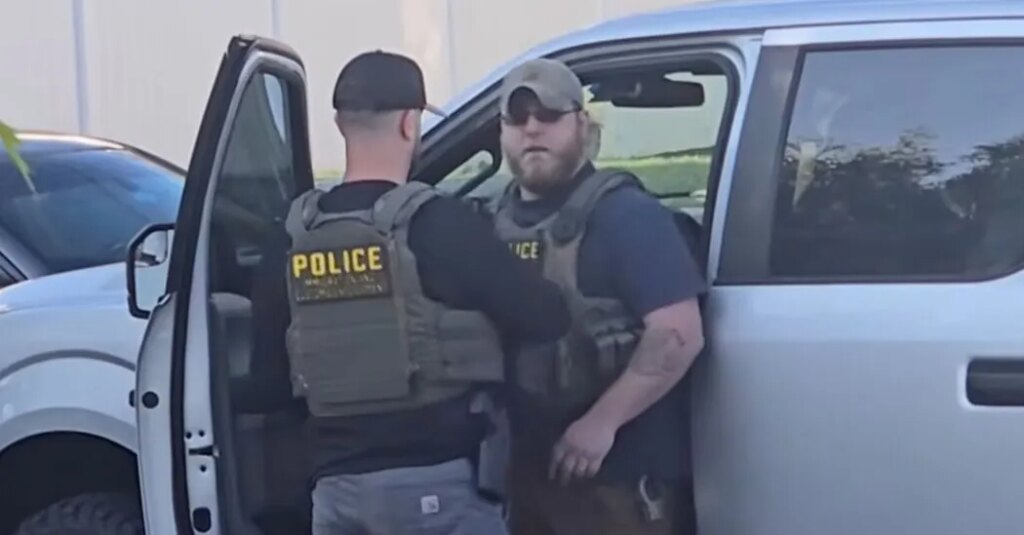
The agency declined to confirm that Mr. Brouillette had fatally shot Mr. Durán Guerrero or describe his employment status. Mr. Brouillette’s family, however, identified him as the man pictured at the scene of the shooting being consoled by other officers.
His ex-wife and daughter told The Times that Mr. Brouillette said he fired the fatal bullets. Also, federal and state investigators examining the shooting have asked people who knew Mr. Brouillette about his background and whether they thought he should be fired over the killing of Mr. Durán Guerrero.
D.H.S. initially said that Mr. Durán Guerrero had illegally entered the country but later recanted that statement to Senator Angus King of Maine, the senator’s office said. The lawyer for the Durán Guerrero family said he was authorized to work in the United States and was not the target of ICE’s investigative efforts.
The shooting sparked a sharp outcry in Biddeford, and state officials from both parties condemned ICE’s actions. Susan Collins, Maine’s Republican senator, asked that ICE “cease all non-urgent vehicle stops.”
The Department of Homeland Security said in a statement that “any claims of substandard training or vetting are FALSE” and that ICE officers were “trained to use the minimum amount of force necessary to resolve dangerous situations.”
Mr. Brouillette declined to speak with a Times reporter who knocked on the door of his home in Maine and left a letter for him. In response, he called the local sheriff to warn the reporter not to return.
According to an incident report, Mr. Brouillette told the sheriff’s deputy he was under “‘executive protection’ through the U.S. Department of Homeland Security.”
This article is based on court records, emails and interviews with Mr. Brouillette’s relatives, including Ms. Emen; his mother; his first ex-wife and daughter; as well as a former classmate, neighbors, former colleagues and people with knowledge of his hiring at ICE. His two ex-wives and some former co-workers had previously spoken to the media about their concerns.
The accounts portray Mr. Brouillette as a man who longed to wield authority as a soldier and an officer of the law. (His teenage online message handle was citizensoldier22.) Yet he worked for only short stints as a corrections officer, a security guard at a V.A. medical center and an enforcement officer for Maine’s Health and Human Services department.
He struggled with mental health challenges, having been diagnosed with bipolar disorder and hospitalized “multiple times,” his mother, Ms. Bedard, told The Times. This type of health history is typically disqualifying for federal agents, according to federal hiring guidelines.
His two former wives said in court filings that he had physically abused them — claims that he disputed. In addition, Mr. Brouillette gave false statements at least twice in court filings. For example, he told a family court judge in 2019 that he had worked as a police officer in Hallowell, Maine, according to court records. The Hallowell police chief told The Times Mr. Brouillette had applied for a job with the department but was not hired.
Several former federal prosecutors said that this kind of false statement would make it hard for Mr. Brouillette to testify in court cases, impairing his ability to do his job.
A new hire on a fast track
Mr. Brouillette was cleared to start at ICE on Dec. 1 after being fast-tracked through a preliminary vetting process that had become much more lenient during that period, according to a person with knowledge of his hiring, who was granted anonymity to discuss sensitive matters. He joined the ranks amid a hiring surge that was prompted by Trump administration demands to more than double the number of deportation officers.
Hiring guidelines were changed, lowered or ignored to meet that demand, according to current and former officials involved in the agency hiring process. One agency whistle-blower told the Office of Inspector General that an “unprecedented lowering of standards” allowed improperly vetted, unqualified candidates to get job offers before they had passed basic fingerprint, identity or credit checks.
Mr. Brouillette was allowed to skip ICE’s full training course in Georgia, according to two people who were briefed on Mr. Brouillette’s work history at ICE and spoke on the condition of anonymity because they were not authorized to discuss the matter. The decision was in keeping with ICE’s practice to have recruits with some law enforcement experience complete a shorter online training program.
After he was hired, his full background check was completed by an outside contractor, as is a standard part of the security clearance process for new officer hires, according to one of the people with knowledge of his hiring. But the agency had started to build a gigantic backlog of background reports. At the time of the shooting in Maine, officials still hadn’t gotten to look into Mr. Brouillette’s background report for red flags that could result in his termination, the person said.
Without his full clearance, Mr. Brouillette was limited in his access to some secure computer systems. But he was still deployed on the streets of Maine, armed and empowered to carry out President Trump’s immigration enforcement mandate.
In April he arrested a man born in Angola; in June, a man born in the Democratic Republic of Congo; on June 30, a man born in the Ivory Coast, federal arrest reports show. None of the men had criminal histories, the records show, and all three were detained for overstaying their visas.
On July 13, Mr. Brouillette shot Mr. Durán Guerrero.
Mr. Brouillette’s work history contained several red flags.
He held at least seven full- and part-time jobs from 2015 to 2025, including as a state corrections officer, a policeman at a V.A. hospital and an agent at Maine’s Health and Human Services Department, where he tracked down family court scofflaws.
His workplace struggles burst into view in late 2021, when he became a volunteer firefighter in Manchester, a small town near Augusta.
“It didn’t take me long to recognize that I’d made a mistake,” said Frank Wozniak, who was the fire chief at the time. “He was a loose cannon.”
While in a firefighter training program at Southern Maine Community College, a steel beam struck Mr. Brouillette in the head, causing a severe injury, according to a lawsuit that he filed against the college. Shortly after, Mr. Brouillette drove to the fire station to find Mr. Wozniak.
“He’s bandaged up and screaming at one of the guys, upset that I wouldn’t let him train or go on calls,” Mr. Wozniak said. “He was screaming, ‘I’ll punch you in the face and take your job!’” Mr. Brouillette then left the department.
Two years later he sued the college, claiming that his cognitive functioning and memory were still impaired. The lawsuit was settled.
In 2025, he ran through three jobs: He was let go from a pest control company over behavioral issues, according to two people briefed on his departure. He quit his job as a truck driver, citing health issues, and he joined a real estate agency, where he received a few thousand dollars in commissions, according to filings in a child support case.
In the fall of 2025, he applied at ICE.
The Times could not find any employer or family member who was contacted by the federal government about Mr. Brouillette until July 2026, after the fatal shooting.
When his first wife, Ashley Brouillette, found out in November that he was joining ICE, she recalled asking him how he continued to get jobs with guns. “He laughed,” she said.
She, like his sister, Ms. Emen, was surprised to learn of his new job. Ms. Emen said Mr. Brouillette’s mental health seemed to have declined after he returned from his service in Afghanistan in 2013.
“We talked about his behavior before, during and after he was in Afghanistan, and about his ongoing PTSD and mental health challenges,” said Ms. Emen, who never treated her brother or spoke with him in a professional capacity. “He conveyed to me that he protected himself in Afghanistan by racially profiling the people there. If he could dehumanize the people, he could be more self-protective and less empathetic.”
Ms. Emen said that Mr. Brouillette had made statements that certain races of people should not live in the United States. Their relationship ended in 2021.
When Ms. Emen invited her relatives to celebrate her son’s birthday, Mr. Brouillette responded with the email tirade, expressing his disapproval of her partner’s “bloodline” and his supposed “anti-American ideologies.”
“Your choices have cost you a brother. I am so so so ashamed of you,” he wrote. “You’re dead to me Liz. Enjoy it. Dead to me. DEAD.”
Dueling state and federal probes
The email exchange could come into play as investigators examine the shooting in Maine.
“Federal statute doesn’t require a prosecutor to prove racial animus, but such bias could support the idea that the officer used excessive force,” said Michael Gennaco, a former federal prosecutor in California who oversaw civil rights prosecutions against officers accused of excessive force.
Attorney General Aaron M. Frey of Maine launched the probe immediately after the shooting, saying his office “has exclusive responsibility both for any criminal investigation of a homicide and for the use of deadly force by law enforcement.”
Mr. Frey, through a spokesperson, declined further comment, citing the pending investigation.
Biddeford police captured footage from the aftermath of the shooting on their body worn cameras, including statements made by Mr. Brouillette, according to two people briefed on the inquiry.
Separately, the Department of Homeland Security’s Inspector General, the agency watchdog, said that it was also investigating the use of deadly force in Maine.
Toby Dilworth, a former federal prosecutor in Maine, said that before the Trump administration, federal and state investigators worked in lock step on these inquiries.
In the Brouillette case, a detective from the state attorney general’s office and a special agent with the D.H.S. Inspector General’s office interviewed Mr. Brouillette’s first wife, Ashley.
But three people briefed on this investigation, none of whom were authorized to discuss the case, said that the federal government’s cooperation with Mr. Frey’s office has been more limited.
This is in keeping with friction that has arisen between federal and state investigators in multiple cases, including the shooting of Alex Pretti, a nurse who was killed by a Customs and Border Protection agent in Minneapolis. Mr. Pretti’s parents said that the Justice Department refuses to confirm the identity of the man who shot their son and has stopped sharing evidence related to the shooting with local investigators.
Local authorities are investigating several high-profile incidents involving federal immigration agents, including deadly shootings, and have indicted four officers in Colorado, Minnesota and Texas.
In Maine, some resolution could come soon. Mr. Frey’s term in office ends this December, when the State Legislature seats the next attorney general. Mr. Murphy, the lawyer for the Durán Guerrero family, said investigators recently told him that Mr. Frey plans to announce any decisions in the case before he leaves office.
Susan C. Beachy and Sheelagh McNeill contributed research.
The post ICE Officer Involved in Maine Shooting Expressed Hatred of Immigrants appeared first on New York Times.