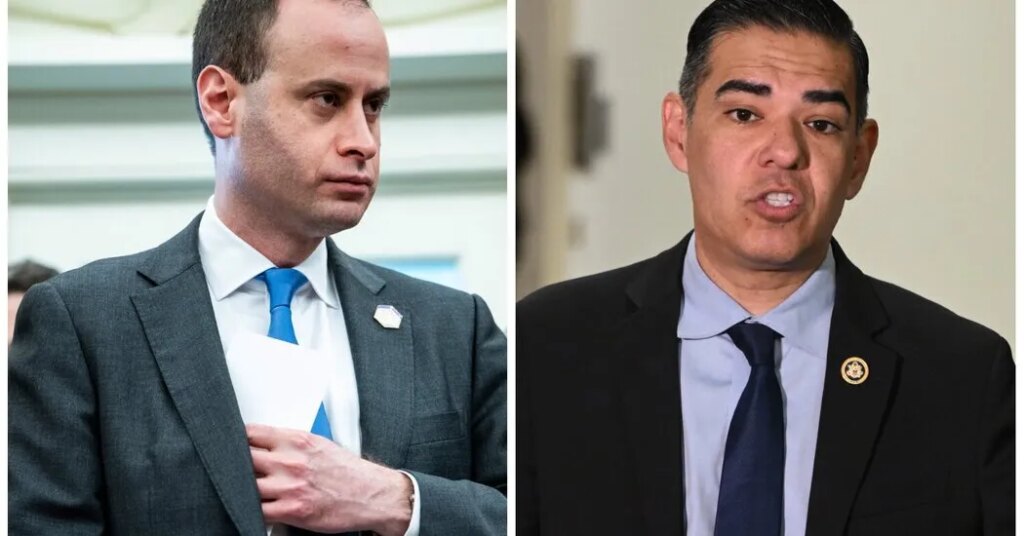
The White House’s top lawyer has warned the Democrat in line to lead the House’s chief investigative committee that aggressive oversight of the Trump administration “may cross the line into blatant criminality,” a threat that experts called legally dubious.
In a three-page letter to Representative Robert Garcia of California, the incoming chairman of the Oversight Committee, the White House counsel, Will Scharf, said Democrats had “evinced a clear intent to transgress” constitutional limits on congressional investigations. He predicted that their inquiries would be used “to harass and aggrandize, rather than to advance any legitimate legislative end.” Punchbowl News first reported the letter, which was later shared by the White House.
The warning from the White House was dated Monday, a day after Attorney General Todd Blanche said on CNN that members of Congress had “done nothing but threaten everything that’s happening in this administration.”
“That is not governing, that is not leading, that is not oversight,” Mr. Blanche said. He, like Mr. Scharf, once represented Mr. Trump as a defense lawyer.
Taken together, their statements signal that Mr. Trump’s administration is likely to follow the playbook his first administration used after Democrats took the House in 2019. Then, Mr. Trump vowed to fight “all” subpoenas, his administration routinely refused to comply and the disputes ended up in court.
In a statement, Mr. Garcia dismissed the letter, which his office said it had not received as of Wednesday morning. Arguing that Congress had broad authority to conduct investigations, Mr. Garcia suggested Mr. Trump had “something to hide” and accused the White House of threatening legislators.
“The Trump administration continues to weaponize the government with threats of unconstitutional attacks on Congress,” he said. “We are a coequal branch of government and will not be deterred by baseless threats from a weaponized D.O.J. or from the president’s lawyers.”
Peter M. Shane, who teaches public law at the New York University School of Law and is an author of a separation-of-powers casebook, criticized Mr. Scharf’s threat as legally baseless, saying, “Our Constitution protects legislators from the threat of criminal prosecution while performing official duties as an essential bulwark to repel executive overreach and defend checks and balances.”
He continued: “Congressional oversight and the issuance of subpoenas by definition cannot be the focus of legitimate criminal prosecution. It may be that an occasional subpoena may be quashed as outside the committee’s jurisdiction or for some other reason, but that is not a criminal offense.”
Most of Mr. Scharf’s letter rests on legal principles courts have used to separate legitimate congressional subpoenas from ones that can be quashed: Congress may compel testimony and documents tied to a valid legislative purpose, like weighing whether new laws are needed or whether there is a basis on which to impeach an official, but not merely to harass people or invade privacy for the sake of exposure.
The first Trump administration made the same argument against congressional subpoenas, including one seeking Mr. Trump’s financial records after he had violated the norm that candidates for president release their tax returns. He said Democrats were just trying to harass him and score political points, while lawmakers maintained they had a valid legislative purpose because they were weighing whether to enact a law requiring such disclosures.
The Supreme Court set clearer limits on subpoenas for a president’s personal records, sending the case back down for further consideration and narrowing the files Congress ultimately received in a 2022 settlement. In the meantime, the litigation also helped Mr. Trump run out the clock on disclosures before the 2020 election.
The parts of Mr. Scharf’s letter about the scope and limits of legitimate congressional oversight cited court precedents. The paragraph raising the prospect of criminality cited no precedent. Mr. Scharf, a 2011 graduate of Harvard Law School, did not address how any attempt to investigate aggressive congressional oversight as a crime could square with the “Speech or Debate” clause of the Constitution, which shields lawmakers from being subpoenaed or prosecuted by the executive branch over their legislative acts.
“Beyond being inconsistent with the clear, well-recognized constitutional limitations on your investigative functions, threats to executive branch officials designed to deter them from public service, or process designed merely to abuse or instill fear in the recipient may cross the line into blatant criminality,” Mr. Scharf wrote. “And issuing unlawful subpoenas with the intention of depriving citizens of their constitutional rights and privileges may warrant further investigation.”
Mr. Scharf’s reference to depriving people of constitutional rights and privileges appeared to be a reference to a statute that makes that a crime. It is generally invoked in the context of people who abuse coercive law enforcement power, like police officers and prison guards.
Mr. Scharf’s letter follows more than a year of efforts by the Trump administration to prosecute officials who have investigated the president. For much of his second term, prosecutors in South Florida have pursued a sprawling inquiry, called the “grand conspiracy” investigation by Mr. Trump’s allies. It is examining whether former F.B.I. and intelligence officials who investigated Mr. Trump over the past decade conspired to violate his constitutional rights. But, so far, that effort has not succeeded in establishing a basis for an indictment against former officials, and several Trump loyalists who worked on the inquiry recently resigned.
Much of Mr. Scharf’s letter is a catalog of Democrats’ post-election social media posts and commentary. As election results came in last week, Mr. Garcia issued a terse statement warning Trump administration officials and others to “lawyer up.” Since the election, Democrats have promised to pass out subpoenas “like candy” or “Mardi Gras beads,” and one representative-elect said he wanted to watch Defense Secretary Pete Hegseth “squirm.”
Mr. Trump has made threatening to prosecute his personal and political adversaries a hallmark of his rhetoric since his 2016 campaign, when his rallies featured “Lock her up!” chants about Hillary Clinton. In his second presidency, he has openly challenged the principle that the Justice Department and F.B.I. should make criminal investigation and charging decisions independent of White House political direction, and courts have repeatedly suppressed subpoenas and thrown out charges based on findings that they lacked a legitimate basis.
Congress has long taken an expansive view of its own investigatory authority, with lawmakers arguing that they cannot legislate properly without being able to seek information. Historically, members have asserted their right to investigate nearly any area where Congress has the power to pass legislation or appropriate funds.
The party out of power often campaigns for the midterm elections on a promise to investigate the president and his allies. When Republicans narrowly won control of the House in 2022, scores of lawmakers vowed to investigate President Joseph R. Biden Jr.’s family members and their businesses, particularly his son Hunter. That year, Republican candidates across the country also campaigned on a promise to investigate Dr. Anthony S. Fauci, then the country’s top medical adviser on the coronavirus, including at least one who vowed to prosecute him. Once in office, they followed through on many of those threats.
The post White House Threatens Congress, Saying Aggressive Investigations Could Be Crime appeared first on New York Times.