There’s a specific mantra drilled into government workers, military officers, and intelligence personnel during counterintelligence briefings: “If she’s a 10 and you’re a 5, she’s a spy!” Or, as the US Army’s Counterintelligence Command posted on Valentine’s Day: “It doesn’t take a mathematician to figure out ‘10 + 5 = honeytrap.’” The very beautiful woman who is suddenly interested in your very ordinary existence probably has ulterior motives, is the message.
Jensen Huang surely doesn’t live a typical life—he’s a centibillionaire, the swashbuckling CEO of Nvidia, one of the hottest and most geopolitically consequential companies of the 21st century. Surely he’s aware of the possibility that he’d cross paths with intelligence assets. In fact, it’s hard to think of many companies in the world that would be a higher priority target for foreign intelligence agencies.
All of that makes the stock-shaking news this week all the more surprising. How did Huang get embroiled in a spy scandal that mixes infidelity, international espionage, the Trump administration, and the economic behemoth of the multitrillion-dollar AI industry?
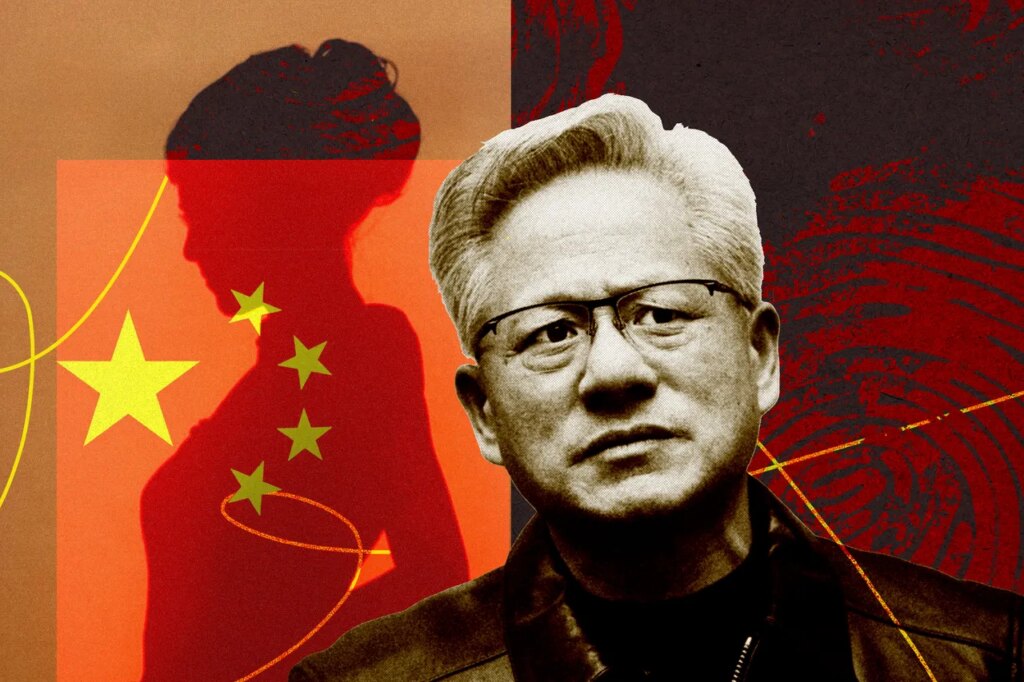
The story kicked off just before Halloween, with a six-byline story in The New York Times reporting that Huang was the target of a Chinese spy plot. Starting somewhere between 2024 and 2025, Huang allegedly had an affair with Alice Huang (no relation), a one-time executive at a Singapore-based cloud provider known as Megaspeed. US intelligence agencies warned top US officials that they believed she was a Chinese intelligence asset. So far, Nvidia’s board, which has launched its own investigation, says it has “no reason to believe that either national security or Nvidia secrets were compromised,” but that’s far from the only concern.
As one would expect, China has denied any nefarious plot centered on Jensen Huang. A Chinese foreign ministry spokesperson on Monday said, “The narrative about so-called Chinese spies is entirely based on groundless speculation—it’s nothing more than slander and smearing.”
But according to reporting by The New York Times and the Financial Times, US intelligence officials also claim that Alice Huang, also known as Huang Le, was reporting to China’s Ministry of State Security intelligence agency. On Monday, Megaspeed said on LinkedIn that US authorities found “no evidence of any violations concerning the illicit transfer of chips or any illegal activities.” (There’s no indication so far that Alice Huang, a one-time Chinese state journalist, is an employee or “officer” of Chinese intelligence; she’s believed to be an “asset,” an outsider who aids an intelligence agency, sometimes for pay, sometimes not.)
China, though, has elevated economic espionage to a core pillar of its economic and military development, stealing the designs for everything from US fighter jets to solar panels and commercial paint recipes. “Honeypots” or “honey traps”—positioning an alluring operative to seduce or develop a relationship with a key target—are one of intelligence’s most infamous and well-established strategies. French officials have warned specifically about Chinese honeypots since at least 2011, when intelligence reports cited a pharmaceutical researcher who was seduced and then blackmailed by a Chinese spy operation.
Over the past quarter of a century, as Silicon Valley emerged as a center of political and economic power, it has become a key focus of Chinese intelligence. In one plot, a Chinese national named Fang Fang spent years trying to cozy up to Bay Area politicians, including then US Representative Eric Swalwell. (While intelligence officials at the time reportedly believed Fang to be an operative, law enforcement officials never brought any charges against her). When traveling to China, US business executives have become accustomed to leaving their regular phones and computers at home and using burner devices to prevent the installation of spyware or malware (as I did, when I traveled to China for WIRED in 2019 to report on Huawei). In 2012, when Leon Panetta was making his first trip to China as defense secretary, he and his team were advised to bathe and shower in the dark in the event his hotel room was bugged. Last year, the threat of honeypots prompted the US government to explicitly ban personnel working in China and Hong Kong from engaging in romantic or sexual relationships with Chinese citizens. More recently, US officials joined with allies to warn about China’s increasingly sophisticated “LinkedIn espionage”: using the business-focused social networking site to recruit and build relationships with unwitting executives.
Alice Huang’s Megaspeed, for its part, is a major Pacific region player in cloud services focused on the advanced computer chips that are the heart of Nvidia’s business. The Biden administration had sharply limited the export of cutting-edge chips globally to slow China’s development of AI, but Jensen Huang has successfully lobbied the Trump administration to loosen those restrictions.
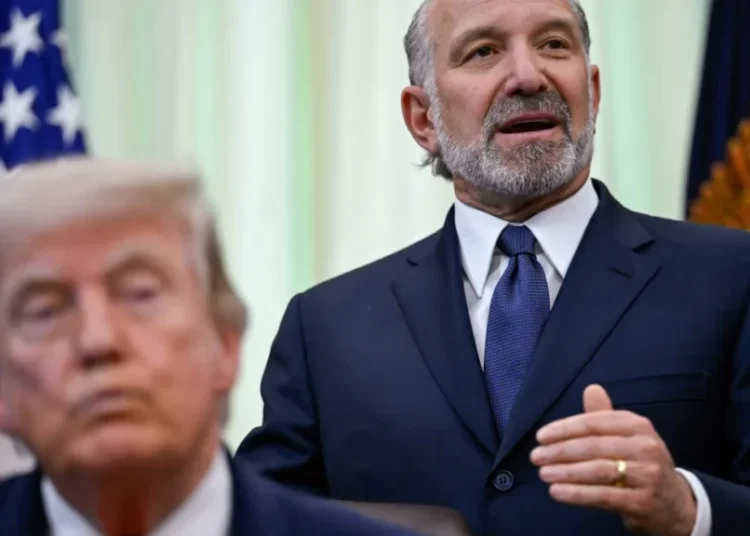
Speaking at a press conference on Monday, Donald Trump denied having prior knowledge of Alice Huang’s potential espionage. “I didn’t hear about it then, but a lot of people have heard about it, and Jensen totally denies that,” Trump said. “I asked him that question: ‘Did you have any idea that she was a spy?’ He said, ‘I had no idea that she was a spy.’” On Tuesday, the Times reported that Marco Rubio had briefed Trump in May, right before Jensen Huang joined the President on Air Force One for a trip to China.
The veracity of Trump’s claims will surely be investigated, especially in the context of the famous Watergate maxim: “What did the president know and when did he know it?” Nvidia’s CEO has been publicly linked to the Megaspeed executive since at least 2024 and Alice’s husband, Kang Weigh, has reportedly known Jensen since the 2010s. WIRED’s Lauren Goode reported on Monday that Jensen Huang, starting in 2025, hired Risa Heller’s crisis communications firm, which is well-versed in handling public sex scandals. This spring, secretary of state Marco Rubio evidently helped craft a classified memo inside the administration warning officials about Jensen Huang’s potentially compromising relationship.
Jensen Huang—who has developed an important reputation as AI’s #1 cheerleader at the frontier of AI labs—is now stuck in an awkward situation. Is he an idiot, unaware that his paramour might have been a foreign intelligence asset? Merely reckless with his own reputation, fiduciary responsibility to Nvidia, and the technological security of the United States? Or a witting accomplice to undermining US national security?
Regardless of the truth, Nvidia loses. Shareholders have ridden a roller-coaster that has seen Nvidia’s stock rise by about 600 percent over the past five years, becoming the world’s second-most valuable company. In the past month, the stock has plummeted by a quarter. The disaster for Nvidia is just beginning, it seems, as lawsuits loom, including by its own shareholders.
Similarly, the Trump administration is likely to face real questions from the newly Democratic congress: When were the president and other top officials briefed about this intelligence threat? What communication, if any, did they make to Nvidia and to whom? Should more have been done by US intelligence to block Alice Huang from having access to Nvidia and its CEO?
The fact that Megaspeed is a major customer of Nvidia makes everything more complicated. Indeed, reports have circulated for at least a year that the US was concerned that Megaspeed was diverting chips to Chinese intelligence agencies, an allegation that could have massive consequences for the global AI race. Bloomberg this week reported that Megaspeed’s subsidiaries have purchased billions of dollars worth of Nvidia chips and that an audit requested by the US government last year found that Megaspeed couldn’t initially account for some 50,000 chips it had purchased.
Meanwhile, Nvidia’s Huang and President Trump developed a uniquely close professional relationship. They’ve met multiple times as Huang has pushed to loosen Biden-era export controls, which Trump has repeatedly relaxed; Huang has donated $25 million to Trump’s ballroom project; while en route to Beijing earlier this year with a delegation of tech leaders, including Elon Musk and Tim Cook, Trump’s Air Force One actually made a special stop in Alaska to pick up Huang; Huang also attended a White House state dinner for Chinese president Xi Jinping and Trump, who in turn, awarded him a National Medal of Science earlier this fall.
The implication that Trump knew and did nothing for a year would make this one of the greatest counterintelligence failures of the past decade. There will be consequences: Across history, many have gone to prison for honeypot scandals; a former adviser was arrested just last year in a similar plot; though he was acquitted of committing economic espionage, he was convicted for making false statements to investigators.
Even in normal circumstances, corporate America’s tolerance of CEO misbehavior has shrunken dramatically. In recent years, CEOs at companies as varied as Nestlé, Kohl’s, BP, NBCUniversal, and the railroad Norfolk Southern have all resigned or been forced out after inappropriate relationships that violated company standards.
If Nvidia were any other company and Jensen Huang any other CEO, the facts of the scandal currently known would be enough to topple some heads. But Trump is still president, and November is only a third over. It’s not even clear that this will rank as the biggest scandal of the month—but it should.
Let us know what you think about this article. Submit a letter to the editor at [email protected].
The post China’s Nvidia Honeypot Isn’t Surprising. Jensen Huang Fell for It Anyway appeared first on Wired.