When Hezekiah Brown landed in Little Rock in 1957, alongside other paratroopers of the famed 101st Airborne Division, he was met by people name-calling and carrying baseball bats, shotguns and rifles.
As the Army trucks rolled through the streets toward Central High School, deployed by President Dwight D. Eisenhower to protect a group of Black students integrating the all-White school, Brown said he went to get out.
“I thought this was my fight, and I was going to get in and do what I had to do to protect those students,” said Brown, now 88.
Only he was told to stay on the truck, Brown said.
While White soldiers escorted the group now known as the Little Rock Nine into school, and American history, Brown and his fellow Black soldiers were sent to a nearby camp amid the heated environment, according to Brown, a military historian and news archives.
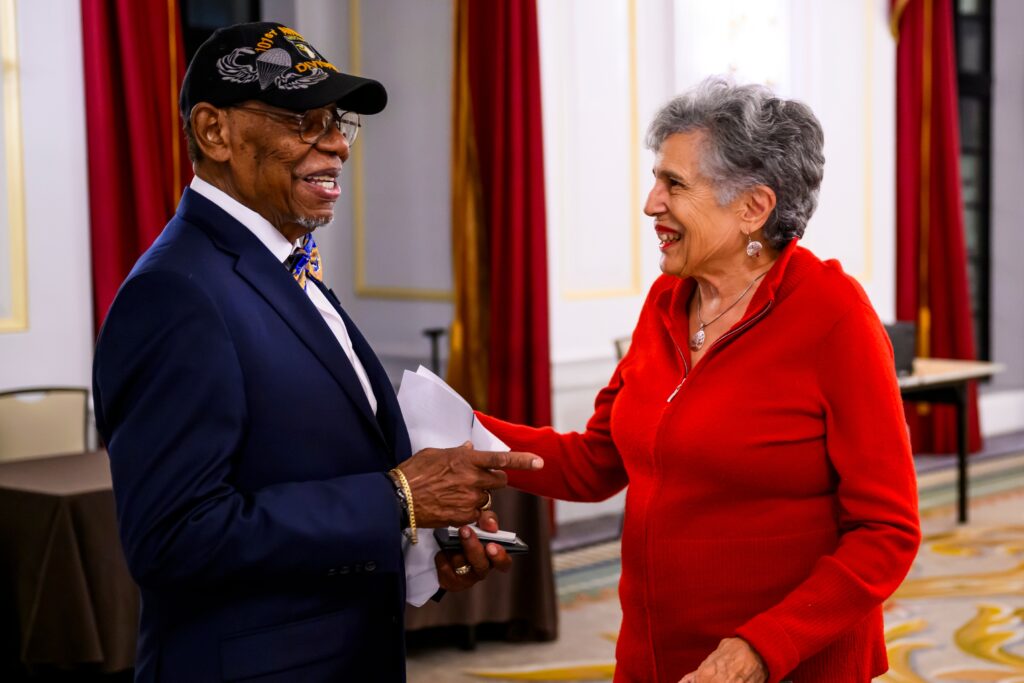
Almost 70 years later, Brown and Carlotta Walls LaNier, then 14 and the youngest member of the Little Rock Nine, sat down together to share their stories with cadets at the American Veterans Center’s annual conference in D.C.
Before the event last week, Brown and LaNier spoke with The Washington Post.
LaNier and Brown had crossed paths years earlier for the 50th anniversary commemorating the Little Rock Nine. However, LaNier said she didn’t know in 1957 that the paratrooper had been present in Arkansas to protect her and her fellow students, because she recalled seeing only White soldiers.
“It feels great to know that they were a part of the 101st, which is a well-renowned group of paratroopers,” said LaNier, 83.
She said it was unfortunate “that the times made it impossible” for the Black paratroopers to be seen and exercise their duties like the others.
In April 1957, LaNier was a ninth-grade student at Dunbar Junior High when her homeroom teacher passed around a sheet of paper seeking students interested in attending Central High. LaNier passed the school every day on her way to class.
She eagerly signed the sheet but said her parents didn’t find that out until the registration card arrived in August. LaNier said she “could see the pride in their face.”
“All I ever heard was to, you must get all the education you possibly can get,” said LaNier, the eldest daughter of a World War II veteran. “Be prepared to go through the door, whether it’s a crack in the door or flung wide open.”
At a meeting before the superintendent of schools in August alongside other Black students, LaNier said they were told they could not be part of the student council, play sports or attend sporting events.
It was a change from her former school, where LaNier was student body vice president and a captain of the basketball and cheerleading teams.
The new rules for Central High didn’t deter her, LaNier said — as an incoming sophomore, she realized she would have to prove herself — and neither did the thought of some people not wanting her there at all.
“I grew up in Jim Crow South. I mean, you saw things like the colored water fountains and restrooms. I had to sit at the back of the bus. I could only go to the zoo on a certain day of the week. I couldn’t go to a public library,” LaNier said. “All of that was just part of living in the South. But at the same time, progress was taking place for a southern capital city.”
States away, Brown was serving in Fort Campbell, Kentucky, the home of the “Screaming Eagles,” the 101st Airborne Division.
Brown said he couldn’t wait until he turned 18 and could join the military — the only way he saw out of Prichard, Alabama, as a Black man.
“We used to always see guys come home with a uniform on,” Brown said. “We just admired them so much.”
One of 11 children, Brown said his father had left the family, and “nobody ever thought that any one of us would be or do anything.”
He expressed interest in being a paratrooper, but a White service member told him he couldn’t because “Black folks are afraid to jump from an airplane,” Brown recalled.
So when he jumped out of an airplane five times and earned his wings to become a member of the 101st, Brown felt “about 20 feet tall,” he said. He also joined the baseball team in the military.
In early September 1957, LaNier and the other students arrived at Central High School for the first time. But Arkansas Gov. Orval Faubus sent in the National Guard to prevent them from entering.
LaNier said she thought there could be some people who didn’t want the Black students there.
“But it grew,” LaNier said. “That crowd, that first day, it was a large crowd out that was angry and vicious.”
Two weeks later, on Sept. 23, she said another large crowd of upward of 1,000 people learned that the students had made their way in through a side door.
The group was calling the Black students names and saying they were “going to hang someone,” LaNier recalled. “That’s when the policemen came to each one of our classes, took us to the bowels of the school and got us out of the school.”
The next day, Brown, who was 19 at the time, and the 101st Airborne were on their way to Arkansas after Eisenhower’s order.
Brown said he was practicing baseball when one of the officers came over and said they were going up in the air. Once aboard a plane, Brown said their mission was revealed: They were heading to Little Rock.
Once they arrived at camp in Arkansas, and were told they would not be escorting the Little Rock Nine, Brown said the Black soldiers decided they were going to line up and march in to protect the students.
But Brown stood up on a barrel, he said, and advised the men differently.
“We didn’t have any ammunition. We had nothing but rifles, and we would have got shot down like dogs,” he said.
Although they were disappointed, Brown said, the soldiers stayed at camp. White soldiers would keep them informed about how things were going at Central High when they returned, he said.
Military historian John McCaskill said Black soldiers had been moved elsewhere during past conflicts for their safety. During the Civil War, for example, the First United States Colored Troops were moved to what is now known as Theodore Roosevelt Island, he said in a statement.
“The reason why they may have been kept [at the camp] is because they did not want to potentially antagonize the residents of Little Rock,” McCaskill said.
Brown said his commanding officer called and highlighted his leadership encouraging the officers to remain at camp and promoted him to an acting sergeant over his company.
One day after the troops arrived, the Little Rock Nine officially began classes on Sept. 25, 1957. The troopers drove the students to and from school, escorted them to classes and lined hallways in the building.
“To have 1,200 troopers bivouacked on that campus … was amazing,” LaNier said. “I said, ‘Well, we can walk up these steps now.’”
Still, the paratroopers’ presence couldn’t stop all harm, LaNier said. Students spat upon the group, pushed them down steps, inked and glued their seats, broke into lockers and watered down their clothes when they were in the gym, LaNier said. They had to bring extra sets of clothes, just in case.
“All I needed to do was to stay focused on doing well in school, which is what I did,” LaNier said.
Brown said he was there for a few weeks. Others in the 101st Airborne stayed until November, according to news archives.
The next year, the Arkansas governor shut down Little Rock high schools for the 1958-59 school year, rather than letting integration continue. LaNier would later return and became the first Black woman to earn her diploma from Central High in 1960, just months after she said her house was bombed.
She went on to Michigan State University and later moved to Denver. LaNier finished her education at what is now the University of Northern Colorado and later sat on its board of trustees.
Upon completing his military service, Brown became a professional mediator and went to work with his son Rodney, training businesses and companies on conflict resolution.
And decades later, he and LaNier got a chance to reflect on their experiences in Little Rock.
“It’s wonderful,” LaNier said of the opportunity to meet Brown now.
Brown often thought about whether keeping the Black troops from guarding the school was the right move.
In hindsight, he said, the paratroopers had resolved that they would not take any name-calling or other attacks from a crowd. Fighting back “would have taken the real focus away from the Little Rock Nine,” Brown said.
LaNier agreed.
While she is thankful the 101st Airborne helped the Little Rock Nine attend school, and break a barrier, she hopes troopers won’t ever have to do the same again.
“All we wanted to do was go to school, and there were the powers that be … trying to make it very difficult for us,” LaNier said. “I don’t want to see that again.”
The post A Black paratrooper was sent to help the Little Rock Nine. Years later, he’s telling his story. appeared first on Washington Post.