Lt. Col. John D. McCrae, a medical officer with the Canadian Field Artillery, had just led the battlefield funeral for a young comrade.
Lt. Alexis Helmer, 22, was killed by an explosive cannon shell in the catastrophic Second Battle of Ypres. It was May 1915, less than a year into World War I, and Canada’s Expeditionary Force was fighting in the Flanders region of Belgium, where the German army was for the first time on the Western Front deploying poison gas.
Now McCrae, sitting on the back of an ambulance at a field dressing station on the Ypres Canal, took up his pen.
“In Flanders Fields,” he wrote, “the poppies blow between the crosses, row on row, that mark our place …
“We are the Dead.”
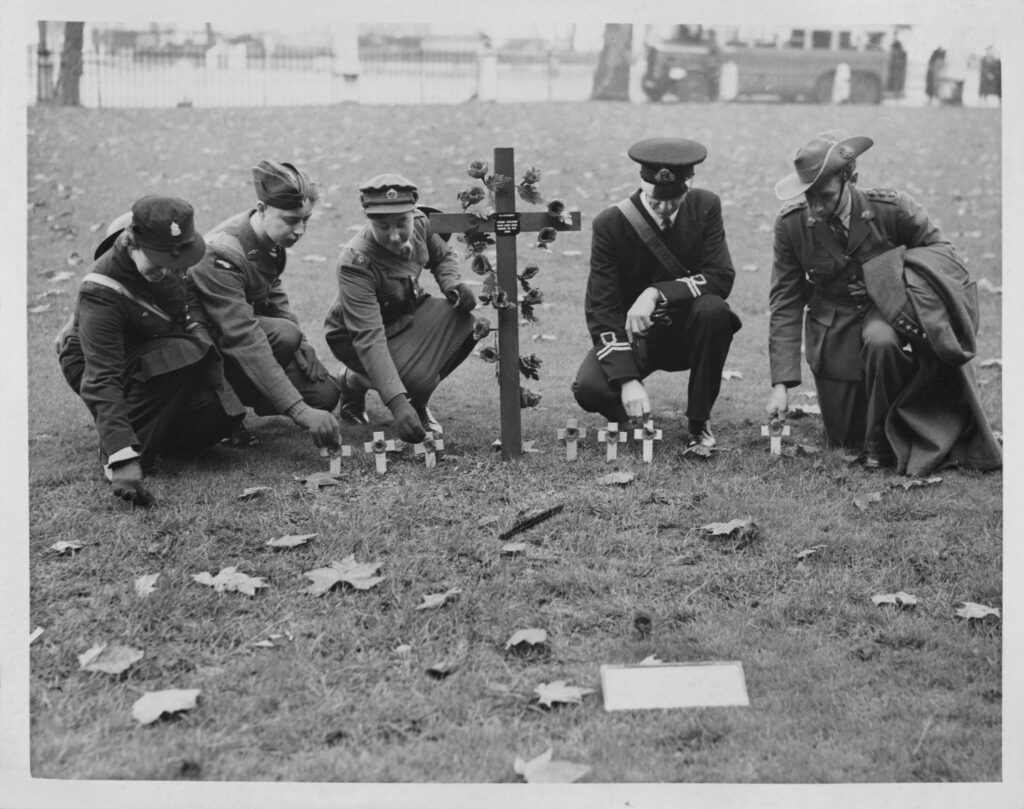
So opens one of the best-known poems in the English language. “In Flanders Fields” is recited each Nov. 11 at Veterans Day ceremonies. It’s the reason the red poppy is a symbol of the commemoration.
The final stanza of the 15-line rondeau make McCrae’s intent clear: He wanted to make the loss of his friend make sense. Still speaking for the dead, he exhorted: “Take up our quarrel with the foe: To you from falling hands we throw the torch; be yours to hold it high.”
Published anonymously in December 1915 by the satirical British magazine Punch, it was an immediate sensation, to be translated and reprinted throughout the world. Governments used it sell war bonds, recruit soldiers and rally their publics. John Philip Sousa and Charles Ives set it to music. George Orwell quoted it in “1984.”
But in the decades since, as World War I has been reassessed, so the presentation of “In Flanders Fields” has evolved. The conflict, with its trench warfare, rapid-firing machine guns and artillery, poison gas and other innovations, is seen as introducing slaughter on an industrial scale. And the poem, once a call to arms, is now often excerpted to convey the futility of war.
I encountered “In Flanders Fields” years ago in an appeal for the Royal British Legion. The charity, which supports veterans and their families, sells handmade poppies each Nov. 11, Remembrance Day in the Commonwealth, the anniversary of the armistice.
The advertisement on the London Underground included only the somber first two stanzas, in which McCrae counts the cost of war in the young men now dead: “Short days ago we lived, felt dawn, saw sunset glow, loved, and were loved, and now we lie in Flanders fields.”
Veterans Day recitations often stop there. The fragment printed on the Canadian $10 bill in 2000 is still briefer: just the first stanza, alongside poppies, a Canadian peacekeeper and white doves.
That’s not what McCrae was going for. The son of a Canadian artillery officer and militia commander, he had volunteered for active service in the Second Boer War at 27 and in World War I at 41. According to Cyril L.C. Allinson, a sergeant-major in his unit, the soldier-physician was more interested in fighting than healing: “All the goddamn doctors in the world will not win this bloody war,” Allinson quoted McCrae telling him. “What we need is more and more fighting men.”
McCrae ended “In Flanders Fields” with a plea: “If ye break faith with us who die, we shall not sleep, though poppies grow in Flanders fields.”
In May 1915, it might still have been possible to believe that more and more fighting men could bring an end to the war. But by then, the Western Front had already solidified into the 440-mile corridor of opposing trenches, from the North Sea to neutral Switzerland, along which for the next three and a half years the belligerents waged a grinding war of attrition.
McCrae didn’t live to see the armistice. He died in January 1918 of pneumonia in Wimereux, France.
In Flanders Fields
In Flanders fields the poppies blow
Between the crosses, row on row,
That mark our place; and in the sky
The larks, still bravely singing, fly
Scarce heard amid the guns below.
We are the Dead. Short days ago
We lived, felt dawn, saw sunset glow,
Loved, and were loved, and now we lie
In Flanders fields.
Take up our quarrel with the foe:
To you from failing hands we throw
The torch; be yours to hold it high.
If ye break faith with us who die
We shall not sleep, though poppies grow
In Flanders fields.
Photo Almanac is an occasional series from The Washington Post, using photo archives to examine where we’ve been to understand where we are.
The post ‘In Flanders Fields’: How a patriotic poem became an anti-war anthem appeared first on Washington Post.